Vobmenka
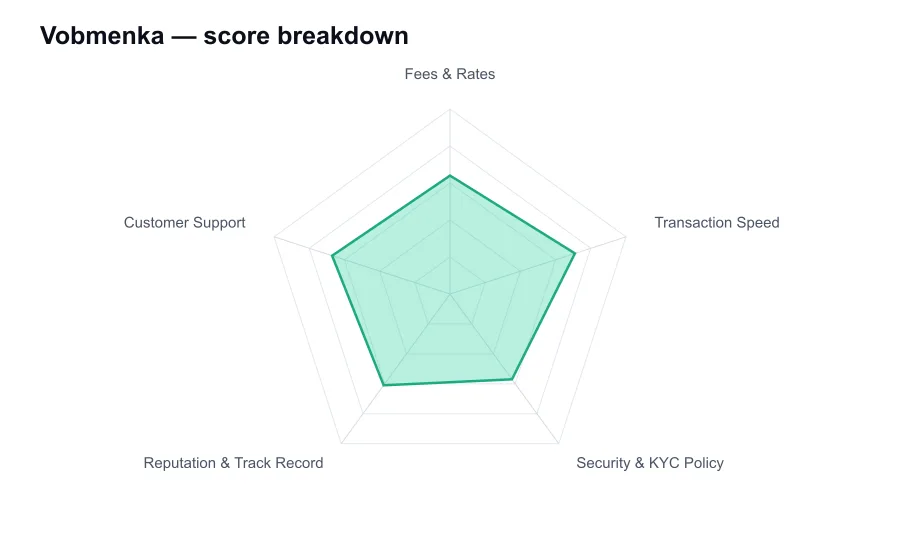
Vobmenka scores 6.3/10 overall in our independent review, measured against every other provider we've compared, strongest on Transaction Speed (7.1/10) and weakest on Security & KYC Policy (5.7/10).
6.3/10 ★★★★★ How we score → Visit official siteEditorial independence: our scores and rankings are produced using the fixed criteria above and are not influenced by advertisers. This is an independent ranking site and is not operated by, or affiliated with, any provider we list.
Affiliate disclosure: some links on this page may earn us a commission at no extra cost to you. This does not affect our rankings.
| Best for | Not for |
|---|---|
| Focused on direct, route-specific exchanges | Rates include an embedded spread |
| Potentially fast on standard confirmed orders | Less public transparency than regulated exchanges |
Criteria & Scores
| Criterion | Score | Note |
|---|---|---|
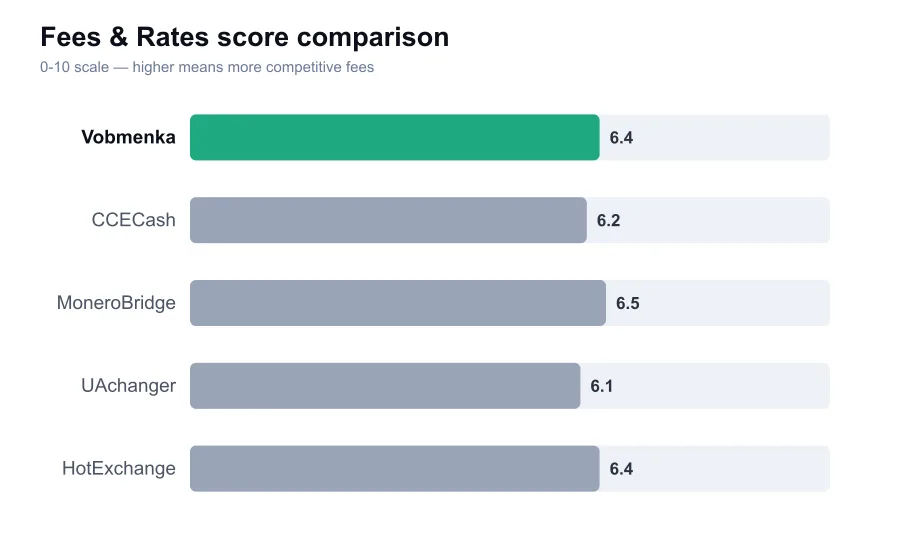
| Fees & Rates | 6.4 | Potentially competitive on niche routes, quote comparison required. |
| Transaction Speed | 7.1 | Routine orders can be quick after incoming funds clear. |
| Security & KYC Policy | 5.7 | Safer for one-off settlement than ongoing custody. |
| Reputation & Track Record | 6.1 | Regional exchanger signals are useful but not institutional proof. |
| Customer Support | 6.7 | Clear order-level communication is the critical service test. |
In-Depth Review
Vobmenka is positioned in the practical exchange-service segment, where users arrive with a specific conversion in mind and want the shortest path to completing it. Its natural audience is not the active trader studying charts. It is the person moving crypto to a payment method, changing one digital asset for another, or handling a regional payout route that a giant exchange may not make especially pleasant. That focus can make a small service more useful than its size suggests.
The name also signals a regional, exchanger-first identity. Services in this category live or die by execution discipline. A beautiful interface cannot compensate for a poor rate, an unexplained delay, or a support team that disappears when an order has a problem. Vobmenka should therefore be judged less by promotional claims and more by the details around each order: rate validity, stated reserve availability, payment instructions, processing status, and the quality of responses when something does not match.
The rate is where Vobmenka can look better or worse than it really is. Instant exchangers commonly include their fee within the offered conversion rate, and Vobmenka should be read through that lens. The visible number is a package price, not necessarily a neutral market quotation. Customers should not expect the mid-market crypto rate, particularly where there is a card, bank, electronic wallet, or cash-oriented leg that introduces operational cost and reversal risk.
That does not mean the service is necessarily expensive. A quote can be competitive if the operator has efficient access to the route and enough demand to manage inventory well. The only honest method is a live comparison. Check the amount you will receive against another exchanger and against a mainstream exchange route including withdrawal costs. For a small conversion, the convenience premium may be trivial. For a larger one, it is often the largest cost in the transaction.
Vobmenka is likely to be strongest where the destination method is difficult or inconvenient elsewhere. In those cases, the spread is not just a crypto charge. It pays for the operator's payment-channel access and manual work. But customers should demand clarity on minimums, maximums, reserve limits, and whether the rate is fixed or floating. A fixed-rate promise is meaningful only if the terms say how long the rate is held and what happens if the incoming payment arrives late or short.
Processing speed has to be treated as a chain of events, not a single stopwatch. A crypto order may be created in seconds, but the service cannot release the payout until the deposit is credited under its confirmation policy. A bank or card-related order may have different cutoffs and screening delays. On easy routes, this structure can still be genuinely fast. On awkward ones, a manual check can turn an expected short exchange into a wait measured in hours or longer.
There is a useful distinction between a delayed transaction and an abandoned customer. Delays happen everywhere, including at the biggest regulated exchanges. What separates a decent exchanger is whether the order page and support team tell you exactly what is happening. Vobmenka should provide, at minimum, an order identifier, payment instructions, status visibility, and a contact route tied to the transaction. If a service cannot explain why a transfer is waiting, it has not earned confidence regardless of how attractive its rates look.
Security is the part where compact exchangers face an unavoidable disadvantage. They generally provide less public information about corporate structure, financial controls, cold-storage arrangements, external audits, and insurance than large exchanges. That does not make every smaller service unsafe. It does mean customers cannot reasonably assign them the same level of trust. The right usage pattern is simple: fund an order only after checking it, receive the payout, and do not leave any residual balance behind.
The KYC position needs the same realism. Vobmenka may offer an order flow that does not begin with a full exchange-account verification process. This can be attractive for straightforward transactions. It is not a contractual promise of anonymity. Payment providers, anti-money-laundering rules, sanctions lists, unusual transaction patterns, and source-of-funds questions can all result in an additional information request. Anyone who cannot tolerate that possibility should not initiate a transfer through any exchanger.
The most common avoidable security failures are user mistakes. A copied address can be replaced by malware. A fake website can appear in a search advertisement. A USDT transfer can be sent over an unsupported network. A customer can reuse a previous order's details after the rate window expires. Vobmenka cannot fully protect a user against these actions. Use a bookmarked address, verify the TLS domain, check the network in writing, and keep screenshots before sending money.
Its reputation should be measured carefully. A regional exchanger may collect favorable mentions on monitoring services and community forums, which can demonstrate that routine orders are reaching their destinations. That is meaningful but incomplete. It does not equal a public audit, a banking license, or guaranteed recovery in a dispute. I give more weight to a consistent record across time, specific responses to complaints, and terms that explain failure scenarios than to a page of anonymous praise.
Vobmenka appears better suited to users who understand this trade-off than to beginners who want a safety net. An experienced customer can inspect the quote, test a small order, verify the destination, and decide whether the convenience is worth the spread. A novice may see a simple form and assume the transaction is as protected as a card purchase at a major retailer. It is not. Crypto settlement and third-party payout systems offer much less room for casual mistakes.
Support deserves a meaningful score because it is the mechanism that makes the rest of the service usable. A good answer should not simply say that an order is being processed. It should state whether the incoming transaction has been detected, how many confirmations are needed, whether the amount matches, and whether any customer action is required. For a card or bank route, support should be able to explain the payer-name and reference requirements before money is sent.
Vobmenka can be a sensible route-specific tool, especially if its final quote and available payout method solve a real problem. I would not elevate it into a primary financial provider. Its appeal is convenience in a narrow moment, and its limitations are the ordinary limitations of the instant-exchanger model: embedded spread, limited public institutional visibility, and the possibility of KYC or manual review at exactly the wrong time. Use it deliberately, not casually.
Pros & Cons
| Pros | Cons |
|---|
Verdict
Frequently Asked Questions
How are Vobmenka's fees calculated?
The effective charge is generally built into the rate for the selected direction. Check the final amount due to arrive, and include any blockchain, bank, card, or payment-provider charges.
Can Vobmenka complete an exchange instantly?
Some routine orders can complete quickly once the inbound payment is confirmed. Actual timing depends on the blockchain, payment method, required confirmations, operating hours, and any review.
Can I use Vobmenka without KYC?
A full account verification may not be required to start every order, but extra documents can still be requested for compliance, fraud prevention, payment-provider rules, or unusual activity.