Coinomi
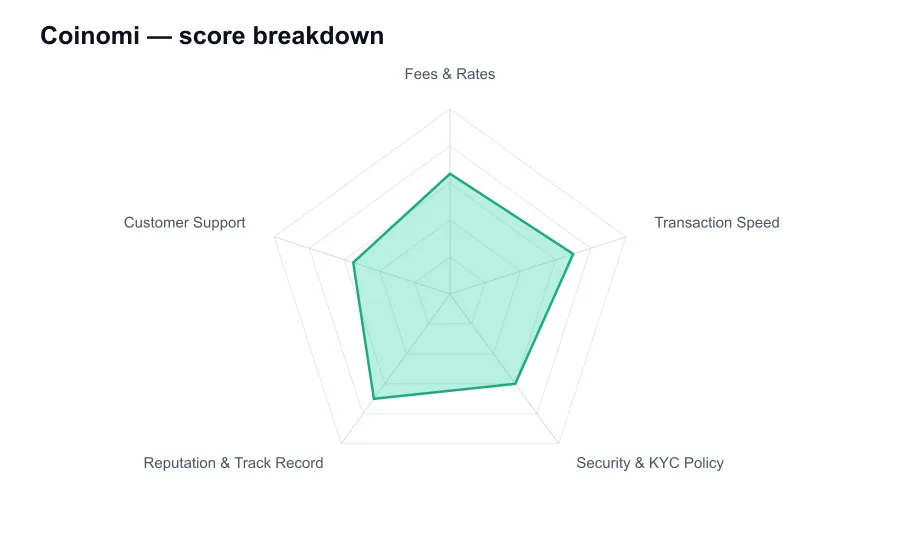
Coinomi scores 6.5/10 overall in our independent review, measured against every other provider we've compared, strongest on Transaction Speed (7.0/10) and weakest on Customer Support (5.5/10).
6.5/10 ★★★★★ How we score → Status: active (checked 2026-10-13T19:43:41.538Z) Visit official siteEditorial independence: our scores and rankings are produced using the fixed criteria above and are not influenced by advertisers. This is an independent ranking site and is not operated by, or affiliated with, any provider we list.
Affiliate disclosure: some links on this page may earn us a commission at no extra cost to you. This does not affect our rankings.
| Best for | Not for |
|---|---|
| Non-custodial wallet with user-controlled keys | Integrated swap quotes may not be the cheapest |
| Operating since 2014 | 2019 Android seed-phrase disclosure affects confidence |
What is Coinomi?
How Coinomi Works
- Download Coinomi from its official source and create a wallet
- Write the recovery phrase down offline before depositing funds
- Add the asset and network you want to receive
- Send funds to the wallet's displayed address
- Use the send function or a third-party in-app swap if needed
- Confirm every address, network, and fee before signing
Criteria & Scores
| Criterion | Score | Note |
|---|---|---|
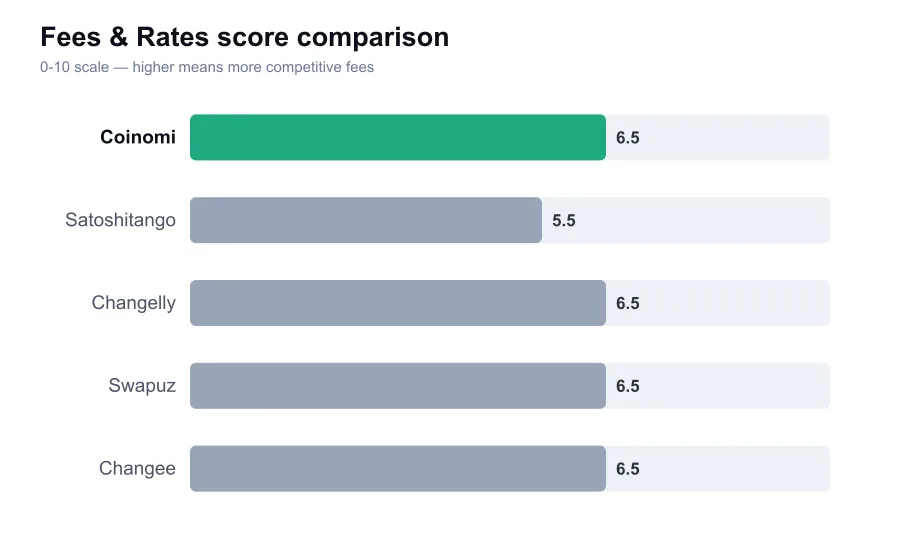
| Fees & Rates | 6.5 | No wallet custody fee, but swap-provider spreads vary |
| Transaction Speed | 7.0 | On-chain speed depends on network and selected provider |
| Security & KYC Policy | 6.0 | Non-custodial, but 2019 Android seed issue remains relevant |
| Reputation & Track Record | 7.0 | Operating since 2014 with a real, mixed public record |
| Customer Support | 5.5 | Helpful documentation, but self-custody limits recovery help |
KYC
| Requirement | optional |
|---|---|
| Notes | Coinomi wallet creation does not normally require KYC. Identity checks can apply if you use an integrated third-party exchange or fiat provider, because those providers set their own compliance rules. |
Supported Assets
How to Use Coinomi Safely
- Write the recovery phrase on paper and keep it offline
- Never share a seed phrase with support or enter it on a website
- Use a hardware wallet for substantial long-term holdings
- Verify token network and recipient address before sending
- Compare third-party swap quotes before confirming
Mobile App
| iOS | Yes |
|---|---|
| Android | Yes |
| Notes | Coinomi provides official mobile apps for Android and iOS. |
In-Depth Review
Coinomi is a long-running self-custody cryptocurrency wallet, not an exchange in the usual sense. That distinction changes how it should be judged. It does not operate a central order book, hold an account balance for you, or set a standard trading fee schedule. Instead, it gives users control of wallet keys and offers access to third-party exchange services from inside the wallet. Coinomi belongs closer to Exodus or Trust Wallet than to Coinbase, Kraken, or Binance.
The product has been around since 2014, which gives it a much longer history than the usual crop of wallet apps. Coinomi's appeal has always been breadth. It supports Bitcoin and a large collection of other assets, offers mobile apps and desktop software, and lets users manage different chains from one interface. For somebody with a mixed bag of older altcoins as well as mainstream assets, that convenience is real. The interface is functional rather than beautiful, but it generally puts the essentials within reach.
Its non-custodial design is Coinomi's strongest feature. The wallet's recovery phrase and private keys are intended to remain under the user's control, so Coinomi cannot simply freeze a self-custody balance in the way a centralized exchange can. That does not make the user invulnerable. A compromised phone, a copied recovery phrase, malware, a fake support agent, or a malicious wallet import can still lead to permanent loss. Self-custody moves responsibility from the platform to the owner.
Coinomi does not charge a separate fee merely to hold assets in the wallet. For normal on-chain sends, the user pays the relevant blockchain network fee. Bitcoin fees are determined by the network and the chosen transaction settings, Ethereum and other smart-contract chains use their own gas model, and the cost can change sharply during congestion. This is a fair arrangement. The wallet is not pretending that a blockchain transfer can be free simply because it is initiated from an app.
Swapping inside Coinomi is different. The built-in exchange function is fulfilled by third-party providers, so the price includes that provider's rate, spread, and any network costs. Coinomi is useful here because it keeps the process in one application, but convenience is not the same as best execution. I would not assume an in-wallet quote is the cheapest available. Compare the final received amount with a major exchange, a decentralized exchange where appropriate, or another instant exchange before confirming.
The wallet's speed is usually governed by the chain and by the provider selected for an in-app exchange. A Bitcoin send can take from minutes to much longer depending on the fee selected and network conditions. An Ethereum transaction might confirm quickly in quiet periods and become expensive during a rush. A third-party swap adds deposit confirmation, the provider's own processing, and a payout transaction. Coinomi cannot eliminate those moving parts, though its transaction display is generally more useful than leaving users to guess what happened.
The security record needs a candid reading. In 2019, a researcher disclosed an issue involving Android's Google spell-checking functionality, which could expose typed recovery phrases under certain conditions. Coinomi said it addressed the issue and disputed claims around the incident. The important lesson is not that Coinomi alone had a mobile-security problem. It is that no software wallet should be treated casually. A seed phrase should never be typed into a device, keyboard, cloud note, or web form unless the user fully understands the exposure.
Coinomi supports password protection and recovery phrases, but it is not a replacement for a hardware wallet when the balance is substantial. A hardware wallet keeps the signing key in a dedicated device, reducing the damage that malware on a computer or phone can do. Coinomi can still have a role as a spending wallet or asset-management interface, but I would keep long-term holdings in hardware-backed storage. That is not a criticism unique to Coinomi. It is basic self-custody discipline.
KYC is nuanced because Coinomi itself is a wallet. Creating and using a Coinomi wallet does not normally require identity verification. However, a third-party exchange or purchase provider accessed through the app may require verification, sometimes based on the transaction size, country, payment method, or compliance screening. A user who wants privacy should not mistake a non-custodial wallet for a guarantee that every integrated service is private. The provider fulfilling the swap or fiat purchase sets those rules.
Coinomi's reputation is solid but not spotless. Its age, broad asset support, and survival through several market cycles put it well ahead of anonymous wallet clones. The 2019 disclosure also remains part of its public history, and rightly so. It is a reminder that reputation is not a binary score. Coinomi has earned credibility through longevity and a real user base, but users have good reason to ask hard questions about security practices rather than relying on old brand recognition.
Support is probably Coinomi's weaker practical area. Wallet support teams can explain application behavior and help users identify common errors, but they cannot reverse an on-chain transfer, recover a seed phrase, or undo a transaction sent to the wrong address. That limitation is inherent to self-custody. Coinomi provides support material and ticket-based assistance, yet users should expect to do some technical work themselves, especially with custom tokens, recovery issues, and delayed third-party exchanges.
The wallet is a better fit for people who understand addresses, backups, transaction IDs, and chain selection. If you are buying your first crypto with a bank card and expect phone-based account recovery, a regulated centralized exchange is often safer operationally. If you already hold assets and want a single wallet with broad chain coverage, Coinomi remains a credible option. It has more depth than many lightweight mobile wallets, though that depth can make the app feel busier.
There are also a few habits I would insist on. Download Coinomi only from the official site or established app stores, verify the publisher, and write the recovery phrase offline. Do not trust a search-engine ad claiming to be wallet support. Do not import a valuable seed phrase into a fresh app merely to test it. And before using an integrated swap, send a small amount first, because a third-party exchange error is much harder to resolve after a large deposit.
My take is that Coinomi is a capable, established wallet with sensible strengths and a history that prevents it from getting a free pass. Its asset coverage and self-custody model are attractive, while its exchange integrations should be treated as convenience tools rather than a reason to choose the wallet. Use it as a carefully secured software wallet, not as a bank and not as a substitute for a hardware wallet. For that role, it remains a respectable choice.
Pros & Cons
| Pros | Cons |
|---|
Verdict
Frequently Asked Questions
Is Coinomi an exchange?
No. Coinomi is primarily a non-custodial wallet. It can connect users to third-party exchange providers inside the app, but it does not operate like Coinbase or Kraken with a central order book.
Does Coinomi require KYC?
Creating and using the wallet normally does not require KYC. A third-party provider used for an in-app swap or fiat purchase may request identity checks based on its own rules.
What happened in Coinomi's 2019 security incident?
A 2019 disclosure concerned Android Google spell-checking and the possible exposure of typed recovery phrases. Coinomi said it addressed the issue and disputed related claims. Never type a seed phrase casually into a mobile device.
Can Coinomi recover a lost recovery phrase?
No. As a self-custody wallet, Coinomi cannot recover a lost seed phrase or private key. If both the device access and offline backup are lost, the assets may be unrecoverable.
Why is an in-app Coinomi swap sometimes expensive?
The swap is supplied by a third party. The final quote can include that provider's spread, exchange charge, and network costs. Compare the exact output amount, not just the displayed rate.
Does Coinomi have mobile apps?
Yes. Coinomi provides Android and iOS apps, and it also offers desktop software. Download only through Coinomi's official website or the established app stores.
Should I store a large Bitcoin balance in Coinomi?
For a large long-term balance, a hardware wallet is usually the safer choice. Coinomi is a software wallet, so phone or computer compromise remains a meaningful risk.