UAchanger
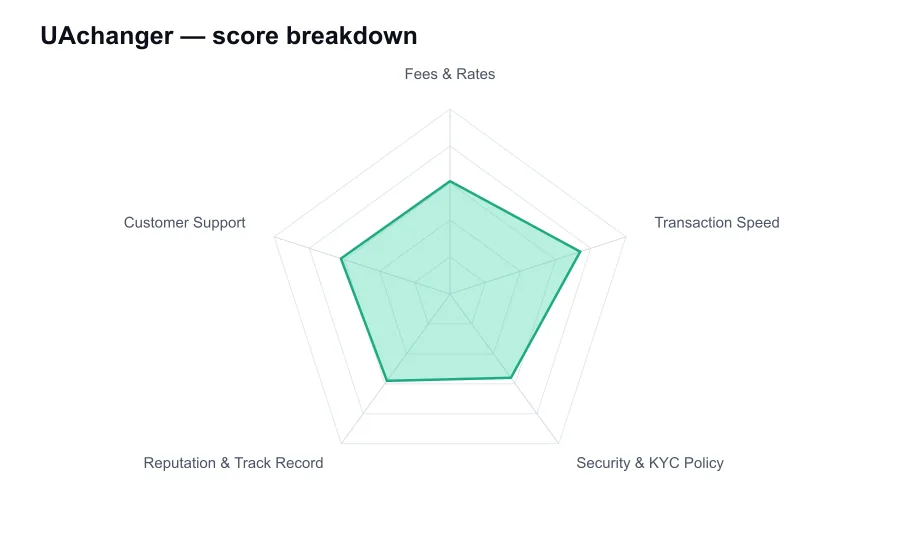
UAchanger scores 6.2/10 overall in our independent review, measured against every other provider we've compared, strongest on Transaction Speed (7.4/10) and weakest on Security & KYC Policy (5.6/10).
6.2/10 ★★★★★ How we score → Visit official siteEditorial independence: our scores and rankings are produced using the fixed criteria above and are not influenced by advertisers. This is an independent ranking site and is not operated by, or affiliated with, any provider we list.
Affiliate disclosure: some links on this page may earn us a commission at no extra cost to you. This does not affect our rankings.
| Best for | Not for |
|---|---|
| Direct conversion flow without a trading terminal | Quoted rates can hide a meaningful spread |
| Potentially quick settlement on routine crypto orders | Limited public transparency on reserves and operations |
Criteria & Scores
| Criterion | Score | Note |
|---|---|---|
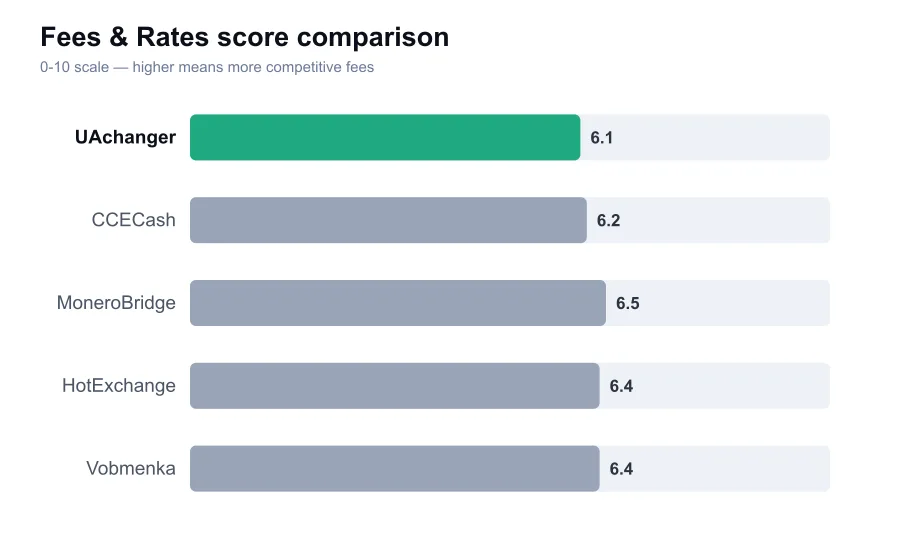
| Fees & Rates | 6.1 | Costs are mainly embedded in each quoted rate. |
| Transaction Speed | 7.4 | Routine orders can move quickly after confirmation. |
| Security & KYC Policy | 5.6 | Order-based model, with limited public control visibility. |
| Reputation & Track Record | 5.8 | Useful niche presence, but not a top-tier exchange record. |
| Customer Support | 6.2 | Order communication matters most during exceptions. |
In-Depth Review
UAchanger sits in the familiar Eastern European online exchanger niche: a service built for converting digital assets, electronic money, and selected bank payment methods without the heavyweight account structure of a major regulated exchange. It is aimed at people who already know what they want to send and receive. This is not a trading venue, a custody platform, or a place to build a diversified portfolio. It is a transactional tool, and it needs to be judged on that narrow but demanding job.
The appeal is obvious. A visitor can usually move straight from an exchange direction to an order rather than spending an afternoon navigating spot markets, order books, staking pages, and promotional banners. For a user converting one balance into another, that simplicity has real value. The drawback is equally obvious: simple exchangers ask customers to place substantial trust in an operator whose reserves, corporate structure, and internal controls are rarely as visible as those of Coinbase, Kraken, or a large licensed regional exchange.
Pricing is the first area where buyers need to slow down. UAchanger's cost is not best understood as a published flat percentage because the economic price is primarily embedded in the quoted exchange rate. That is normal for this class of service, but it makes comparisons harder. A rate can look attractive until the destination network fee, payment processor charge, or difference between the displayed rate and the final order rate is considered. Treat the quote as the fee disclosure, not as a market price.
That approach can work well on popular, liquid routes. A user swapping mainstream crypto assets or common electronic-money balances may find the convenience premium acceptable, especially for a one-off transfer. It is less persuasive on larger orders. Even a modest spread becomes expensive once the amount rises, and a centralised exchange with a transparent maker and taker schedule can often beat it. UAchanger makes more sense for execution convenience than for aggressive price discovery.
The practical test is to compare the final received amount against at least two alternatives at the exact time of the transaction. Compare it with a regulated exchange plus withdrawal fee, and with another established instant exchanger. Do not compare only the headline rate. Network costs can change sharply, particularly on Bitcoin and Ethereum, and payment-system commissions may be external to UAchanger's own margin. A quote that is good for a small USDT conversion may be mediocre for a larger bank-related payout.
Speed is one of the stronger reasons to use a service like this. Straightforward orders can move quickly once the inbound payment is detected and confirmed. Crypto transfers remain dependent on blockchain confirmations, so no exchanger can honestly promise a fixed completion time for every network and every congestion event. A fast operator can release the outgoing leg promptly, but it cannot force a slow sender, a delayed bank rail, or a congested chain to behave.
That distinction matters because customers often call an order delayed when the delay occurred before UAchanger could act. A Bitcoin deposit with an insufficient fee can sit waiting for confirmations. A bank or payment-system transfer can be held for its own compliance checks. Still, the customer sees only one transaction and expects an answer. The good exchanger keeps the order status readable, explains what confirmation is missing, and replies before frustration turns into a public complaint.
UAchanger's security posture is harder to assess than its interface. Like many instant exchangers, it appears designed to collect only the information necessary for a given order rather than requiring every visitor to open a full trading account. That is attractive to privacy-conscious users, but no-KYC marketing should never be interpreted as a guarantee that identification will never be requested. Suspicious activity controls, payment-provider rules, sanctions screening, and source-of-funds questions can all trigger additional review.
For users, the biggest security risk is often operational rather than technical. Copying a wallet address incorrectly, sending the wrong network, or paying an expired order can create a problem that no support team can resolve instantly. Check the destination address character by character, keep the order page and transaction hash, and send only the exact asset and network requested. Do not rely on browser search ads or lookalike domains. Bookmark the service after independently confirming the address.
The public reputation picture is mixed in the way it often is for compact exchangers. There may be monitoring-site listings and scattered user commentary, but that is not equivalent to the long, auditable record of a globally licensed platform. A high count of positive exchange-monitor feedback can be useful evidence that ordinary orders are being completed. It cannot prove reserve strength, legal recourse, or how an operator will handle a difficult compliance dispute. Those are different questions.
This is why I would not use UAchanger as a wallet or as a place to leave funds between transactions. Send in, receive out, and verify completion. That is sensible behavior with any instant exchanger, including reputable ones. The service model gives customers less visibility into internal balances and fewer formal protections than a regulated custodian. If an order is substantial enough that a delay would hurt your business or personal finances, split the exposure or use a provider with clearer contractual and regulatory safeguards.
Support is central here because the service is only as good as its response when an order does not auto-complete. The available contact options and order-linked communication matter more than polished marketing copy. A competent response should identify whether the issue is an unconfirmed deposit, an incorrect amount, a compliance review, or an outgoing payment delay. Vague assurances are not enough. Users should expect an order number, timestamps, and a precise explanation of the next action.
I also dislike the habit some customers have of measuring an exchanger solely by whether a first small test succeeded. Small tests are sensible, but they do not answer every question. Test the exact route you plan to use, including the destination method, because payout speed and pricing can vary widely by direction. Save screenshots of the rate and terms before paying. If the rate is floating, accept that the final result can move before the inbound payment is credited.
UAchanger is a usable option for experienced users who understand instant-exchange mechanics and need a direct conversion rather than an exchange account. Its strengths are simplicity and the potential for rapid completion on routine routes. Its weak points are the limited transparency inherent in the model, quote-based pricing, and a public track record that does not carry the weight of a major regulated venue. Use it for contained transactions, not for blind trust or life-changing sums.
Pros & Cons
| Pros | Cons |
|---|
Verdict
Frequently Asked Questions
Does UAchanger charge a separate fee?
The effective cost is generally reflected in the quoted exchange rate, while network or payment-system charges may also affect the final amount. Compare the amount you will receive, not just the displayed rate.
Is identity verification required at UAchanger?
An order-based exchanger may not require a full account for every transaction, but compliance checks can still be requested for flagged payments, payment-provider issues, or suspicious activity.
How quickly does a crypto order complete?
Completion depends first on confirmation of your inbound transfer. Once credited, routine outgoing crypto payments can be prompt, but blockchain congestion and manual review can extend the process.