MoneroBridge
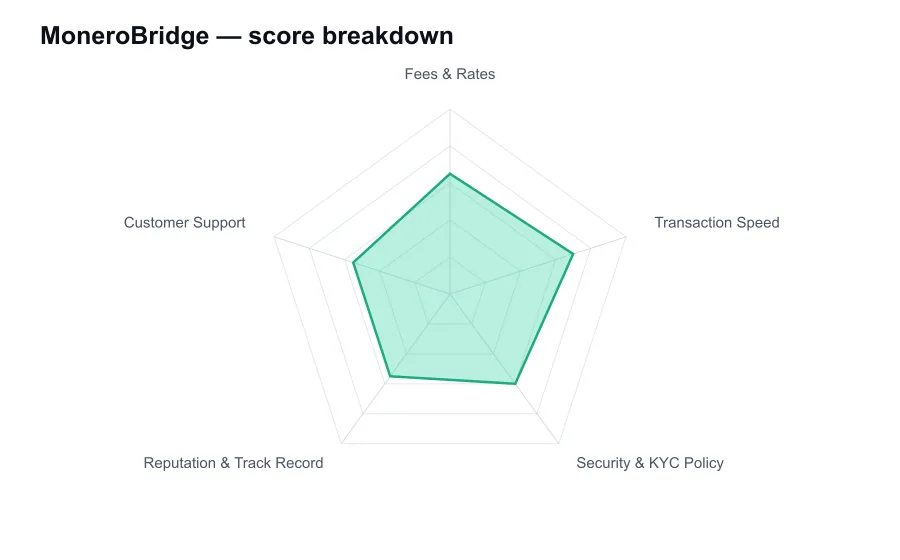
MoneroBridge scores 6.2/10 overall in our independent review, measured against every other provider we've compared, strongest on Transaction Speed (7.0/10) and weakest on Customer Support (5.5/10).
6.2/10 ★★★★★ How we score → Status: active (checked 2026-10-13T19:33:16.387Z) Visit official siteEditorial independence: our scores and rankings are produced using the fixed criteria above and are not influenced by advertisers. This is an independent ranking site and is not operated by, or affiliated with, any provider we list.
Affiliate disclosure: some links on this page may earn us a commission at no extra cost to you. This does not affect our rankings.
| Best for | Not for |
|---|---|
| Account-free swaps for standard transactions | Limited public operating history |
| Clear focus on Monero conversions | No transparent flat fee schedule |
What is MoneroBridge?
How MoneroBridge Works
- Choose the asset you are sending and the asset you want to receive
- Enter a valid receiving wallet address
- Review the quoted amount and create the exchange
- Send the exact required amount to the generated deposit address
- Track confirmations and wait for the payout to your wallet
Criteria & Scores
| Criterion | Score | Note |
|---|---|---|
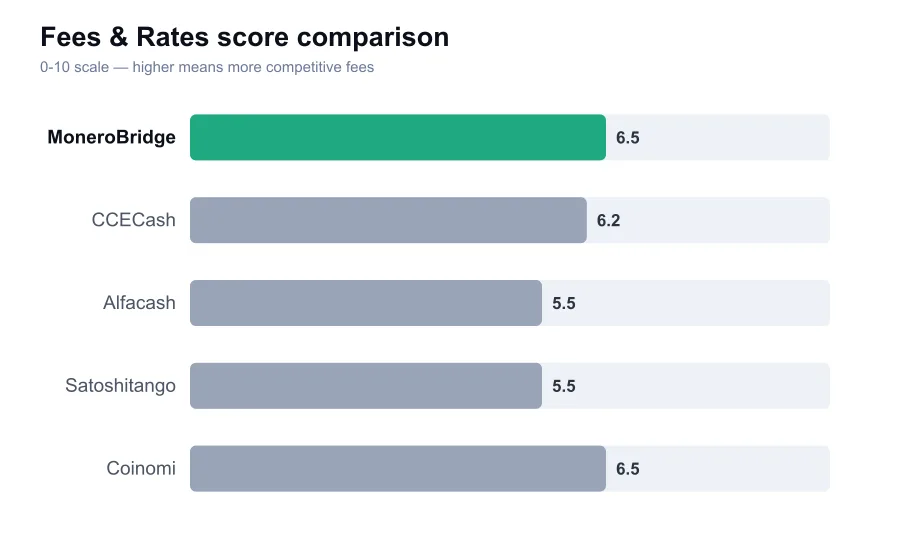
| Fees & Rates | 6.5 | Quote-based pricing, compare the final receive amount. |
| Transaction Speed | 7.0 | Usually limited more by blockchain confirmations. |
| Security & KYC Policy | 6.0 | No routine account KYC, but limited public disclosure. |
| Reputation & Track Record | 5.5 | Useful niche service with a thinner public record. |
| Customer Support | 5.5 | Transaction-based support, not a large support operation. |
| Fact | Value | Source |
|---|---|---|
| Service model | Instant wallet-to-wallet exchanger | - |
| Account requirement | No account for standard swaps | - |
| Primary focus | Conversions involving Monero | - |
| Custody model | Per-transaction deposit and payout | - |
| Rate model | Quote-based, commonly floating | - |
KYC
| Requirement | optional |
|---|---|
| Notes | Registration and routine identity checks are generally not part of the standard flow. Exceptional transactions can still be subject to review. |
Supported Assets
How to Use MoneroBridge Safely
- Test a new route with a small transaction first
- Compare the final receive amount with at least two alternatives
- Copy the receiving address from your own wallet, never from chat
- Save the exchange ID and deposit transaction hash
- Do not send coins on a network different from the order network
In-Depth Review
MoneroBridge is a small instant-swap service built around a straightforward idea: make it easy to move into or out of Monero without opening an exchange account. It occupies a narrow part of the market, aimed at people who already understand self-custody and want a quick conversion rather than charts, margin trading, or an account dashboard. Its focus is an advantage, but it also means the service has less public depth than established multi-provider platforms.
The site presents a simple exchange flow. Choose the asset pair, enter a receiving address, send funds to the generated deposit address, then wait for the outbound payment. That is the right shape for a privacy-minded swap service. There is no custody account to fund, no order book to interpret, and no reason to leave coins sitting with the operator after a completed transaction.
MoneroBridge's appeal rests heavily on its no-account approach. A standard exchange transaction can generally be initiated without registration or routine identity verification. For ordinary users exchanging a modest amount of Bitcoin, Litecoin, USDT, or another supported asset for XMR, that is materially less intrusive than using a large centralized exchange. It is also a policy that can change if a transaction triggers fraud or compliance controls, so users should never treat no-KYC marketing as a guarantee against questions in every circumstance.
The weakness is transparency. MoneroBridge does not have the long, heavily documented operating history of a company such as Kraken, Coinbase, or even ChangeNOW. That does not make it inherently unsafe, but it changes the risk calculation. A small non-custodial exchange can be perfectly functional for modest swaps while still being a poor choice for a life-changing transaction. The public record is simply thinner.
Pricing is quoted in the exchange estimate rather than advertised as a clean platform-wide percentage. That is common among instant exchangers, because the rate incorporates liquidity-provider pricing, miner fees, network conditions, and the service margin. It also makes fee comparisons harder. The number that matters is the amount shown as receivable, compared with a couple of alternatives at the same moment, not an attractive headline rate.
In practice, MoneroBridge can be competitive on common pairs, especially where its available liquidity is good. It is not consistently the cheapest place to acquire Monero. Trocador can sometimes surface a better quote by comparing multiple providers, while a major exchange may be cheaper for users who are willing to complete KYC and trade on an order book. MoneroBridge is paying for convenience and privacy, so a modest premium is expected. A large unexplained premium is not.
Floating-rate swaps carry the familiar execution risk. The estimated output can move after the deposit arrives if the input asset changes sharply or confirmation takes longer than expected. Fixed-rate choices, where offered for a pair, reduce that uncertainty but usually build more protection into the quote. I would use floating rate for a small, liquid transaction when timing is normal, and fixed rate when the exact XMR amount matters more than squeezing out a few extra dollars.
Speed depends far more on the chain being sent than on the web interface. A Litecoin or fast stablecoin transfer can clear quickly, while Bitcoin deposits may take substantially longer once confirmation requirements and network congestion are included. The Monero payout itself is usually the easier leg. A realistic expectation is minutes to an hour for a normal liquid swap, not an instant result just because the site uses the word instant.
The service gives users a transaction page and an exchange identifier, and those details should be saved before sending. That sounds basic, but it matters if a payment is delayed or a support agent needs to trace a deposit. Do not close the tab, do not lose the deposit transaction ID, and do not send from a wallet that applies unusual smart-contract or memo behavior unless the route explicitly supports it.
Security is strongest where MoneroBridge does not hold a standing customer balance. That reduces the exposure that comes with exchange accounts and central hot wallets. It does not remove counterparty risk. The service still receives the deposit, executes the swap, and sends the payout. Users are trusting its liquidity, operational controls, and willingness to resolve an exception at precisely the moment their coins are in transit.
There is no public security architecture detailed at the level a serious institutional customer would expect. I have not seen evidence of proof-of-reserves reporting, a published audit program, or a detailed corporate disclosure package. That is normal for a small instant exchanger, but it limits the confidence a reviewer can reasonably assign. A slick no-KYC checkout is not a substitute for verifiable operational history.
Customer support appears to be based on the site's transaction and contact channels rather than a mature, staffed support ecosystem. For a simple completed order, that is enough. Problems are where small providers are tested: an underpayment, an incorrect network, a compliance review, or a payout that needs manual attention. I would not assume the same response speed or escalation process available from a large regulated exchange.
MoneroBridge is best used with a cautious mindset. Test it with a small transaction, compare the receive amount against Trocador and at least one larger instant exchanger, then proceed only if the quote is sensible. It should be treated as a conversion tool, not as a wallet, savings account, or venue for repeated high-value trading.
My view is that MoneroBridge is useful because it stays focused on the job privacy-oriented users actually need: swapping assets into Monero without creating an account. Its convenience is real, and the non-custodial transaction model is preferable to parking funds on a small exchange. Still, the modest public track record and limited transparency keep it below better-established options for large sums. Use it for measured, self-custodied swaps, not blind trust.
Pros & Cons
| Pros | Cons |
|---|
Verdict
Frequently Asked Questions
Does MoneroBridge require KYC?
Standard swaps can generally be started without registration or routine KYC. Like other instant exchangers, a transaction may still be reviewed if it triggers fraud or compliance controls.
Does MoneroBridge hold a customer balance?
It is designed as a transaction-by-transaction exchange rather than an account-based custodial platform. Funds are sent to a generated deposit address for the specific swap.
Why did my quoted output change?
A floating-rate exchange can move between quote creation and deposit confirmation. The rate reflects market movement, available liquidity, and the time needed for the input chain to confirm.
How long can a Bitcoin to Monero swap take?
The main delay is commonly Bitcoin confirmation time. A normal swap may take minutes to an hour, with longer waits possible during Bitcoin congestion or when more confirmations are required.
Should I use MoneroBridge for a very large swap?
It is safer to split a large conversion and test the service first. MoneroBridge has less public operational disclosure than major centralized exchanges or long-running aggregators.
What information should I save after creating an order?
Save the exchange ID, deposit address, expected receiving address, and the input transaction hash. Those are the key details support will need if a transaction needs tracing.