ClickPay
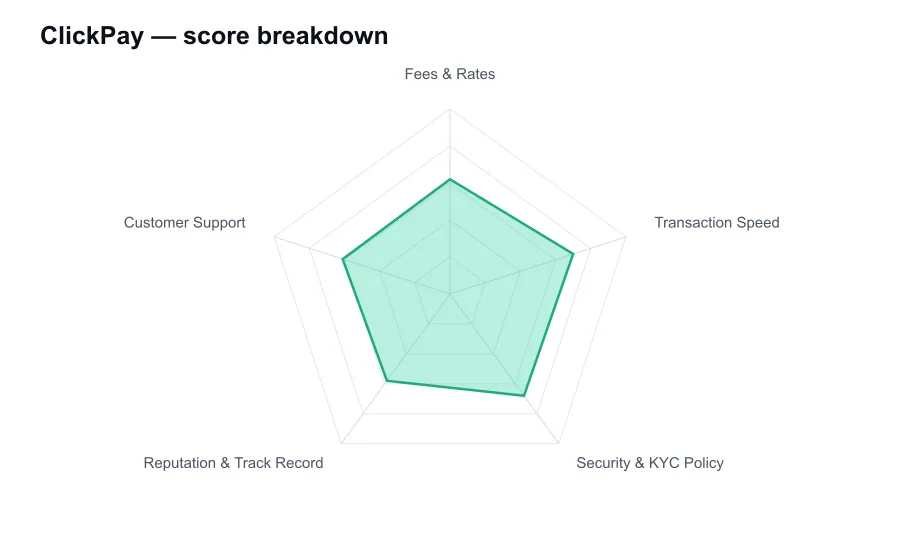
ClickPay scores 6.4/10 overall in our independent review, measured against every other provider we've compared, strongest on Transaction Speed (7.0/10) and weakest on Reputation & Track Record (5.8/10).
6.4/10 ★★★★★ How we score → Visit official siteEditorial independence: our scores and rankings are produced using the fixed criteria above and are not influenced by advertisers. This is an independent ranking site and is not operated by, or affiliated with, any provider we list.
Affiliate disclosure: some links on this page may earn us a commission at no extra cost to you. This does not affect our rankings.
| Best for | Not for |
|---|---|
| More relevant to merchant payments than trading | Not a natural substitute for a crypto exchange |
| Potentially fast customer checkout flow | Fees vary by method, region, and business profile |
Criteria & Scores
| Criterion | Score | Note |
|---|---|---|
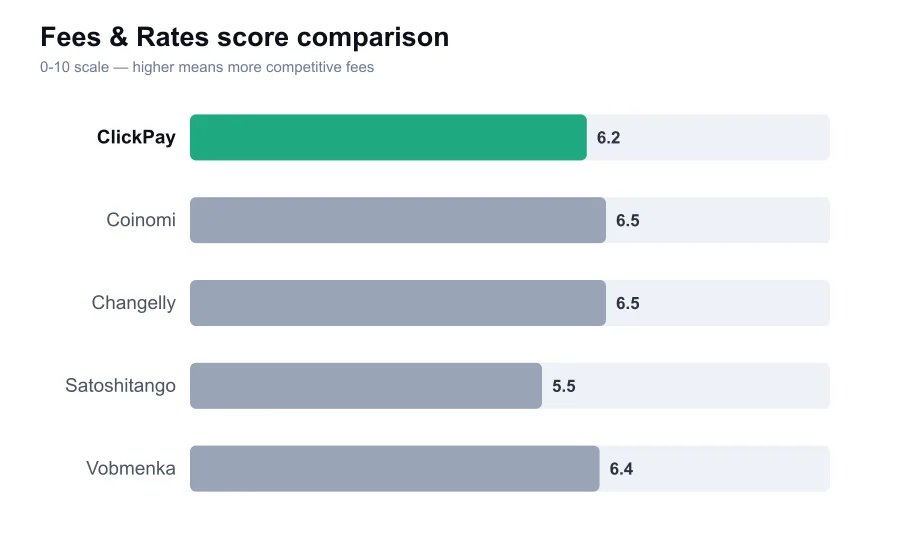
| Fees & Rates | 6.2 | Pricing depends heavily on payment method and market. |
| Transaction Speed | 7.0 | Checkout can be fast, settlement may be scheduled. |
| Security & KYC Policy | 6.8 | Compliance and payment controls matter most. |
| Reputation & Track Record | 5.8 | Reputation varies by entity and jurisdiction. |
| Customer Support | 6.1 | Merchant support quality is central to value. |
In-Depth Review
ClickPay is a name used in payment technology more often than in mainstream crypto trading, and that distinction matters. A payment processor, checkout provider, or merchant gateway should not be judged by the same standards as a spot exchange, even if it supports digital assets or crypto-adjacent settlement. Its likely value lies in helping businesses accept payments or move funds through a simpler checkout layer, not in giving retail customers a place to speculate on tokens.
That positioning can be attractive to merchants. Businesses usually care about successful payment completion, settlement timing, checkout reliability, fraud controls, and integration quality far more than a BTC order book. A well-designed payment layer can reduce operational pain, especially for online sellers that need card, wallet, invoice, or regional payment methods in one place. The question is whether ClickPay provides that reliability in the markets a merchant actually serves.
For crypto users, the brand requires extra care because a familiar payment name can create a false sense that every service bearing it is an established cryptocurrency exchange. Before sending crypto or connecting an account, users should verify the exact company, official domain, supported jurisdiction, and product terms. Do not assume a ClickPay-branded page has the same ownership, licensing, or customer protections as another company with a similar name.
Fee assessment depends heavily on the product. Merchant payment providers often charge processing fees by card type, payment method, currency, country, chargeback risk, and settlement arrangement. Crypto conversion costs may be embedded in a quoted rate or passed through as a network fee. That makes a single universal ClickPay fee figure misleading. A merchant should request or locate a specific rate card and model the total cost for its own sales mix.
For a retail customer making a crypto purchase through a checkout flow, convenience often comes with a premium. Card-funded crypto purchases are frequently more expensive than bank-transfer purchases on a mainstream exchange because the provider is taking on card fees and fraud exposure. The buyer should compare the final crypto amount, including network charges, rather than focusing on a small advertised processing percentage.
Speed is one of the areas where payment platforms can shine. A card authorization or digital-wallet payment can appear nearly immediate to the customer, and a crypto transfer can be initiated as soon as a payment passes risk checks. Merchant settlement is different. Funds may settle on a schedule, and reserves or rolling holds can apply to newer or higher-risk businesses. Fast checkout does not necessarily mean same-day access to revenue.
Crypto payouts have their own timing constraints. A provider can broadcast a transaction quickly, but it cannot make a blockchain confirm faster than the network allows. Bitcoin payouts may need several confirmations, while TRON or some other networks may appear faster. Customers must ensure that the receiving wallet supports the selected asset and chain. A payment platform cannot reverse a completed on-chain withdrawal because the buyer typed the wrong address.
Security should be evaluated through operational controls, not slogans. Merchants need to know whether the provider supports strong account authentication, role-based access, API-key restrictions, webhook verification, fraud screening, and clear dispute handling. Retail buyers need to know who holds their payment data, whether transactions are screened, and how account recovery works. Payment services hold sensitive information even when they do not hold crypto balances.
KYC and KYB are not optional details in this category. A merchant-facing provider is likely to verify company ownership, business model, bank details, and transaction history. Individual users may also face identity verification depending on the payment method, geography, and transaction size. That can feel inconvenient, but it is generally a more credible posture than a fiat payment provider claiming that it has no compliance process at all.
ClickPay's reputation should be considered product by product and jurisdiction by jurisdiction. Payment companies can have good standing with merchants in one region while being nearly unknown to international crypto users. That is not necessarily a defect. It does mean that a merchant should seek evidence from businesses with a similar model, country, average ticket size, and chargeback exposure, rather than relying on generalized online reviews.
Support quality is particularly important for merchants because a payment interruption can directly stop sales. The key questions are practical: Is there a dedicated account manager for larger businesses? Is emergency support available after hours? How are chargebacks handled? Can the merchant reach someone who understands API logs and settlement reports, rather than only a frontline agent reading scripted answers? These details matter more than a glossy onboarding page.
For small online sellers, ClickPay may be attractive if it offers the relevant regional methods and an integration that works with their store. Yet a seller should not migrate a live checkout without testing the sandbox, settlement process, refund flow, and support responsiveness. A single failed webhook configuration or delayed payout can cost more than a slightly higher processing fee. Technical diligence is part of the purchase decision.
I would be even more conservative for a person seeking a crypto exchange. ClickPay is not the natural first choice for buying and holding digital assets unless its specific product clearly provides that service with transparent terms. Coinbase, Kraken, Bitstamp, and established regional exchanges are easier to evaluate for basic crypto custody and trading. ClickPay makes more sense where payment acceptance, not investing, is the actual requirement.
My take is that ClickPay can be useful as a payments tool, but it should be assessed like infrastructure. Look at integration, settlement, compliance, pricing, and support in the exact country where you operate. Do not expect it to replace a full-featured crypto exchange, and do not assume all ClickPay-branded services are the same entity. For the right merchant, its specialization may be an advantage. For the wrong user, it is simply the wrong category of product.
Pros & Cons
| Pros | Cons |
|---|
Verdict
Frequently Asked Questions
Is ClickPay a cryptocurrency exchange?
ClickPay is better evaluated as a payments or checkout service unless the specific product clearly states otherwise. It should not automatically be treated as a full-featured crypto trading and custody platform.
How fast does ClickPay settle merchant payments?
Customer payment approval can be quick, but merchant settlement can follow a separate schedule. Timing may depend on country, payment method, risk review, bank processing, and the merchant agreement.
Will ClickPay require business verification?
A merchant payment provider will commonly require KYB information such as company details, beneficial owners, bank details, and business activity. Individual verification can also apply to certain payment flows.