HotExchange
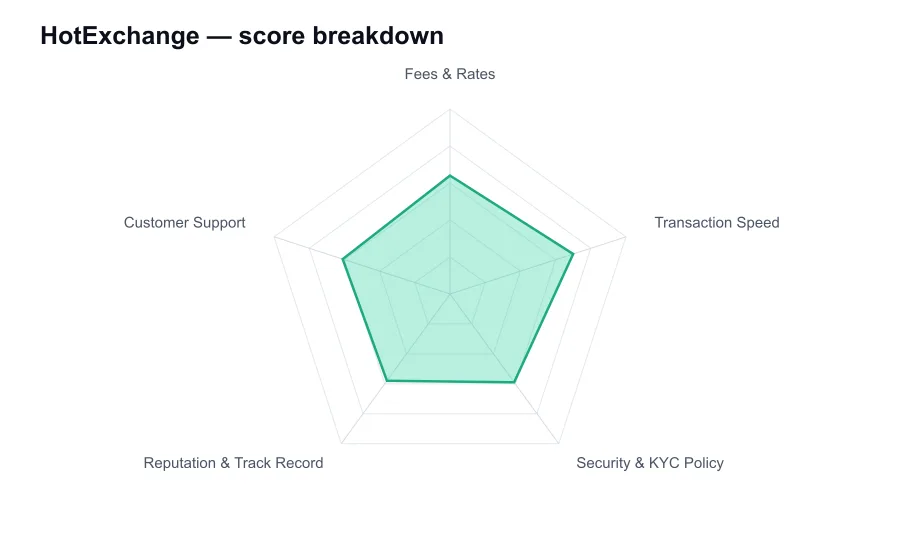
HotExchange scores 6.2/10 overall in our independent review, measured against every other provider we've compared, strongest on Transaction Speed (7.0/10) and weakest on Reputation & Track Record (5.8/10).
6.2/10 ★★★★★ How we score → Visit official siteEditorial independence: our scores and rankings are produced using the fixed criteria above and are not influenced by advertisers. This is an independent ranking site and is not operated by, or affiliated with, any provider we list.
Affiliate disclosure: some links on this page may earn us a commission at no extra cost to you. This does not affect our rankings.
| Best for | Not for |
|---|---|
| Direct order form for simple swaps | Effective fee is embedded in the quote |
| Potentially quick crypto processing | Less transparent than large exchanges |
Criteria & Scores
| Criterion | Score | Note |
|---|---|---|
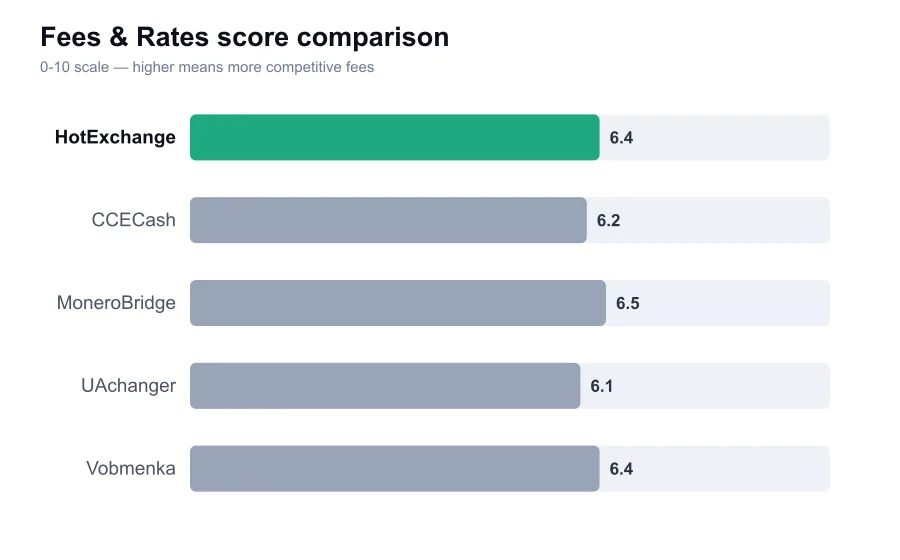
| Fees & Rates | 6.4 | Convenient pricing, but the spread is not always transparent. |
| Transaction Speed | 7.0 | Fast for clean crypto orders after confirmations. |
| Security & KYC Policy | 5.9 | Compliance checks remain possible despite low-friction ordering. |
| Reputation & Track Record | 5.8 | Smaller specialist with a limited public track record. |
| Customer Support | 6.1 | Useful for order issues, not a premium support operation. |
In-Depth Review
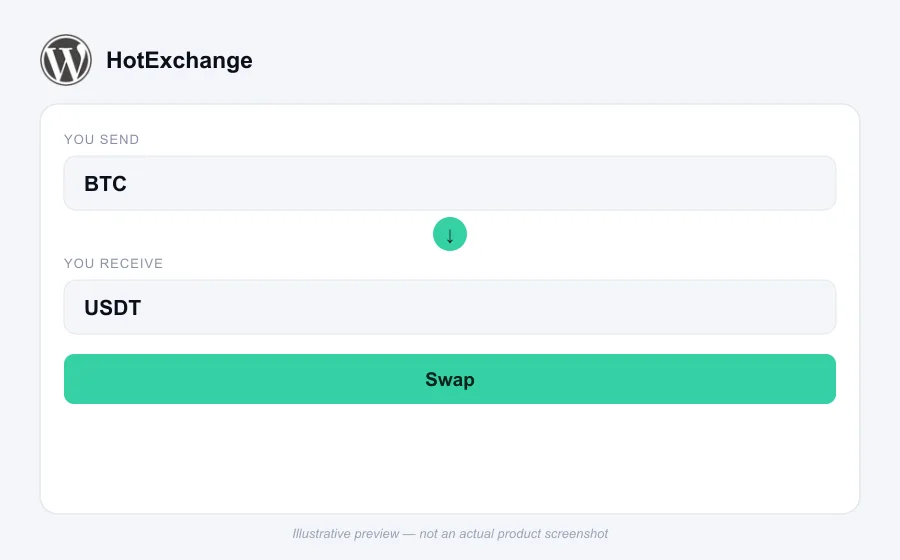
HotExchange is a compact online currency exchanger rather than a full cryptocurrency marketplace. Its appeal is obvious from the first screen: it tries to get the user from one asset or payment method to another with as few steps as possible. That is a perfectly legitimate niche, but buyers should understand the distinction. This is not a venue where you place limit orders or receive the compliance framework of a large licensed exchange.
The service is designed around exchange directions, and that makes it approachable for people converting crypto to local payment methods or moving between electronic currencies. The interface generally avoids complexity. The downside is that a clean order form can give a false sense of simplicity. A wallet address, network choice, card number and payment reference each need to be right the first time. Small exchangers have less room to absorb user mistakes.
HotExchange's fees are best described as opaque but not necessarily unreasonable. Like many instant exchangers, it tends to express its charge through the buy and sell quote rather than through a clearly separated trading commission. The visible rate is what matters. If the platform says you will receive a stated amount, compare that number with competitors after accounting for network withdrawal costs and any fee charged by your bank or payment provider.
The service can be competitive on routes where it has active liquidity, particularly common stablecoin and mainstream crypto directions. It becomes less attractive when the order involves a thinly traded coin, an unpopular network or a payment method that creates chargeback risk. Those directions usually carry a wider margin. Anyone making regular large conversions should calculate the effective percentage cost across several completed quotes rather than relying on a single attractive landing-page rate.
I would not call HotExchange a bargain by default. It is a convenience product. That convenience may be worth paying for if it saves an hour of account setup and a withdrawal delay, but it should not be confused with the tight market pricing available on deep order-book exchanges. Users who trade frequently will almost certainly find lower raw costs on Binance, OKX or Kraken, assuming those platforms support their preferred local payout route.
Execution speed is decent for straightforward crypto payments. Once an incoming transfer is confirmed and the order passes automatic checks, processing can be quick. The slow points are predictable: blockchain confirmations, payment processor downtime, manual review and bank settlement. HotExchange cannot make Bitcoin confirmations or a bank's anti-fraud department move faster, so a promised instant exchange should always be understood as instant after the necessary inputs clear.
The platform's order status tools are important here. Users should keep the order ID, transaction hash and screenshots of the quote. If a payment is delayed, those details give support something concrete to investigate. Sending a second transfer because the first appears slow is one of the easiest ways to turn a routine delay into a reconciliation problem. Patience is not glamorous, but it is often the fastest route to resolution.
HotExchange presents the lower-registration model many users seek. That can mean no standing account requirement for ordinary orders, yet it does not remove compliance obligations. Suspicious transactions, sanctioned-wallet exposure, mismatched payer details or unusually large transfers can lead to a KYC request. Any reviewer claiming that an exchanger is permanently anonymous is selling a fantasy. The actual policy matters only when a transaction is stopped.
The concern is predictability. A customer should know before sending funds that a transaction might be paused and what documents could be requested. HotExchange's terms and support materials should be read before a large order, not after it. If the possibility of document submission is unacceptable, then a regulated exchange with upfront verification is actually the less stressful choice, despite the extra onboarding work.
Security is also about operational habits. HotExchange should be treated as a pass-through service, not long-term storage. Verify the domain independently, avoid links from unsolicited messages, use a newly copied wallet address rather than an old clipboard entry, and confirm token network compatibility. The most common losses in this market arise from phishing, wrong-network deposits and fraudulent lookalike sites, not from sophisticated exchange mechanics.
Reputation-wise, HotExchange has the profile of a smaller specialist. Its public footprint and customer feedback can help establish whether it is active and responsive, but they do not create the kind of long-term assurance offered by an established global brand. A favorable monitor listing is a starting point. It tells you the service is visible enough to be tracked. It does not guarantee an uncomplicated outcome on every order.
Support is more important at HotExchange than marketing copy suggests. For a normal order, you may never need it. For a delayed payment, incorrect memo or compliance review, the support channel becomes the whole product. Responses tend to be most effective when the request contains an order number, timestamp, exact payment amount, screenshot and blockchain hash. A provider can resolve a technical issue much faster with evidence than with a frustrated paragraph.
There is little reason to dismiss HotExchange outright, but there is also little reason to grant it automatic trust. The service makes most sense for users who already understand exchange mechanics and can accept that quote-based conversion has a different risk profile from trading on a major venue. Its usability is better than its transparency. That is useful, but it should shape the size of the transaction you are willing to make.
My view is that HotExchange belongs in the shortlist for a comparison, not at the top of a blind recommendation list. It can handle ordinary swaps efficiently, and its low-friction design is appealing. Yet the embedded-rate model, conditional verification and limited institutional record argue for restraint. Check the payout amount, make a test transaction, and use a larger regulated platform if certainty matters more than convenience.
Pros & Cons
| Pros | Cons |
|---|
Verdict
Frequently Asked Questions
Are HotExchange fees shown separately?
The practical cost is generally reflected in the exchange quote. Compare the final payout, including network and payment-provider charges, with alternative services.
Can HotExchange ask for identity documents?
Yes. Low-friction ordering does not prevent transaction monitoring or KYC requests where compliance checks require them.
Should I use HotExchange for a large first transfer?
A small test order is the safer approach. Confirm the route, payout details and support responsiveness before increasing the amount.