Defillama
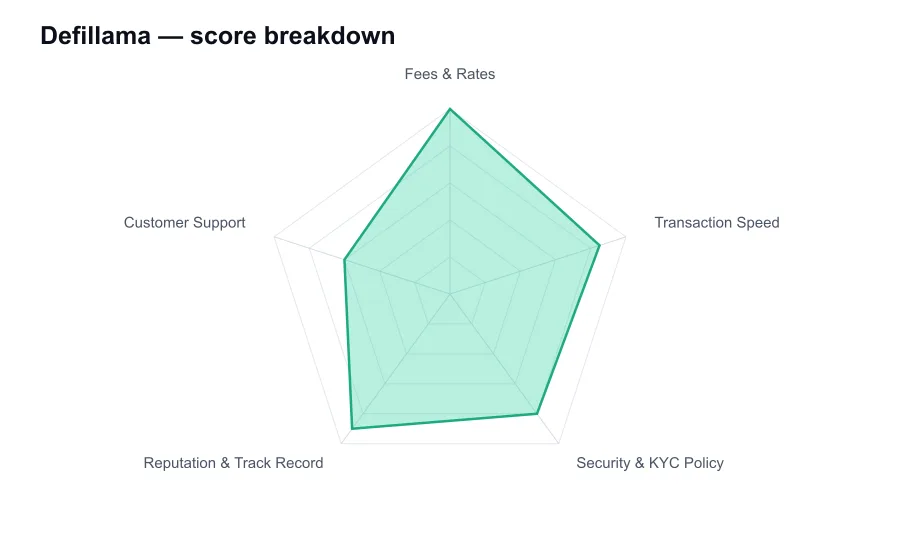
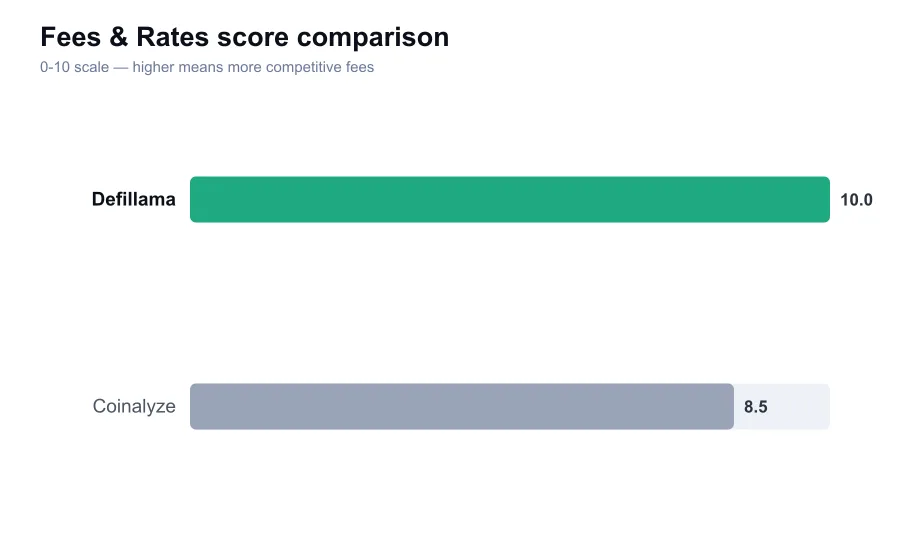
Defillama scores 8.6/10 overall in our independent review, measured against every other provider we've compared, strongest on Fees & Rates (10.0/10) and weakest on Customer Support (6.0/10).
8.6/10 ★★★★★ How we score → Status: active (checked 2026-10-13T19:48:03.113Z) Visit official siteEditorial independence: our scores and rankings are produced using the fixed criteria above and are not influenced by advertisers. This is an independent ranking site and is not operated by, or affiliated with, any provider we list.
Affiliate disclosure: some links on this page may earn us a commission at no extra cost to you. This does not affect our rankings.
| Best for | Not for |
|---|---|
| Free access to extensive DeFi metrics | TVL and APY figures can be misunderstood |
| No routine custody of user assets | No personal customer service model |
What is Defillama?
Criteria & Scores
| Criterion | Score | Note |
|---|---|---|
| Fees & Rates | 10.0 | Core analytics are available free of charge |
| Transaction Speed | 8.5 | Fast dashboards, though data freshness varies by integration |
| Security & KYC Policy | 8.0 | No routine asset custody or wallet connection required |
| Reputation & Track Record | 9.0 | A widely cited source for DeFi protocol data |
| Customer Support | 6.0 | Community and developer channels, limited personal support |
How to Use Defillama Safely
- Type the official DefiLlama URL yourself or bookmark it
- Do not approve wallet transactions from links that imitate an analytics page
- Treat TVL as a usage metric, not a security audit
- Check whether yield comes from fees or token incentives
- Verify major figures against protocol documentation and onchain sources
In-Depth Review
DefiLlama is not a crypto exchange, a broker or a wallet. It is an analytics platform that tracks decentralized finance protocols, chains, yields, stablecoins, bridges, fees, revenue and other onchain activity. That distinction matters. Nobody deposits money with DefiLlama to execute a trade, so judging it by the same standards as Coinmotion or ChangeNOW would be misleading. Its value lies in research. For many DeFi users, it has become the first tab they open before putting capital into a protocol.
The site grew rapidly because it made a difficult category legible. DeFi data used to be scattered across block explorers, protocol dashboards, Discord announcements and opaque token presentations. DefiLlama pulls a great deal of that information into comparable tables and charts. A reader can check total value locked, chain activity, protocol categories, historical changes and yield listings without connecting a wallet. That free, walletless starting point is a major reason it has become such a widely used public tool.
Its fee score is effectively excellent because the ordinary website is free to use. There is no trading commission, withdrawal fee, deposit fee or subscription wall blocking the central data pages. The platform earns attention by becoming useful enough that researchers, builders and investors return daily. Its API and data products have commercial uses, but the public-facing product remains unusually generous. That puts it in sharp contrast with premium financial-data terminals, where even basic historical information can be locked behind a recurring bill.
Free does not mean costless in the broader sense. A user can make bad decisions from misunderstood data, and DefiLlama cannot protect anyone from that. Total value locked is not a safety rating. A protocol with a large TVL number can still have a flawed contract, weak governance, inflated incentives or a fragile bridge dependency. The site's figures are a starting point for due diligence, not permission to deposit. People who treat a dashboard ranking as a risk report are using the tool badly.
Speed is excellent for what DefiLlama actually does. Most pages load quickly, charts are easy to scan, and protocol comparisons do not require a wallet confirmation or blockchain settlement. Data freshness varies by chain and integration, however. Some values come from onchain reads, while other metrics depend on adapters, indexers and methodology choices. The number on a dashboard should never be assumed to update block by block across every chain. For strategic research, that is rarely a problem. For a time-sensitive liquidation or trade decision, it may be.
The interface has improved without becoming cluttered. DefiLlama manages to put a huge amount of data in front of users while keeping the primary paths obvious: protocols, chains, yields, stablecoins, bridges and fees. Its clean presentation is a real advantage over many crypto dashboards that bury useful figures under visual noise. The flip side is that newcomers can still be overwhelmed by terminology. TVL, FDV, emissions, APY, real yield and bridged value are not interchangeable concepts. The site gives you the measurements, but it does not make financial literacy optional.
DefiLlama's strongest security feature is also structural. It generally does not need custody of customer assets, and casual readers can use most of the platform without an account or wallet connection. That sharply reduces the usual exchange risks involving a centralized balance, withdrawal lock or compromised login. A fake DefiLlama link can still be dangerous, especially if it directs visitors to a wallet-connection prompt. The legitimate analytics site itself is not a reason to approve a transaction from a wallet.
The project has had its share of internal drama, most visibly a 2023 dispute among contributors involving control and a proposed token launch. The situation was public and messy, but it did not turn into a long-term disappearance of the service. In a strange way, the episode reminded users that even community-oriented crypto projects can have governance tensions and key-person risk. DefiLlama continued operating and remains a major data source, but its history should stop anyone from treating its brand as institutionally invulnerable.
Reputation is very strong among DeFi-native users. Researchers cite its protocol and chain figures constantly, journalists rely on it for market context, and project teams care deeply about how they are categorized there. That influence has been earned through broad coverage and a willingness to make methodology visible. Yet a respected dashboard can still get a classification wrong or lag behind a protocol change. If a number matters to an investment committee, a treasury or a news story, verify it against the protocol's contracts, documentation and official reporting.
Yield pages are among DefiLlama's most useful and most potentially misleading tools. They can surface opportunities across lending markets, liquidity pools and other strategies far faster than manual browsing. They can also tempt users into chasing a high displayed APY without asking whether the yield comes from sustainable fees or inflationary token rewards. A 200 percent rate is usually a warning to investigate, not a prize to grab. DefiLlama provides the map, but it cannot judge whether the road is mined.
Customer support is modest, which is normal for a free analytics product but still worth stating plainly. There is no concierge desk for a confused retail investor, and a visitor should not expect exchange-style account recovery because there usually is no account to recover. Community channels, documentation, GitHub activity and social channels are the practical routes for corrections or questions. Developers and protocol teams can often get attention for data issues. Casual users looking for personal investment guidance will get little from the support model.
The open and public nature of the project is a strength. It encourages scrutiny of data adapters and methodology rather than asking people to accept a black-box score. Still, users need to understand what they are seeing. TVL can move because token prices moved, because deposits arrived, because a protocol counted collateral differently, or because a chain integration changed. A sudden chart increase deserves an explanation. The best DefiLlama users read the number and then ask what caused it.
For a DeFi researcher, the site is close to essential. I would use it to compare protocols, inspect chain trends, discover markets and challenge claims made in promotional threads. I would not use it as a one-click investment selector. The more a protocol advertises a headline metric, the more useful it is to cross-check that metric on DefiLlama and then inspect the details behind it. Used this way, the platform saves enormous time.
My final view is simple: DefiLlama is one of crypto's genuinely useful public utilities. It earns a top fee score because core access is free, and it earns a high reputation score because it has become embedded in serious DeFi research. Its limitations are the limitations of data itself, delayed updates, imperfect classifications and the risk that a reader mistakes visibility for safety. It is not an exchange and should never be reviewed as though it holds your assets. As an analytics tool, though, it is hard to beat.
Pros & Cons
| Pros | Cons |
|---|
Verdict
Frequently Asked Questions
Is DefiLlama a cryptocurrency exchange?
No. DefiLlama is an analytics platform. It tracks DeFi data such as TVL, yields, stablecoins, fees and chains, but it does not act as a normal exchange or custodian.
Does DefiLlama require KYC or a wallet connection?
No. Most DefiLlama pages can be used without an account, KYC process or wallet connection.
What does TVL on DefiLlama mean?
TVL means total value locked, an estimate of assets deposited in a protocol or chain. It is not a safety rating and can change with token prices or methodology.
Why can a DefiLlama yield look unusually high?
A high APY may include temporary token incentives, volatile rewards or riskier strategies. Check the source of yield before treating the displayed figure as sustainable income.
Can DefiLlama numbers be wrong?
They can be delayed, incomplete or affected by adapter and classification changes. Important figures should be checked against a protocol's own contracts and documentation.
Did DefiLlama have a governance dispute?
Yes. A public contributor dispute in 2023 involved control of the project and a proposed token launch. The site continued operating after the dispute.