1inch
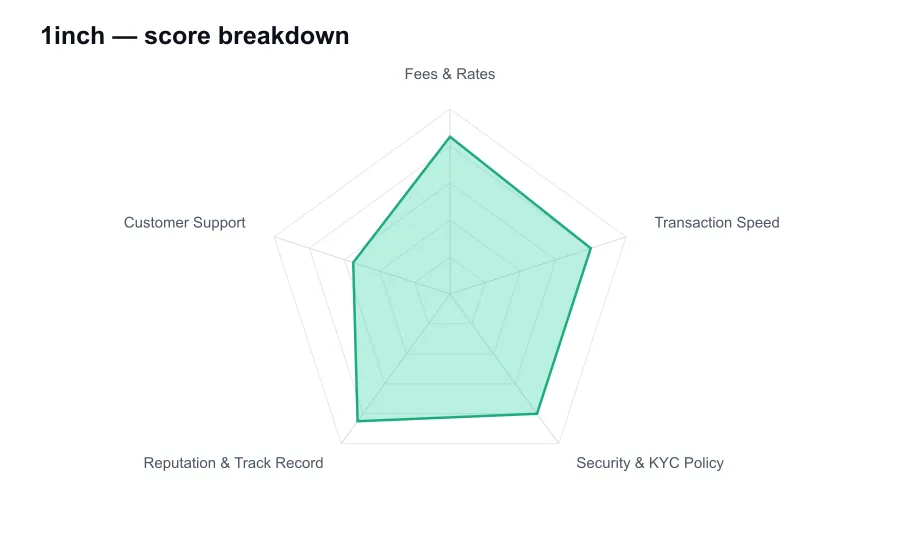
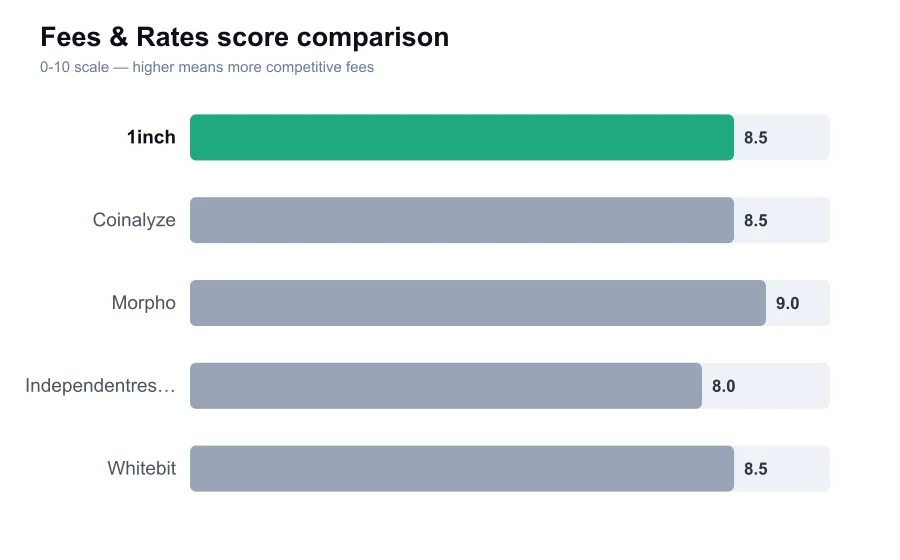
1inch scores 8.0/10 overall in our independent review, measured against every other provider we've compared, strongest on Fees & Rates (8.5/10) and weakest on Customer Support (5.5/10).
8.0/10 ★★★★★ How we score → Visit official siteEditorial independence: our scores and rankings are produced using the fixed criteria above and are not influenced by advertisers. This is an independent ranking site and is not operated by, or affiliated with, any provider we list.
Affiliate disclosure: some links on this page may earn us a commission at no extra cost to you. This does not affect our rankings.
| Best for | Not for |
|---|---|
| Strong multi-DEX routing for competitive swap prices | No recovery path for wallet or transaction mistakes |
| Fusion can remove the need to hold native gas tokens | Fusion execution can be less attractive during volatile markets |
Criteria & Scores
| Criterion | Score | Note |
|---|---|---|
| Fees & Rates | 8.5 | No standard swap platform fee, but routing and gas costs still matter |
| Transaction Speed | 8.0 | Fast on L2s, Ethereum timing depends on network conditions |
| Security & KYC Policy | 8.0 | Audited self-custody protocol with no routine KYC |
| Reputation & Track Record | 8.5 | Established since 2020 with deep DeFi integration |
| Customer Support | 5.5 | Good documentation, limited human account-level help |
In-Depth Review
1inch is one of the few decentralized exchange aggregators that has remained genuinely relevant through several market cycles. It started as a tool for finding better Ethereum swap routes, then grew into a broader trading stack with its own aggregation, limit-order, wallet, Fusion intent system, and DAO governance. For active DeFi users, it sits closer to a routing layer than a conventional exchange. You bring the wallet, keep custody, and let 1inch search liquidity across multiple venues.
The core appeal is simple. A direct swap on Uniswap, Curve, Balancer, or another automated market maker may not be the cheapest route for a given trade. 1inch breaks an order across pools and sometimes across protocols to reduce price impact. That can make a meaningful difference on large stablecoin or blue-chip token swaps, particularly on Ethereum where poor routing and gas costs punish casual execution.
Its standard aggregation interface does not usually charge a visible platform fee for most swaps. The real cost comes from the liquidity sources, network gas, token spreads, and any protocol-specific charges in the route. That is better than a flat fee model for sophisticated traders, but it also means the quoted output is the only number that matters. Don't assume a route is cheap merely because the interface advertises zero platform fees.
Fusion is where 1inch gets more interesting. Rather than asking the user to submit an onchain swap transaction directly, Fusion lets a user sign an intent that third-party resolvers fill. The user can often avoid paying gas in the native chain token, with costs reflected in execution instead. It is an elegant solution for traders who hate holding ETH, MATIC, or other gas tokens just to swap assets.
That convenience has a trade-off. Fusion is not magic free execution. Resolvers need to be paid, and their compensation can show up as a less favorable price than a straightforward onchain route during volatile markets or thin liquidity periods. For a small Ethereum trade, Fusion can be excellent. For a larger order, I would still compare Fusion, classic aggregation, and a direct route on the deepest underlying venue before committing.
Speed depends heavily on the chain and mode used. A normal Ethereum swap settles once the transaction is included and confirmed, so it may feel quick during calm conditions and irritatingly slow when gas spikes. On Arbitrum, Optimism, Polygon, Base, and other supported networks, execution is usually much snappier. Fusion adds an offchain matching step, but a good resolver can make the experience feel smoother than manually wrestling with gas and slippage settings.
1inch has a strong security culture by DeFi standards. Its smart contracts have been audited by firms including OpenZeppelin, CertiK, SlowMist, and others across different products and releases. The team also runs bug bounty efforts. Still, an audited contract is not a bank guarantee. Aggregators add approval risk, routing complexity, interface risk, and the possibility that a user approves a malicious token or interacts with a fake frontend.
There is no standard KYC requirement to use the 1inch protocol. You connect a self-custody wallet and trade from it. That is a major advantage for users who want permissionless access, but it also means 1inch cannot recover funds, reverse a mistaken transfer, or protect somebody who signs a bad approval. Privacy is stronger than at a centralized exchange, though public blockchain activity remains visible.
The brand has survived since 2020, which matters in a sector full of short-lived aggregators. Its name recognition, broad chain support, and integration footprint are substantial. The 1INCH token and DAO have had their share of governance and token-economics debate, but the underlying routing product has continued to develop rather than becoming a relic of the previous bull market.
I also like that 1inch has not tried to pretend every user needs the same tool. The regular aggregation flow is sensible for straightforward swaps. Limit orders suit traders who want a target price without leaving assets on a centralized venue. Fusion suits users who prioritize convenience and gas abstraction. The wallet product is useful, though I would not choose a wallet merely because it belongs to an exchange aggregator.
The weak spot is support. 1inch has documentation, a help center, community channels, and social accounts, but it does not offer the kind of personal rescue service that centralized exchange users expect. If a swap is pending, a token approval was too broad, or funds were sent to the wrong address, the practical answer is often blockchain investigation rather than a support ticket resolution.
Scam awareness is particularly important here. 1inch is popular enough that fake support accounts, malicious browser extensions, counterfeit airdrops, and phishing websites routinely use its name. Legitimate staff will not ask for a seed phrase. The protocol's permissionless nature is a strength, but it gives fraudsters plenty of room to imitate official channels and exploit users who are new to wallet-based trading.
For pricing, 1inch is excellent at what it actually does, which is optimizing fragmented onchain liquidity. It is less compelling for somebody buying crypto with a card, cashing out to a bank account, or seeking a simple account dashboard. Those users need a regulated fiat platform first. 1inch is best treated as a trading tool after assets are already in a wallet.
My view is that 1inch remains a top-tier DEX aggregator, especially for Ethereum ecosystem users who understand slippage, approvals, and self-custody. Its routing can save real money, Fusion can remove a lot of transaction friction, and the protocol has earned its longevity. The price of that power is responsibility. If you want someone to answer the phone and fix mistakes, this is the wrong venue. If you want competitive onchain execution without surrendering custody, 1inch is still one of the strongest choices available.
Pros & Cons
| Pros | Cons |
|---|
Verdict
Frequently Asked Questions
Does 1inch charge a fee for swaps?
1inch generally does not add a standard visible fee to regular aggregation swaps. You still pay network gas, liquidity-pool fees, spreads, and any execution cost built into the selected route.
Do I need KYC to use 1inch?
No routine KYC is required for the 1inch protocol. You connect a compatible self-custody wallet, though blockchain transactions remain public.
Is 1inch Fusion really gasless?
Fusion can let users avoid paying gas directly in the native token. Resolver costs are reflected in execution, so compare the final quote against a normal onchain swap.