Independentreserve
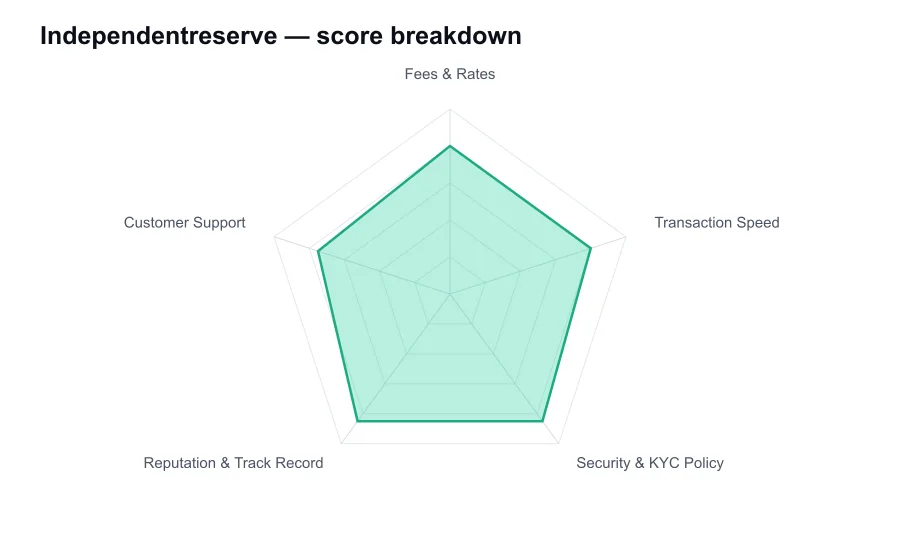
Independentreserve scores 8.2/10 overall in our independent review, measured against every other provider we've compared, strongest on Security & KYC Policy (8.5/10) and weakest on Customer Support (7.5/10).
8.2/10 ★★★★★ How we score → Status: active (checked 2026-10-13T19:48:03.174Z) Visit official siteEditorial independence: our scores and rankings are produced using the fixed criteria above and are not influenced by advertisers. This is an independent ranking site and is not operated by, or affiliated with, any provider we list.
Affiliate disclosure: some links on this page may earn us a commission at no extra cost to you. This does not affect our rankings.
| Best for | Not for |
|---|---|
| Established Australian exchange founded in 2013 | Smaller liquidity pool than global top exchanges |
| Fees decline from a 0.5% starting rate | Mandatory verification and compliance reviews |
What is Independentreserve?
How Independentreserve Works
- Create an account and complete identity verification
- Deposit supported fiat currency through a local funding method
- Choose a trading pair and place a market or limit order
- Monitor the order and account balance
- Withdraw crypto to a personal wallet or fiat to a verified bank account
Criteria & Scores
| Criterion | Score | Note |
|---|---|---|
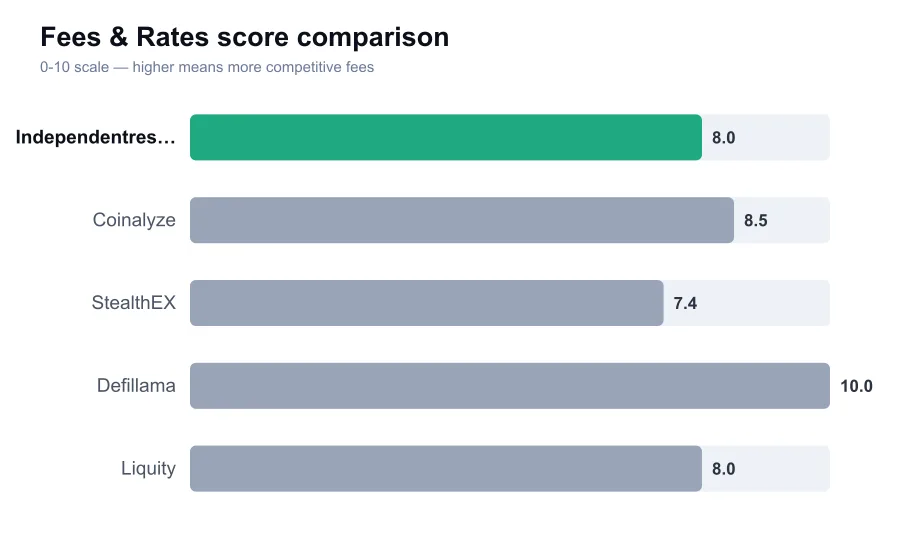
| Fees & Rates | 8.0 | Trading fees start at 0.5% and decline with 30-day volume |
| Transaction Speed | 8.0 | Fast order matching and practical local fiat funding |
| Security & KYC Policy | 8.5 | KYC, cold storage controls and ISO 27001 certification |
| Reputation & Track Record | 8.5 | Operating since 2013 with strong regional standing |
| Customer Support | 7.5 | Local-oriented support, though reviews can slow transfers |
KYC
| Requirement | mandatory |
|---|---|
| Notes | Independent Reserve is a verified centralized exchange. Users must complete identity checks, and larger or unusual transactions can require more documentation. |
Supported Assets
Availability
| Global | No |
|---|---|
| Notes | The exchange is primarily intended for eligible customers in Australia and Singapore, with availability dependent on residence and verification. |
How to Use Independentreserve Safely
- Use an authenticator app for two-factor authentication
- Use limit orders for large or less-liquid trades
- Whitelist and verify withdrawal addresses carefully
- Keep records for tax and SMSF administration
- Move long-term holdings to secure self-custody where appropriate
Mobile App
| iOS | Yes |
|---|---|
| Android | Yes |
| Notes | Independent Reserve offers mobile access for account and trading management. |
In-Depth Review
Independent Reserve is a centralized cryptocurrency exchange built around Australian and Singaporean customers who want a relatively conservative, fiat-connected place to trade major digital assets. Founded in 2013, it has survived multiple crypto cycles and has generally avoided the theatrical marketing style common among newer exchanges. The platform is not trying to be the loudest name in crypto. It is trying to be a credible bridge between bank money and digital assets, with trading tools that can serve both ordinary investors and more serious clients.
That positioning is important. Independent Reserve feels closer to a financial service business than a token supermarket. Its strongest appeal is to users dealing in Australian dollars, Singapore dollars or United States dollars, particularly those who want local banking options and a company with a long history in the region. The interface can serve a beginner, but it is more capable than a simple broker app. Traders can use an order book rather than accept only a broker quote, which immediately gives it an edge over higher-spread retail services.
Fees are one of the platform's better features. Standard trading fees have traditionally started at 0.5 percent and fall as a customer trades more over a 30-day period, reaching much lower rates for high-volume accounts. That is not the absolute cheapest retail pricing available anywhere, but it is fair for a regulated regional exchange. Compared with a broker charging 1 percent to 2 percent or more, Independent Reserve gives regular users a meaningful cost advantage. Large traders should still study the current schedule closely because maker and taker economics matter.
The actual cost of a trade is more than the stated commission. Liquidity varies by market pair, and a large order in a thin book can suffer slippage. The major AUD and USD pairs are the sensible place to trade if execution quality matters. Someone buying a modest amount of Bitcoin may barely notice the difference, while a customer moving a substantial portfolio should use limit orders, split orders or consult the over-the-counter desk. Independent Reserve offers the tools for disciplined execution, but it does not guarantee deep global liquidity on every listed asset.
Fiat funding is a practical strength. Australian users can use local transfer methods such as PayID and bank transfers, while Singapore customers have local funding options tied to the platform's regional operation. These rails can make deposits and withdrawals feel much less awkward than sending money to an offshore exchange. Timing still depends on the bank, the account's verification status and compliance review. A transfer that clears instantly through a domestic banking network is possible, but customers should not assume every deposit will be available at once.
Trade execution itself is fast because orders are matched inside the exchange. A market order can fill in seconds if there is sufficient liquidity, while a limit order remains open until it meets the market. Crypto withdrawals then return to the rules of the blockchain. Bitcoin confirmation time, Ethereum network conditions and the exchange's own security checks determine the final timeline. That is normal. Independent Reserve is quick enough for investors and spot traders, though it does not offer the derivatives depth, high-frequency infrastructure or global volume of a major international trading venue.
Security has been central to the company's public identity. Independent Reserve has promoted a mix of cold storage, multi-signature controls, two-factor authentication and operational security practices. It has also highlighted ISO 27001 certification, a meaningful signal that information security management has been formally assessed. Certification is not insurance against every failure and it does not remove counterparty risk, but it is more substantive than vague claims about military-grade security. Customers should still secure their own email account and use an authenticator app rather than relying on SMS.
KYC is compulsory, as it should be expected from an exchange that handles bank money and operates in regulated jurisdictions. New customers must verify identity before they can use the platform fully, and larger or unusual activity can trigger further questions. This is not a defect for the service's intended customer, it is part of the proposition. The exchange wants to work with banks and regulated users. People who want to swap crypto privately without providing identification are looking for a different product category.
The company has a solid reputation built on age and restraint. Operating since 2013 is meaningful in an industry where many platforms disappear before their second bull market. Independent Reserve has not been immune to the pressures faced by all centralized exchanges, including banking friction, market volatility and customer anxiety after high-profile failures elsewhere. Still, it has maintained a more measured public profile than many competitors. That tone has helped it appeal to self-managed super fund investors and businesses that need a platform they can explain to accountants.
One feature that sets Independent Reserve apart in Australia is its support for self-managed super funds. Crypto inside an SMSF requires careful administration, custody records and tax treatment, so this is not a casual retail feature. The platform's willingness to accommodate that customer type shows where its priorities lie. It also offers over-the-counter services for larger transactions. Those services are valuable if you need execution assistance, but they do not replace the need to negotiate, compare quotes and understand settlement terms.
The asset range is respectable without being reckless. Independent Reserve lists major cryptocurrencies and selected established assets, but it does not chase every short-lived narrative token. I consider that a positive for its main audience. The exchange is for building a manageable portfolio, not for finding the newest micro-cap before social media discovers it. The downside is obvious: users interested in DeFi tokens, small chain ecosystems or very new listings may have to maintain an account elsewhere.
Support is better positioned than at many giant global exchanges because the company serves a narrower regional user base and has real local-business expectations. Help channels, educational material and account assistance are useful, especially for users who are new to bank-funded crypto trading. Yet no centralized exchange support team makes compliance friction pleasant. If a withdrawal is reviewed or documentation is requested, the process can feel slow. Plan transfers before you need the money urgently, and keep records ready for any sizeable transaction.
Independent Reserve is a good fit for someone who wants sensible spot-market trading and local currency access, not a flashy all-in-one crypto app. Its order-book model, descending fee schedule and regional banking integrations make it a more serious choice than many simple brokers. I would be comfortable recommending it to an Australian investor who wants to buy Bitcoin or Ethereum regularly, use limit orders and maintain clean transaction records. I would not recommend it to someone whose priority is leverage, meme coins or anonymous activity.
My verdict is favorable, with a clear caveat about scale. Independent Reserve offers a mature and credible service, strong regional utility and fees that make sense once you move beyond tiny purchases. It does not have the deepest markets or broadest feature set, and its KYC-first approach will not suit privacy-focused users. But it has lasted because it concentrates on the fundamentals: local fiat access, security practices, order-book trading and a measured operational style. For its intended market, that is a much better foundation than noise.
Pros & Cons
| Pros | Cons |
|---|
Verdict
Frequently Asked Questions
What are Independent Reserve's trading fees?
Trading fees have traditionally started at 0.5% and decrease as 30-day trading volume rises. Check the current fee page before trading because tier thresholds can change.
Does Independent Reserve require KYC?
Yes. Identity verification is required to use the exchange's bank-connected service, and additional checks may apply for certain transactions or account activity.
Can Australians fund Independent Reserve with PayID?
Independent Reserve supports Australian local funding methods including PayID. Bank processing and account compliance status can still affect availability timing.
Does Independent Reserve support SMSFs?
Yes. Independent Reserve has services designed for Australian self-managed super funds, which can help users maintain an account structure suitable for SMSF administration.
Is Independent Reserve ISO 27001 certified?
Independent Reserve has publicly stated that it holds ISO 27001 certification for its information security management system.
Can I use Independent Reserve for leveraged futures?
Independent Reserve is primarily a spot exchange. Users looking for leveraged derivatives should choose a platform specifically built and authorized for those products.