Kamino
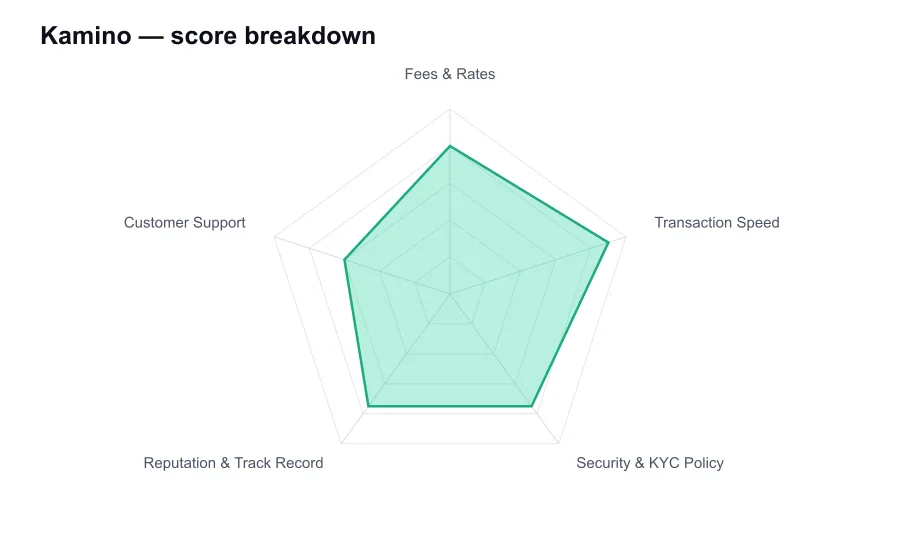
Kamino scores 7.8/10 overall in our independent review, measured against every other provider we've compared, strongest on Transaction Speed (9.0/10) and weakest on Customer Support (6.0/10).
7.8/10 ★★★★★ How we score → Visit official siteEditorial independence: our scores and rankings are produced using the fixed criteria above and are not influenced by advertisers. This is an independent ranking site and is not operated by, or affiliated with, any provider we list.
Affiliate disclosure: some links on this page may earn us a commission at no extra cost to you. This does not affect our rankings.
| Best for | Not for |
|---|---|
| Fast, low-cost Solana execution | Leverage tools can liquidate users quickly |
| Strong lending dashboard and risk metrics | Rates and yields change with utilization |
Criteria & Scores
| Criterion | Score | Note |
|---|---|---|
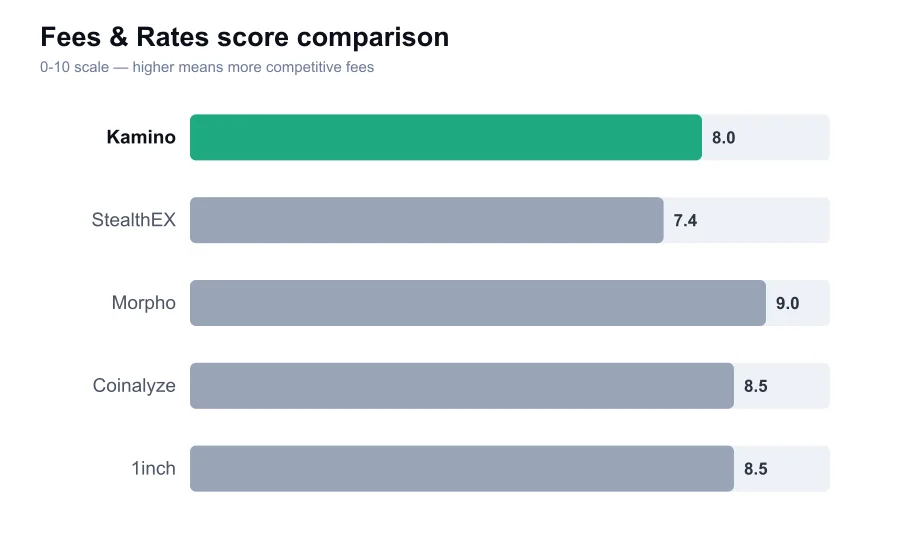
| Fees & Rates | 8.0 | Low Solana costs, but borrowing and vault economics vary by market |
| Transaction Speed | 9.0 | Most actions settle in seconds on Solana |
| Security & KYC Policy | 7.5 | Audited contracts, but leverage and smart contract risk remain |
| Reputation & Track Record | 7.5 | A leading Solana DeFi name, though still relatively young |
| Customer Support | 6.0 | Good docs and community help, no account-level safety net |
In-Depth Review
Kamino is one of Solana's more ambitious DeFi applications, a lending market, liquidity manager, leveraged trading venue, and automated vault platform rolled into one. It is not an exchange in the conventional Coinbase sense. Users connect a Solana wallet, deposit assets into smart contracts, borrow against collateral, or put capital into concentrated liquidity strategies. Its closest peers are Marginfi, Drift, Solend's successor markets, and Jupiter's growing lending ecosystem.
That breadth is Kamino's appeal and its main risk. A straightforward lending deposit is easy enough, but the product surface expands quickly once you move into Multiply positions, liquidity vaults, looped leverage, and isolated pools. The interface does a better job than most Solana protocols of showing loan-to-value ratios, liquidation prices, and projected yields. Still, this is an application for people who already understand that a high displayed APY can disappear fast if the borrowed asset moves against them.
Fees are not captured by one tidy Kamino tariff. Lending users pay variable interest determined by each reserve's utilization curve. Borrowing USDC, SOL, JitoSOL, or other assets can be cheap in quiet periods and expensive when a pool is heavily used. Deposit yields are net of reserve economics and any protocol take. That is normal for an onchain money market, but it means the number on the screen is a moving market price, not a promise.
Kamino's Multiply feature deserves extra scrutiny. It packages recursive borrowing and swapping into a few clicks, which is convenient, but users still absorb borrow interest, swap costs, slippage, and the possibility of liquidation. The leverage itself is not a free productivity tool. A two or three times SOL position may look manageable until SOL falls sharply while utilization rises. Kamino presents the mechanics clearly, yet no interface can make leveraged lending conservative.
For liquidity providers, the fee picture is even more conditional. Kamino Liquidity vaults automate concentrated liquidity positions on Orca and Raydium style markets, collect trading fees, and rebalance according to strategy rules. Users may face vault performance fees, underlying pool fees, token emissions, and ordinary Solana transaction costs. The vault saves work, but it does not eliminate impermanent loss. Anybody comparing its headline yield with a simple USDC lending rate is comparing two very different risk profiles.
Speed is a genuine Solana advantage. Deposits, withdrawals, repayments, and collateral adjustments usually settle in seconds once the wallet transaction reaches the network. This feels dramatically faster than Ethereum mainnet lending, where even an uncomplicated position change can require waiting for inclusion and paying uncomfortable gas. Kamino's transaction fees are also typically fractions of a cent, though priority fees can rise during busy Solana periods.
The fast execution has a less glamorous side. Solana congestion, RPC problems, wallet glitches, or a delayed transaction can be frightening when a position is near liquidation. A user cannot rely on a support agent to rescue a risky account at the last minute. Kamino includes health metrics and automation features, but borrowers should maintain a meaningful collateral buffer. Treat the displayed liquidation threshold as a danger line, not a target.
Kamino has built a more serious security record than many short-lived Solana yield projects. Its code has been reviewed by established security firms including OtterSec, and the team has published audit materials and documentation around its lending architecture. That is encouraging, especially beside anonymous forks with no public security process. It is not the same thing as a guarantee. Audits reduce known bug risk, they do not remove smart contract, oracle, governance, or economic attack risk.
There is no traditional KYC gate for the core protocol. A compatible Solana wallet is enough to interact with the contracts, subject to local law and any restrictions applied by the front end or wallet provider. That privacy and permissionlessness will suit experienced DeFi users. It also means there is no account recovery desk. Lose a seed phrase, sign a malicious approval, or send assets to the wrong address, and the usual financial-service safeguards do not exist.
The protocol's governance token, KMNO, and its migration toward more community governance have given Kamino a stronger public identity than a simple app run by a hidden team. It has also benefited from Solana's resurgence and meaningful integrations across the ecosystem. The reputation is good within Solana DeFi, but it remains a young protocol in a young chain ecosystem. It does not have the multi-cycle battle testing of Aave, Maker, or Liquity.
Kamino's documentation is unusually useful for a product this technical. The app surfaces reserve data, utilization, collateral parameters, and position health in a way that lets diligent users investigate before committing funds. Discord and community channels are the practical support route. Responses can be helpful, but they are not equivalent to regulated broker support, and users should assume scammers will imitate moderators in public channels.
I would particularly avoid treating isolated markets as interchangeable with the major SOL and stablecoin pools. Isolated assets can have thinner liquidity, more abrupt oracle moves, and different collateral rules. A higher APY in one of those markets may reflect genuine demand or simply compensate for a risk that is hard to model. Kamino gives users tools, not a due diligence substitute.
Compared with Marginfi, Kamino feels more product-complete and more polished for someone who wants lending plus managed liquidity. Compared with Drift, it is less focused on active derivatives trading. Compared with Aave, it is cheaper and faster to use, but its Solana-specific risk profile is less familiar to institutions. That distinction matters more than a few basis points of yield.
My view is that Kamino is one of the better places to use DeFi capital on Solana, provided the user stays with liquid assets and understands collateral management. Its cost structure is competitive, its execution is quick, and the product has earned real ecosystem credibility. I would not hand it a beginner's first crypto deposit, and I would be very selective about leverage. Used deliberately, it is powerful. Used casually, it can turn a small market move into an expensive lesson.
Pros & Cons
| Pros | Cons |
|---|
Verdict
Frequently Asked Questions
Does Kamino require KYC?
The core Kamino protocol is wallet-based and does not generally require KYC. Your wallet provider, fiat on-ramp, or local rules may impose separate checks.
What does it cost to borrow on Kamino?
Borrowing costs are variable and depend on the reserve, utilization, and asset. Users also pay small Solana network fees and may incur swap or vault-related costs.
Can a Kamino position be liquidated?
Yes. Borrowed positions can be liquidated if collateral falls below the market's required health threshold. Leveraged Multiply positions need particularly close monitoring.