Whitebit
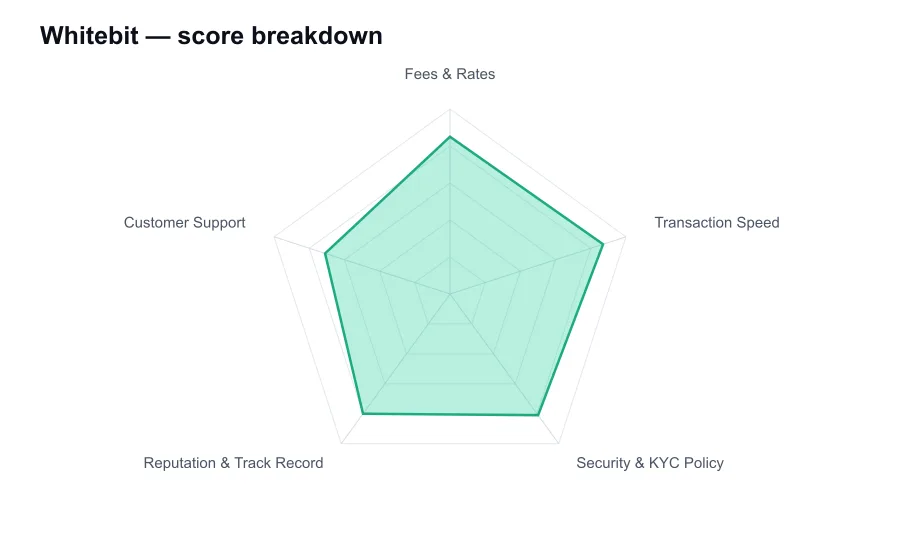
Whitebit scores 8.2/10 overall in our independent review, measured against every other provider we've compared, strongest on Transaction Speed (8.7/10) and weakest on Customer Support (7.1/10).
8.2/10 ★★★★★ How we score → Visit official siteEditorial independence: our scores and rankings are produced using the fixed criteria above and are not influenced by advertisers. This is an independent ranking site and is not operated by, or affiliated with, any provider we list.
Affiliate disclosure: some links on this page may earn us a commission at no extra cost to you. This does not affect our rankings.
| Best for | Not for |
|---|---|
| Competitive spot trading fees | Full KYC is central to the platform experience |
| Deep feature set for a European-focused exchange | Liquidity varies significantly by trading pair |
Criteria & Scores
| Criterion | Score | Note |
|---|---|---|
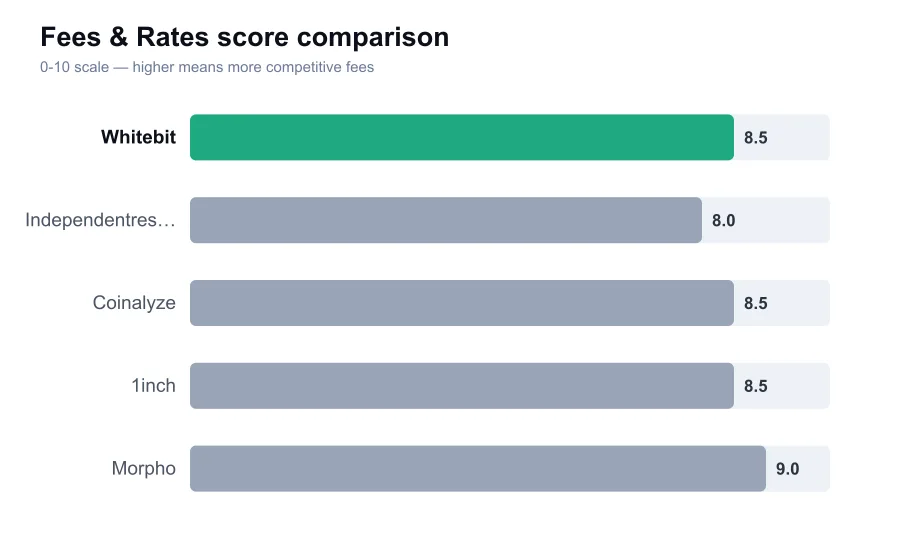
| Fees & Rates | 8.5 | Spot fees up to 0.1%, competitive for active traders |
| Transaction Speed | 8.7 | Fast internal matching, normal blockchain withdrawal delays |
| Security & KYC Policy | 8.1 | Strong account controls, but customers still face custody risk |
| Reputation & Track Record | 8.0 | Large European exchange with a growing multi-year record |
| Customer Support | 7.1 | Extensive help materials, tougher cases can require tickets |
In-Depth Review
WhiteBIT is a centralized cryptocurrency exchange with a distinctly European profile, substantial roots in Ukraine, and a product range that goes well beyond a simple coin swap. It offers spot trading, futures, staking-style earning products, fiat on-ramps, token launch activity, and an ecosystem built around its WBT token. It competes more directly with Binance, Bybit, KuCoin, Bitget, and regional regulated exchanges than with no-account swap services.
The exchange has grown quickly since launching in 2018. Its branding is polished, its interface is accessible, and it has invested heavily in sports and entertainment partnerships, including high-profile football sponsorships. That marketing reach should not be confused with proof of safety, but it does signal that WhiteBIT is trying to be a mainstream platform rather than a marginal offshore venue.
For spot traders, the fee schedule is one of WhiteBIT's better arguments. Standard spot fees are commonly listed at up to 0.1 percent for makers and takers, with discounts and special terms possible for certain pairs or account levels. That is competitive with major centralized exchanges and materially cheaper than buying crypto through a high-spread retail app. Traders should still inspect each market because the fee treatment and liquidity are not identical everywhere.
The important caveat is liquidity. WhiteBIT has useful volume in major pairs, particularly USDT markets and assets popular with its regional user base. It is not automatically the best venue for every altcoin. A low commission on a thin order book can cost more than a higher commission on Binance or Kraken if the spread is wide or your order moves the market. Limit orders are available, and anyone moving serious size should use them.
Fiat purchases are a different story. Card buying, third-party payment providers, and currency conversion add costs that are less tidy than the trading fee headline. That is standard across the industry, but it catches newcomers off guard. Funding by bank transfer, where supported in your location, is usually more economical than repeatedly buying small amounts by card.
Execution is fast in the way centralized exchanges should be fast. Matching happens internally in fractions of a second, and you can cancel or amend orders without waiting for a blockchain. Deposits and withdrawals are where the real-world delays sit. Network confirmations, wallet maintenance, withdrawal queues, travel-rule checks, and banking rails can all slow a transfer, especially during volatile markets.
WhiteBIT has a much stronger security posture than a casual swap site, at least in terms of visible account controls. It offers two-factor authentication, anti-phishing protections, address whitelisting, device and session management, and withdrawal safeguards. The exchange has also said that it keeps the vast majority of customer assets in cold storage. Those are sensible layers, and users should enable every one of them.
Still, the defining risk is custody. Your balance is a claim against WhiteBIT's systems and policies, not coins you independently control. The platform has discussed proof-of-reserves efforts and security practices, but customers should understand the limits of exchange attestations. They are useful signals, not the same thing as a full public audit of assets, liabilities, controls, and solvency under a globally uniform standard.
Identity verification is integral to using WhiteBIT properly. It is a centralized exchange operating in regulated markets, and KYC is required for meaningful account functionality. Some newcomers resent that after using decentralized wallets, but it is the price of access to fiat services, higher limits, derivatives-related products where available, and a more formal compliance setup. Do not choose WhiteBIT if anonymous trading is your priority.
Its regulatory positioning has become more serious over time, with registrations and compliance activity tied to European operations. That is a point in its favor against anonymous offshore platforms. At the same time, rules, product access, and legal entities can differ by country. Before depositing, verify which WhiteBIT entity serves your residence, what protections apply, and whether futures or earn products are actually offered where you live.
The trading platform is friendly enough for a beginner but not stripped down. Spot screens include standard charting tools, order types, market data, and a clean order-book layout. More advanced users will find familiar futures controls, though the derivatives experience does not feel as deep as the specialist environments at Binance, Bybit, or OKX. That is not fatal, but experienced traders may eventually notice the difference.
Customer support is available through help-center materials and ticket-based channels, with chat availability depending on the service path and region. WhiteBIT's documentation is broader than that of a small exchange, covering verification, deposits, security, and trading mechanics. Resolution quality is harder to judge than the presence of an FAQ. Verification failures, account restrictions, and payment disputes are the cases where centralized exchanges tend to frustrate people most.
Reputation is solid but not untouchable. WhiteBIT has survived several difficult years for crypto markets, expanded its user base, and avoided becoming synonymous with a major collapse or breach. That matters. It also has not earned the long, globally tested institutional reputation of Coinbase or Kraken, so I would be cautious about treating it as a permanent vault for wealth.
For someone who wants low spot fees, euro-oriented access, and a more developed product suite than a basic broker, WhiteBIT is a credible choice. It rewards users who secure their account, use limit orders, and withdraw long-term holdings to self-custody. The exchange is less attractive for privacy-focused users, for traders requiring the deepest global liquidity, or for anyone who expects a regulated platform to eliminate all counterparty risk.
WhiteBIT has the ingredients of a strong mid-to-large centralized exchange. Its pricing is competitive, its account security toolkit is respectable, and its growth is real. The part I would challenge is any suggestion that convenience and compliance make exchange custody harmless. Keep trading capital there, keep your security settings tight, and move savings to a wallet you control. With that discipline, WhiteBIT is a serious platform rather than just another flashy crypto brand.
Pros & Cons
| Pros | Cons |
|---|
Verdict
Frequently Asked Questions
What are WhiteBIT spot trading fees?
Standard spot fees are commonly listed at up to 0.1 percent for both makers and takers. Specific pairs, promotions, account tiers, and payment methods can have different effective costs.
Does WhiteBIT require identity verification?
Yes. WhiteBIT is a centralized, compliance-oriented exchange and KYC is required for normal account access and meaningful use of its services.
Is WhiteBIT suitable for long-term crypto storage?
It has useful security features, but it remains a custodian. Many experienced users keep only trading funds on an exchange and withdraw long-term holdings to a self-controlled wallet.