Morpho
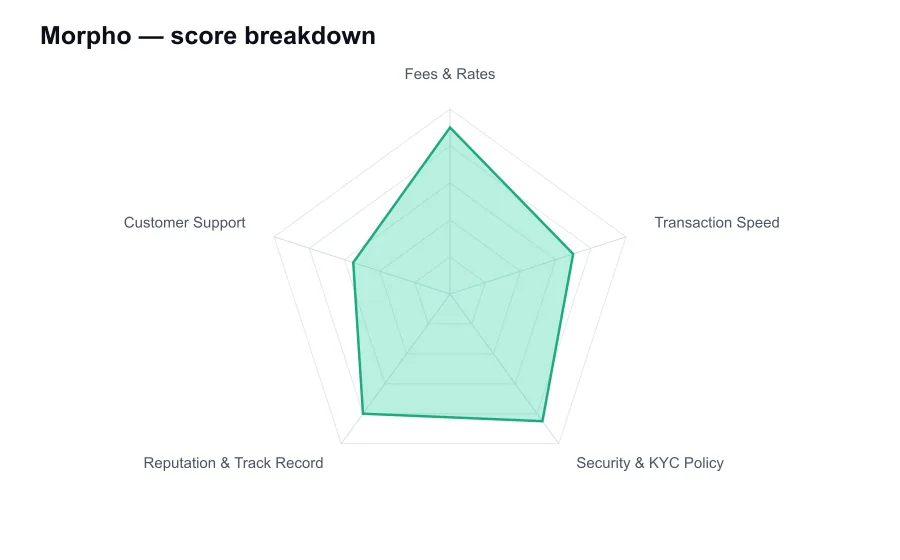
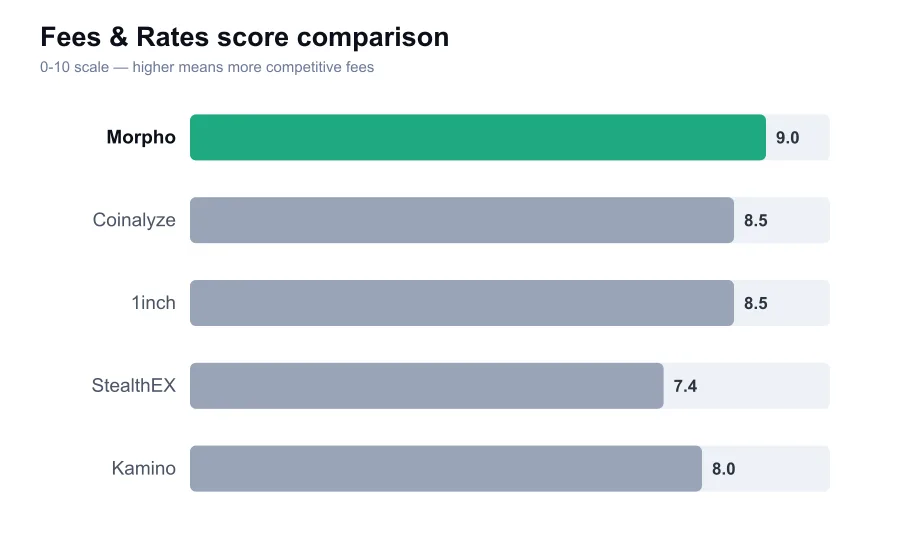
Morpho scores 7.9/10 overall in our independent review, measured against every other provider we've compared, strongest on Fees & Rates (9.0/10) and weakest on Customer Support (5.5/10).
7.9/10 ★★★★★ How we score → Visit official siteEditorial independence: our scores and rankings are produced using the fixed criteria above and are not influenced by advertisers. This is an independent ranking site and is not operated by, or affiliated with, any provider we list.
Affiliate disclosure: some links on this page may earn us a commission at no extra cost to you. This does not affect our rankings.
| Best for | Not for |
|---|---|
| No core Morpho Blue protocol fee | Permissionless markets vary greatly in quality |
| Isolated markets limit cross-market contagion | Borrowers can be liquidated without human intervention |
Criteria & Scores
| Criterion | Score | Note |
|---|---|---|
| Fees & Rates | 9.0 | No built-in Morpho Blue protocol fee, vault fees can apply |
| Transaction Speed | 7.0 | Efficient contracts, but settlement follows the chosen chain |
| Security & KYC Policy | 8.5 | Audited isolated markets, with configuration risk left to users |
| Reputation & Track Record | 8.0 | Highly regarded DeFi lending infrastructure since 2022 |
| Customer Support | 5.5 | Strong docs and community, no rescue service for liquidations |
In-Depth Review
Morpho is a lending protocol for users who want more control than the usual pool-based DeFi model provides. Its current identity is built around Morpho Blue, a permissionless lending primitive on Ethereum and compatible networks, where individual markets are defined by a collateral asset, loan asset, oracle, interest-rate model, and liquidation threshold. It is not trying to be a friendly bank replacement. It is infrastructure for lending markets.
That distinction matters. Aave and Compound pool assets together under protocol-defined parameters. Morpho Blue lets market creators configure isolated markets. Users can lend into those markets directly or deposit through curated vaults, often called MetaMorpho vaults, where risk managers allocate capital across selected markets. The design can be capital efficient and transparent, but it places more responsibility on the user to understand who selected the market parameters.
Fees are one of Morpho's strongest selling points. Morpho Blue itself is designed with no built-in protocol fee on borrowing or lending. That does not mean borrowing is free. Lenders earn interest, borrowers pay it, and vault managers can charge management or performance fees depending on the vault. Oracle, gas, liquidation, and market-specific economics also affect the real cost.
For borrowers, the displayed annual percentage rate deserves close scrutiny. A low rate can change quickly when utilization rises, depending on the interest-rate model selected for that market. Isolated markets avoid some contagion from a giant pooled system, but they can be thinner and more sensitive to a large lender withdrawing. The attractive rate on a dashboard is a starting point, not a contract with the user.
For lenders, Morpho can be excellent if you know what you are funding. Direct lending gives a user a clear view of collateral and risk parameters, but it requires judgment. Vaults make the process easier, though they introduce curator risk. A well-respected curator may actively manage exposures and respond to market conditions. A weak curator can turn a simple deposit into a poorly understood bundle of isolated risks.
Transaction speed depends on the chain. On Ethereum mainnet, supplying, borrowing, repaying, and liquidating are subject to normal block inclusion and gas conditions. The protocol is not unusually slow, but it cannot outrun Ethereum. Deployments and integrations on lower-cost networks improve the experience for smaller users, while serious Ethereum users still need to account for gas during periods of liquidation stress.
Morpho's security model is thoughtful, but its openness cuts both ways. The protocol has undergone multiple audits, maintains a bug bounty program, and has been designed with modularity and minimized core complexity in mind. Morpho Blue's market isolation is a meaningful security improvement compared with systems where one compromised asset listing can threaten a broader lending pool.
Yet permissionless market creation means not every market deserves trust. An oracle choice can be inappropriate. Collateral can be illiquid. A liquidation threshold can be too aggressive or too loose. An interest-rate model can behave badly under stress. Morpho gives users the tools to inspect these choices, but it does not make the choices for them. That is a feature for experts and a hazard for everyone else.
There is no standard KYC requirement for direct Morpho usage. Users connect a self-custody wallet, and onchain activity remains public. This is good for permissionless finance, but the protocol cannot assess whether a borrower understands health factors or whether a lender can absorb a loss. Liquidation is automatic and mechanical. A user who waits for a warning email has already misunderstood the product.
Morpho has developed a strong reputation among serious DeFi participants. The project emerged in 2022 with peer-to-peer optimization layers for Aave and Compound, then moved toward the more independent Morpho Blue design. It has attracted respected backers, curators, and integrations, while gaining substantial usage during a period when onchain lending was rebuilding trust after several large failures elsewhere in crypto.
The reputation score is not perfect because the protocol's model still needs long-term stress testing across a full range of market conditions. Morpho Blue is powerful precisely because it is flexible. Flexibility creates a larger surface for bad configuration and bad incentives. I trust the core design more than I trust every market deployed on it, which is the correct way to think about a permissionless lending layer.
Support is adequate for a protocol audience, not for a retail banking audience. Morpho offers documentation, community channels, governance information, and ecosystem help through curators and integrators. There is no realistic expectation that a central agent will reverse a liquidation or restore access after a wallet compromise. Users should test with small amounts and understand repayment mechanics before borrowing against a meaningful position.
One practical advantage is transparency. Markets and vault strategies can be examined onchain, and users can see collateral types, utilization, rates, and allocations. This makes Morpho more legible than opaque yield products that simply advertise a return. Transparency does not eliminate risk, but it gives a diligent user a fighting chance to identify it before depositing.
Morpho is among the best DeFi lending protocols for informed users, particularly lenders who want curated vaults and borrowers who want isolated-market flexibility. Its low core fee design is attractive, and its security architecture is more deliberate than many copycat money markets. Still, this is not a set-and-forget savings account. The quality of the curator, market, oracle, and collateral matters as much as the Morpho name on the interface. Use the protocol for precision, not for blind yield hunting.
Pros & Cons
| Pros | Cons |
|---|
Verdict
Frequently Asked Questions
Does Morpho charge protocol fees?
Morpho Blue has no built-in protocol fee on lending or borrowing. Individual vault curators may charge fees, and users still pay interest, gas, and potential liquidation costs.
Is Morpho safer than pooled lending protocols?
Its isolated-market design can reduce contagion between markets. Safety still depends on collateral quality, oracle design, liquidation parameters, and the curator or market configuration selected.
Do I need KYC to use Morpho?
No routine KYC is required for direct protocol use. You use a compatible self-custody wallet and remain responsible for wallet security and loan health.