XGram
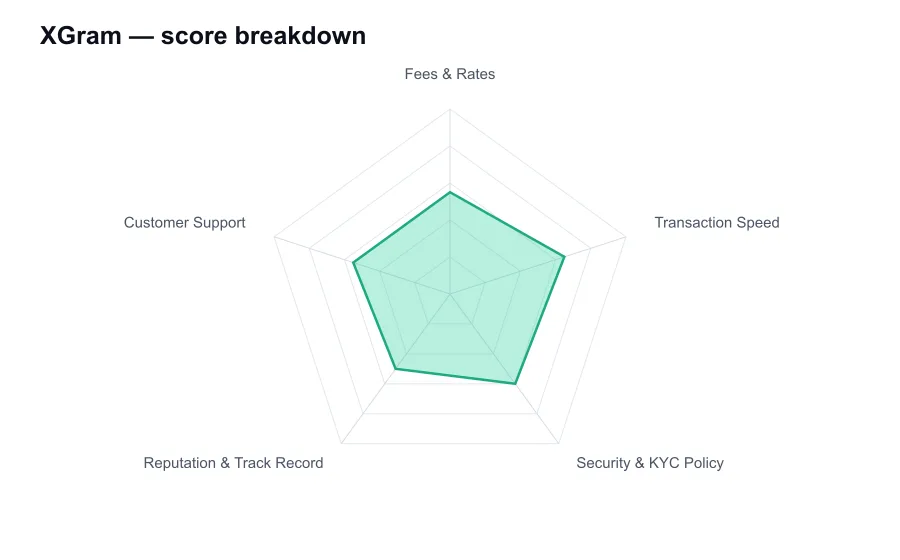
XGram scores 5.7/10 overall in our independent review, measured against every other provider we've compared, strongest on Transaction Speed (6.5/10) and weakest on Reputation & Track Record (5.0/10).
5.7/10 ★★★★★ How we score → Status: active (checked 2026-10-13T19:25:12.490Z) Visit official siteEditorial independence: our scores and rankings are produced using the fixed criteria above and are not influenced by advertisers. This is an independent ranking site and is not operated by, or affiliated with, any provider we list.
Affiliate disclosure: some links on this page may earn us a commission at no extra cost to you. This does not affect our rankings.
| Best for | Not for |
|---|---|
| Built around crypto payment and payout use cases | Fee transparency is weaker than major trading venues |
| Potentially useful for cross-border recipients | Delivery speed varies by payout route |
What is XGram?
How XGram Works
- Choose the sending asset and intended payout method
- Enter the recipient and destination details
- Review the quoted conversion and payout amount
- Complete any required identity checks
- Send the crypto or fund the transaction
- Track delivery to the selected payout route
Criteria & Scores
| Criterion | Score | Note |
|---|---|---|
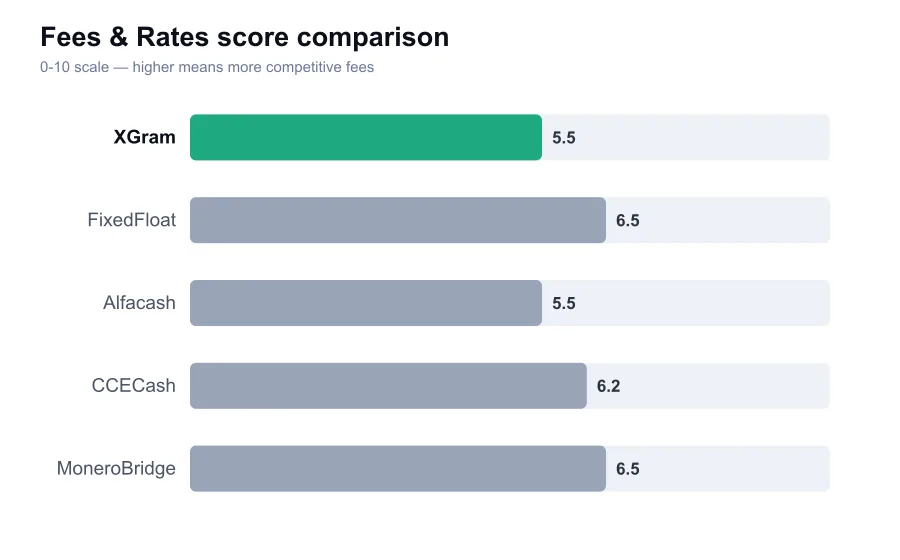
| Fees & Rates | 5.5 | Final payout quote matters more than a simple public fee |
| Transaction Speed | 6.5 | Crypto can move quickly, bank and cash payouts vary |
| Security & KYC Policy | 6.0 | KYC-relevant payment flow, recipient fraud remains a risk |
| Reputation & Track Record | 5.0 | Smaller public track record than major remittance firms |
| Customer Support | 5.5 | Payment disputes need stronger public service evidence |
| Fact | Value | Source |
|---|---|---|
| Provider type | Crypto payment and exchange service | Source |
| Core use case | Crypto-to-payment conversion | Source |
| Service model | Transaction-focused payment flow | Source |
| Identity checks | May apply by route and transaction | Source |
| Payout timing | Varies by method and destination | Source |
KYC
| Requirement | tiered |
|---|---|
| Notes | Verification needs can vary by payment route, destination, transfer amount, and compliance screening. Expect more checks for fiat-connected or higher-risk transfers. |
How to Use XGram Safely
- Verify recipient details through a separate communication channel
- Run a small test transfer before a larger remittance
- Compare the final payout amount with alternatives
- Keep transfer references and payment confirmations
- Do not send funds for a recipient you have not independently verified
In-Depth Review
XGram is a crypto payment and exchange service aimed at moving value between digital assets, bank payment rails, and cash-oriented payout methods. It is not trying to be another full-featured trading exchange with hundreds of speculative pairs and a deep derivatives menu. Its pitch is more practical, helping users convert crypto into spendable money or send value across borders.
That position makes XGram interesting, but it also makes it harder to judge than a conventional exchange. A centralized trading venue can be compared on maker fees, order-book depth, proof of reserves, and withdrawal records. A payment-oriented crypto service has to be judged on payout reliability, identity verification, banking partners, geographic coverage, recipient experience, and how clearly it explains conversion costs.
The platform's attraction is obvious for someone paid in crypto who needs a transfer, bank payout, or local cash collection option. In places where exchange withdrawals are slow, expensive, or awkward, a service with payment distribution can solve a real problem. Sending USDT to a relative is easy. Turning that USDT into usable local money without asking the recipient to manage a wallet is the difficult part.
Fees deserve scrutiny because payment services often advertise a simple conversion while the real cost appears in the exchange rate, payout method, or local partner charge. XGram does not have the transparent, exchange-style fee schedule that serious traders expect from a venue such as Kraken Pro. The user needs to inspect the actual quote before committing, including the number of fiat units the recipient receives and any disclosed network cost.
That lack of easy fee comparison is the service's biggest commercial weakness. A user can forgive a premium for cash delivery or a difficult corridor. They should not forgive ambiguity. If XGram's final payout is better than a bank wire, Western Union-style remittance provider, or a stablecoin transfer plus local off-ramp, then the fee is justified. If it isn't, the convenience story falls apart quickly.
Transaction speed depends heavily on the selected route. A crypto transfer may reach the platform quickly, but a bank payout can depend on local banking hours, beneficiary checks, and payment-partner processing. Cash collection also depends on the recipient, local agent availability, and identification rules. This is not the sort of service where every transfer can honestly be described as instant.
For crypto-to-crypto transactions, speed is usually tied to the source network and the number of confirmations required before conversion. For fiat delivery, plan for operational friction. A transaction sent at a weekend, a mismatch in the recipient name, or a local compliance query can turn a simple payout into a support matter. Users should send a modest test amount before relying on XGram for a family payment or business invoice.
The service is KYC-relevant by nature. A platform that connects crypto to bank and cash payout systems cannot realistically operate with the same privacy model as a no-account swap site. Expect identity and transaction checks to vary with the product, amount, destination country, and risk review. That is not inherently bad. In fact, for a payment provider, a visible compliance process can be more reassuring than vague claims of total anonymity.
The security concern is less about wallet hacks than about recipient fraud and account details. If you type the wrong bank information or send cash payout instructions to a scammer, blockchain finality offers little comfort. XGram users should verify the beneficiary through another channel, especially when a payment request arrives through Telegram, WhatsApp, or a compromised email account.
XGram's reputation is still limited compared with established international money-transfer companies and major regulated exchanges. That does not prove it is unreliable, but it means the buyer has less independent evidence to work with. I would want to see clear legal-entity details, transparent terms, supported-country disclosures, and responsive pre-transfer support before using it for a substantial payment.
The platform should also be judged corridor by corridor. A payment company can perform well in one country and poorly in another because the real service is delivered through local banking and payout partners. A glowing experience receiving a transfer in one jurisdiction says little about a payout to another. Reviews that fail to name the route, method, amount, and date are not particularly useful.
Support matters more here than on an ordinary token swap. Payments involve recipients, identity checks, and deadlines. If a bank transfer is delayed, the sender needs a clear case status and a human who can explain whether the problem is on-chain, in compliance review, or with the payout partner. XGram does not have the public support reputation of a large retail financial institution, so I would not assume frictionless escalation.
I would also be cautious about using a service like XGram as a crypto trading platform. Its value lies in the payment function, not in beating liquid exchange prices. If your real goal is to rebalance BTC, ETH, and stablecoins, use a transparent exchange or a decentralized protocol where appropriate. If your goal is to get value to a person who needs local money, then XGram's model makes more sense.
My take is measured. XGram addresses a real use case that many crypto products ignore, particularly cross-border conversion and payout. But the limited public track record and less transparent pricing make it a service to test rather than trust blindly. It may be useful for small remittances in supported routes. For large transfers, business payroll, or urgent payments, choose a provider with stronger public regulatory disclosure and established support infrastructure.
Pros & Cons
| Pros | Cons |
|---|
Verdict
Frequently Asked Questions
Is XGram mainly a crypto trading exchange?
No. XGram is better understood as a crypto payment and exchange service focused on moving value between digital assets and payout methods, rather than a full order-book trading venue.
Does XGram require identity verification?
Identity checks can apply because the service connects crypto with bank and cash-oriented payment routes. Requirements can vary by transaction amount, destination, payment method, and compliance review.
Can every XGram payment arrive instantly?
No. Crypto settlement depends on the source network, while bank transfers and cash payouts can depend on business hours, recipient checks, and local payout partners.
What should I compare before making an XGram transfer?
Compare the final recipient payout, not just the crypto amount sent. Check the exchange rate, network cost, payout method, recipient currency, and any local delivery charge.
Why should I test a payout corridor first?
Payment performance can differ by country and local partner. A small test confirms the recipient information, timing, verification requirements, and actual final amount.
What is the main fraud risk with crypto payouts?
Recipient fraud is a major risk. Verify bank details or cash-collection instructions through an independent channel, particularly if the request came through a messaging app.