111Obmen
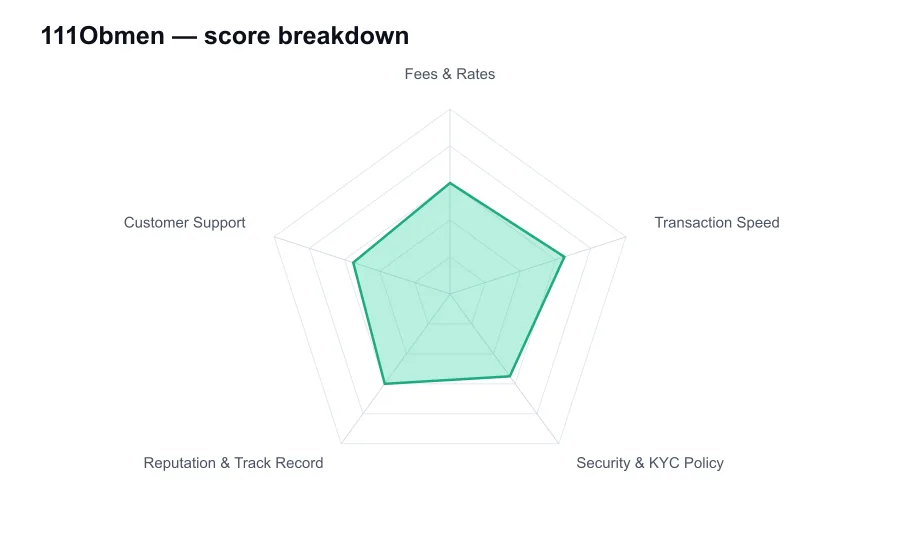
111Obmen scores 5.9/10 overall in our independent review, measured against every other provider we've compared, strongest on Transaction Speed (6.5/10) and weakest on Customer Support (5.5/10).
5.9/10 ★★★★★ How we score → Visit official siteEditorial independence: our scores and rankings are produced using the fixed criteria above and are not influenced by advertisers. This is an independent ranking site and is not operated by, or affiliated with, any provider we list.
Affiliate disclosure: some links on this page may earn us a commission at no extra cost to you. This does not affect our rankings.
| Best for | Not for |
|---|---|
| Supports regional exchanger-style payment routes | Rates can include meaningful spreads |
| Can be practical for local fiat payouts | Fiat payout timing is not always predictable |
Criteria & Scores
| Criterion | Score | Note |
|---|---|---|
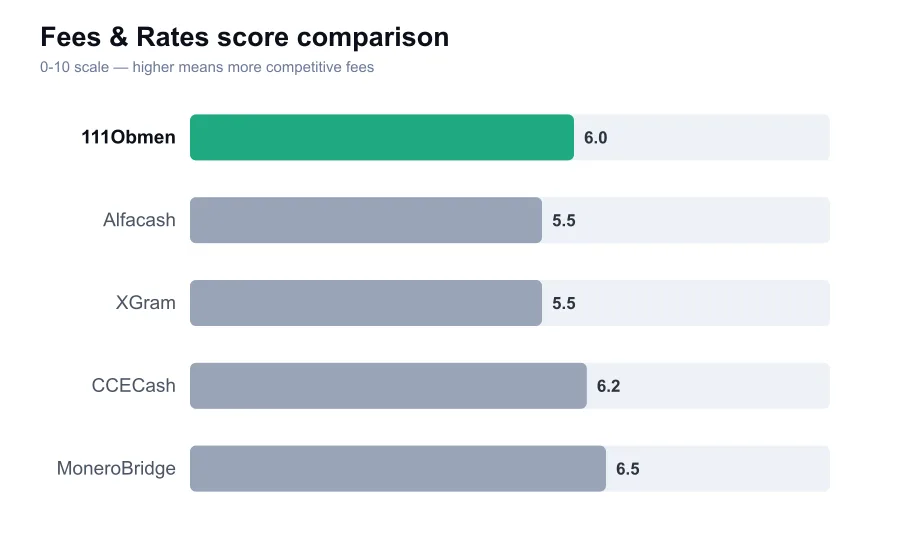
| Fees & Rates | 6.0 | Useful payment routes, but spreads vary by direction. |
| Transaction Speed | 6.5 | Fast routes depend on reserves and bank processing. |
| Security & KYC Policy | 5.5 | Check KYC, refund rules, and payment details carefully. |
| Reputation & Track Record | 6.0 | Regional exchanger profile, not institutional-grade assurance. |
| Customer Support | 5.5 | Order-specific help matters more than general chat availability. |
In-Depth Review
111Obmen is a regional-style online exchanger, a category that operates very differently from a polished global crypto exchange. These services often focus on practical conversion routes between cryptocurrency, bank cards, electronic payment systems, and local fiat methods. That can make them genuinely useful for customers whose banking options are poorly served by major platforms. It also means the buyer has to pay closer attention to reserve levels, payout rules, and the exact direction of exchange.
The service is more comparable to a BestChange-listed exchanger than to Kraken or Coinbase. You select a giving currency and receiving currency, enter the amount and payment details, then complete the transfer according to the order instructions. The experience can be fast and direct, but it lacks the investor protections, formal market infrastructure, and extensive compliance material that users expect from regulated multinational exchanges.
111Obmen's value usually lies in access rather than in headline pricing. A customer may find routes that are difficult to obtain on a large platform, especially for regional payment methods or smaller electronic-money systems. That does not automatically make the rate attractive. Exchange rates in this market can include a substantial spread, and the displayed amount may depend on reserve availability, payment method, and whether the order is completed within a short time window.
Look at the net amount, not the percentage you hope you are paying. A bank-card purchase, a cash-out route, and a crypto-to-crypto conversion each carry different operational costs. Card-related directions can be particularly expensive because payment risk and processing costs are high. If you are moving USDT to a bank card, compare the final fiat payout with at least one regulated exchange withdrawal route and another exchanger quote before creating the order.
The service's rate can also change if you choose a floating conversion. Fixed-rate orders may provide more certainty but may include a wider buffer for market movement. That is a reasonable tradeoff if you need a known payout, but it should be explicit. Never assume the rate shown on an aggregator is the amount you will receive without reading the exchanger's current rules, minimums, and order deadline.
For speed, 111Obmen can be efficient where the exchange direction is straightforward and funds are available in reserve. Crypto transfers still have to confirm on-chain, and fiat payouts can be constrained by bank processing hours or card-provider controls. A rapid USDT transfer does not guarantee that the card payout will be immediate. Weekend and holiday handling matters a great deal for this sort of service.
The practical transaction time is often determined by the slowest leg. A Bitcoin deposit may require confirmations. A card payment might be checked manually. A bank transfer can sit in a pending state even after the exchanger says it has sent the funds. Users should not use a service like 111Obmen for rent, payroll, a liquidation deadline, or any payment where a delay of several hours would cause damage.
Security deserves a more skeptical reading than the site's exchange form might encourage. The customer is normally asked to provide payment details and send funds to the order destination, so the operation depends on carefully matching the displayed details and retaining proof of payment. Phishing is a real concern with recognizable exchanger names. Use a bookmarked address, inspect the domain carefully, and do not rely on payment instructions sent in an unsolicited message.
KYC is another point that needs realism. Some regional exchangers advertise quick exchanges and limited registration, but that does not create a guarantee of anonymity. Transactions can be reviewed under anti-money-laundering procedures, particularly if the amount, source wallet, or card activity looks unusual. A responsible user should read the verification and refund rules before paying, because a frozen order becomes much more painful if the identity requirements were unclear at the start.
111Obmen's reputation benefits from being part of an established ecosystem of regional exchange monitoring and customer feedback, provided users independently confirm the current listing and domain. That is useful evidence, not a blank cheque. Review pages can tell you whether orders are being completed, but they do not replace the legal safeguards and audited controls of a major licensed exchange. Pay attention to recent complaints and the way the operator responds to them.
I would give the service more credit for practical market fit than for institutional credibility. It appears aimed at people who already understand payment directions, wallet networks, and the risks of sending funds to an exchanger. A beginner can use it, but only if they are methodical. Someone who needs to call a support desk, reverse a mistake, or obtain formal transaction documentation may find the model frustrating.
Support is likely most important when an order is incomplete, and that is where regional exchangers live or die. Chat or ticket access can be helpful, but the quality test is whether the team identifies an order quickly and gives a specific answer instead of a generic queue message. Before paying, confirm that the order page includes an identifiable order number and that the support contact details are current.
The right way to use 111Obmen is to start with a modest transfer and choose a very familiar network. Do not mix a first-time exchange with a new wallet, a large amount, or a complex payment method. Check the recipient details character by character, especially on USDT where sending through the wrong network can create a costly recovery problem.
111Obmen can fill a real gap for users needing regional exchange directions that global exchanges do not cover well. Its practical usefulness is stronger than its transparency. That is not a reason to dismiss it, but it is a reason to set firm limits. If the rate is competitive, the reserve is available, and the transaction is modest, it can be a sensible tool. If any of those conditions are missing, choose a more established route.
My take is that 111Obmen is for experienced users who understand exchangers, not for people seeking a full-service crypto platform. It may be exactly the right answer for a specific local payout route. It is not where I would store funds, make a large first transaction, or expect the protections of a regulated broker. Use it deliberately, not casually.
Pros & Cons
| Pros | Cons |
|---|
Verdict
Frequently Asked Questions
Does 111Obmen always pay out instantly?
No. Crypto confirmations, reserve availability, manual checks, and bank or card processing can all extend an order.
How should I compare 111Obmen's fees?
Compare the final amount you receive against live quotes from other exchangers and regulated platforms for the same payment method.
Can identity verification be requested?
It can be. Read the current verification and refund terms before sending funds, especially for larger or unusual transactions.