FixedFloat
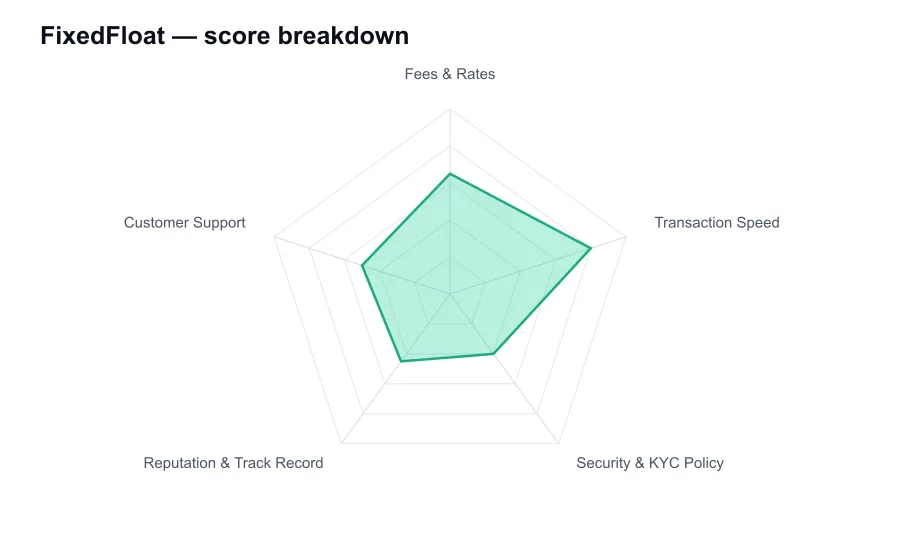
FixedFloat scores 5.6/10 overall in our independent review, measured against every other provider we've compared, strongest on Transaction Speed (8.0/10) and weakest on Security & KYC Policy (4.0/10).
5.6/10 ★★★★★ How we score → Status: active (checked 2026-10-13T19:25:12.476Z) Visit official siteEditorial independence: our scores and rankings are produced using the fixed criteria above and are not influenced by advertisers. This is an independent ranking site and is not operated by, or affiliated with, any provider we list.
Affiliate disclosure: some links on this page may earn us a commission at no extra cost to you. This does not affect our rankings.
| Best for | Not for |
|---|---|
| No routine account registration for swaps | Linked to a roughly $26 million 2024 hack |
| Fixed and floating-rate quote options | 0.5% to 1% service fee is high for regular trading |
What is FixedFloat?
How FixedFloat Works
- Choose the asset pair and enter the amount
- Pick a floating-rate or fixed-rate quote
- Enter your receiving wallet address
- Send the exact deposit amount to the generated address
- Wait for blockchain confirmations and receive the output
Criteria & Scores
| Criterion | Score | Note |
|---|---|---|
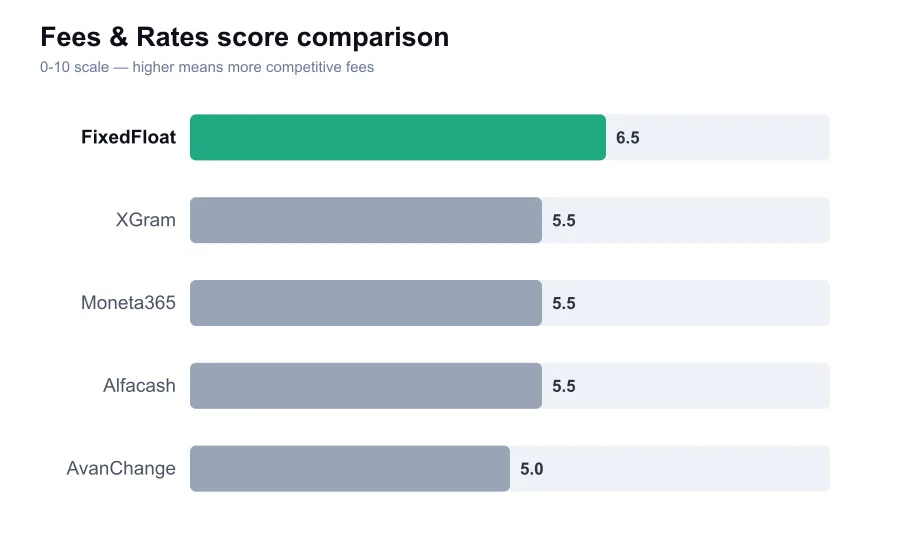
| Fees & Rates | 6.5 | 0.5% floating or 1% fixed service fee, plus network fees |
| Transaction Speed | 8.0 | Automated swaps can finish in minutes after confirmations |
| Security & KYC Policy | 4.0 | Non-custodial flow, but a major 2024 hack weighs heavily |
| Reputation & Track Record | 4.5 | Known service, but trust was damaged by the 2024 incident |
| Customer Support | 5.0 | Automation is strong, difficult cases can be slow |
KYC
| Requirement | optional |
|---|---|
| Notes | Routine swaps have historically not required account registration or standard KYC. The provider may still request information or review transactions flagged by compliance controls. |
Supported Assets
Transaction Limits
| Notes | Minimum and maximum amounts vary by pair, available liquidity, network fee conditions, and the quote shown before payment. |
|---|
How to Use FixedFloat Safely
- Test an unfamiliar pair with a small amount first
- Compare the final received amount with another provider
- Use the exact network shown on the exchange page
- Save the deposit transaction hash and exchange ID
- Do not use it for funds you cannot afford to have delayed
In-Depth Review
FixedFloat is a non-custodial instant crypto exchange that is built for one thing, swapping one asset for another without opening a conventional exchange account. You choose a pair, receive a deposit address, send the coins, and receive the output to your own wallet. It has long appealed to users who value speed, no routine identity check, and a stripped-down interface.
The service is not a traditional exchange despite the name. There is no visible order book, no fiat balance, no margin account, and no place to park a portfolio. FixedFloat acts as a swap intermediary, sourcing conversion liquidity and settling the output transaction. That makes it convenient, but it also means you must judge the quoted rate, network conditions, and the platform's operational trustworthiness in a matter of minutes.
Its defining feature is the choice between a floating rate and a fixed rate. The floating option has historically carried a 0.5 percent service fee, while the fixed-rate option has historically charged 1 percent. Network fees are added separately. The fixed option is useful in volatile markets because it protects the quoted exchange rate during the swap window, though it costs more and still depends on you sending the exact required amount on time.
A 0.5 percent headline fee is not cheap compared with trading on a liquid centralized exchange. Binance, Kraken Pro, and Coinbase Advanced can be far cheaper for users who are willing to create an account, complete checks where required, and trade through an order book. FixedFloat competes on convenience. For an occasional wallet-to-wallet swap, that convenience can be worth the premium. For frequent trading, it becomes an expensive habit.
The quote also needs close attention. The service fee is just one component of the transaction. The spread between the reference market price and the rate you receive can matter, especially in thin pairs or fast conditions. Bitcoin and Ethereum network fees can also change sharply. Always compare the final amount you will receive with at least one alternative, such as ChangeNOW, SimpleSwap, a decentralized exchange, or an exchange withdrawal route.
Speed is usually excellent when the source chain is moving normally. Many swaps are processed automatically after the required deposit confirmations arrive, and popular asset pairs can complete in minutes. But no instant exchange can make Bitcoin confirmations, Ethereum congestion, wallet broadcast delays, or blockchain reorg risk disappear. The word instant describes the conversion workflow, not a guarantee that every transaction settles immediately.
FixedFloat is particularly suited to users who understand confirmation requirements. A Bitcoin payment may take longer than a Litecoin or Tron transfer. An Ethereum token swap can be held up by gas conditions. Sending a token through the wrong network can turn a quick exchange into a manual support case, and manual support is exactly where anonymous instant exchangers are least reassuring.
The security story is mixed. On the positive side, FixedFloat is non-custodial in the ordinary sense that it does not ask users to maintain a long-term account balance. Funds are sent for a specific swap and then forwarded. That is materially safer than leaving assets on a lightly regulated exchange for months. It does not mean the service is trustless. During the exchange, the provider controls the operational process and users take counterparty risk.
That risk became impossible to ignore in February 2024, when blockchain investigators linked suspicious outflows of roughly $26 million in Bitcoin and Ether to FixedFloat wallets. The service later acknowledged a hack and said it had suffered technical problems. This was a serious incident, not minor downtime. Any review that waves it away because the platform is non-custodial is not taking customer risk seriously.
The practical result is that I would not send a large, time-sensitive amount through FixedFloat unless I had tested the exact pair and had a clear backup plan. The platform may still work well for modest swaps, but its hack history demands a lower trust score than its formerly smooth interface might suggest. Avoid sending funds from an exchange account if you cannot tolerate a compliance inquiry or a delayed destination transaction.
FixedFloat has historically operated without mandatory account registration or standard KYC for ordinary swaps. That privacy is the point for many users. It should not be confused with immunity from compliance controls. Like other instant exchanges, it can request information, halt processing, or review a transaction if its risk systems flag an address or activity. A no-KYC marketing message is not a contractual promise that a transfer can never be questioned.
Reputation is therefore complicated. Before the 2024 compromise, FixedFloat had built substantial recognition among privacy-minded swap users and was often praised for speed. The hack changed the calculation. A provider can recover operationally, but it cannot erase the fact that users now have to account for a major security event and the uncertain burden placed on its incident response systems.
Support is another weak point. The platform's automated flow is excellent when everything proceeds normally, but user reports over the years have shown that difficult cases can be frustrating, particularly around delayed exchanges and compliance reviews. There is no reassuring phone desk or extensive regulated-entity structure behind the service. Keep all transaction IDs, screenshots, deposit hashes, and destination addresses until the swap is fully complete.
FixedFloat remains useful, but it is no longer a service I would recommend casually. Its fixed-rate option is genuinely practical, its interface is simple, and routine swaps can be fast. The 2024 hack and the inherent opacity of no-account instant exchanges put hard limits on that praise. Use it for a small, deliberate swap if its final quote is compelling. For large transfers or money you cannot afford to have delayed, choose a more accountable route.
Pros & Cons
| Pros | Cons |
|---|
Verdict
Frequently Asked Questions
What does FixedFloat charge?
FixedFloat has historically listed a 0.5% fee for floating-rate exchanges and 1% for fixed-rate exchanges. Blockchain network fees are separate and can materially affect the final quote.
Does FixedFloat require KYC?
Routine swaps have historically been available without standard KYC or account registration. The service can still review or request information for transactions flagged by its risk controls.
What happened to FixedFloat in 2024?
In February 2024, blockchain investigators identified suspicious outflows of roughly $26 million in Bitcoin and Ether linked to FixedFloat wallets. The company later said it had been hacked.
Is a fixed-rate swap guaranteed regardless of market movement?
It protects the quoted conversion rate during the stated exchange conditions, but you must send the required amount to the correct address before the quote window or transaction rules expire.
Why can a FixedFloat swap take longer than expected?
The provider must wait for required blockchain confirmations. Bitcoin confirmation times, Ethereum congestion, low sender fees, and wrong-network deposits can all delay processing.
Should I send a large amount through FixedFloat?
It is not a prudent choice for a large or irreplaceable transfer. The February 2024 hack and the limited escalation options justify testing any route with a small transaction first.