WmMoney
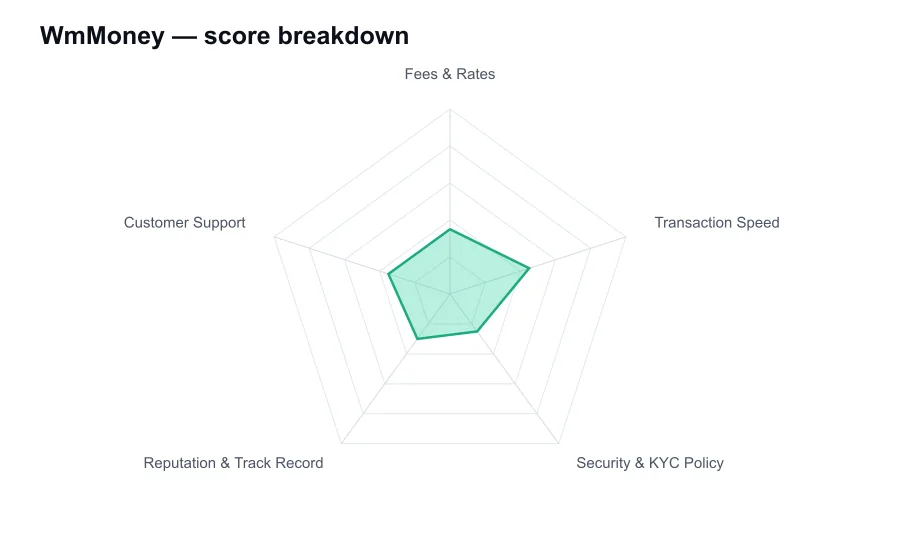
WmMoney scores 3.4/10 overall in our independent review, measured against every other provider we've compared, strongest on Transaction Speed (4.5/10) and weakest on Security & KYC Policy (2.5/10).
3.4/10 ★★★★★ How we score → Status: active (checked 2026-10-13T19:37:19.955Z) Visit official siteEditorial independence: our scores and rankings are produced using the fixed criteria above and are not influenced by advertisers. This is an independent ranking site and is not operated by, or affiliated with, any provider we list.
Affiliate disclosure: some links on this page may earn us a commission at no extra cost to you. This does not affect our rankings.
| Best for | Not for |
|---|---|
| Potential shortcut between payment systems | Fee components are not readily transparent |
| Useful for small, familiar exchange routes | Limited independently verified security information |
What is WmMoney?
How WmMoney Works
- Select the source and destination payment routes
- Enter the exchange amount
- Review the final receive amount and order rules
- Submit recipient details
- Pay using the provided instructions
- Confirm receipt and withdraw funds where applicable
Criteria & Scores
| Criterion | Score | Note |
|---|---|---|
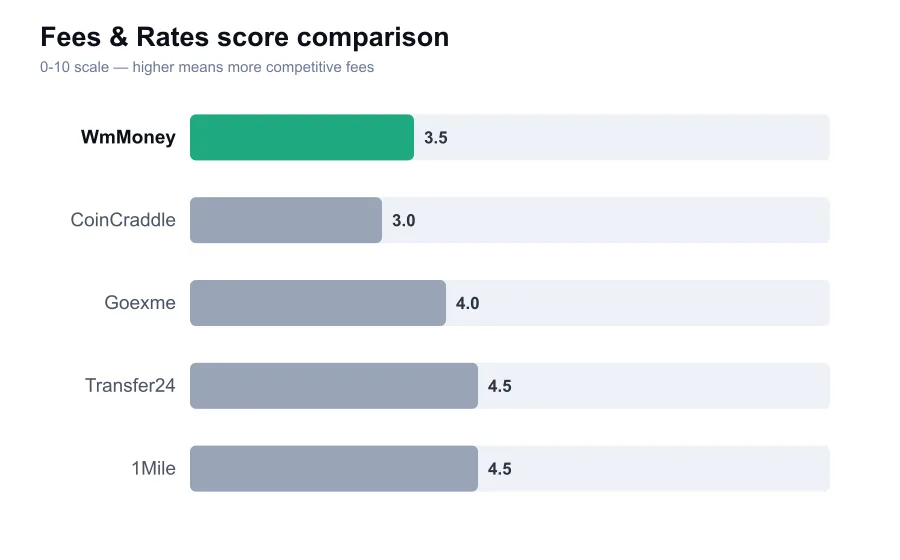
| Fees & Rates | 3.5 | Final exchange spread and payment costs need close checking. |
| Transaction Speed | 4.5 | Routine electronic-money routes may be quick. |
| Security & KYC Policy | 2.5 | No independently verified public security controls. |
| Reputation & Track Record | 3.0 | Brand history is difficult to verify independently. |
| Customer Support | 3.5 | Exception handling is the key service test. |
| Fact | Value | Source |
|---|---|---|
| Entity class | E-money exchanger | - |
| Exchange method | Direct conversion | - |
| Pricing visibility | Final rate needs verification | - |
| Recommended use | Small one-off conversions | - |
| Custody recommendation | Do not store balances | - |
KYC
| Requirement | tiered |
|---|---|
| Notes | Payment ownership, source-of-funds, or identity information can be requested for flagged transfers. Confirm refund and review terms before payment. |
How to Use WmMoney Safely
- Verify the actual counterparty before payment
- Check sender-name rules before placing an order
- Use a small test amount first
- Keep receipts and screenshots of all order terms
- Ignore support requests sent through unofficial accounts
In-Depth Review
WmMoney sits in the older e-money exchanger category, a part of the market built around moving funds between payment systems and, in some cases, cryptocurrency. These services can be useful where mainstream exchanges do not support a particular local payment route. They are also difficult to review because the quality gap between operators is enormous. A clean-looking exchange form proves very little.
The name itself suggests a connection to WebMoney-style exchange activity, but a customer should never infer official affiliation from branding alone. Confirm the exact payment method, account ownership requirements, and recipient details shown on the order page. Financial services that rely on similar names and familiar payment brands can create false confidence. The actual contractual counterparty is what matters.
WmMoney's biggest attraction is likely practical rather than technical. It can offer a route between balances that may otherwise require several steps, multiple accounts, and separate verification checks. For users who know the relevant payment systems, that can save time. For new users, the same shortcut can hide important costs and compliance risks.
I could not independently verify a stable public schedule that separates WmMoney's service charge from the exchange spread and third-party payment costs. That limitation is central to the fee score. The right comparison is never the displayed rate alone. You need the exact sent amount, the exact received amount, and any blockchain or payment-system deductions that appear later.
This kind of exchanger may look cheap when the base rate is close to market, yet become expensive after the payment provider's own charges. That is particularly true for routes involving electronic money systems, card funding, or small crypto withdrawals. Small orders are often hit hardest because fixed costs take up a larger share. WmMoney should therefore be judged on the final payout, not marketing language about low commissions.
Speed can be respectable on mature electronic-money rails. A conversion may be completed quickly if the incoming transfer is recognized automatically and the outgoing balance is immediately available. The difficult part is exception handling. Incorrect payment comments, mismatched names, duplicate transfers, or a blockchain deposit from the wrong network can turn a quick order into a manual case.
I would not rely on WmMoney for a deadline-sensitive payment unless its support team confirms the process in writing beforehand. There is a big difference between an exchange that normally completes in minutes and one that commits to handling exceptions quickly. If you are sending money for a property deposit, merchant invoice, or time-limited crypto purchase, use a provider with an explicit service agreement instead.
The security picture is incomplete. I could not verify public evidence of independent security audits, proof of reserves, formal wallet controls, or a detailed incident history. That does not mean WmMoney has suffered a particular failure. It means a reviewer cannot give it credit for controls that are not clearly documented. In a custodial exchange flow, the lack of visible controls deserves a discount.
The sensible defense is to minimize exposure. Fund only the amount required, double-check every account identifier, and do not use the exchanger as a storage location. If the service offers any account password or confirmation feature, use it, but do not assume account-level protection removes counterparty risk. The fastest way to lose money on this type of service is usually a wrong payment destination or a fraudulent support impersonator.
WmMoney's reputation is constrained by the same disclosure issue. A service can accumulate years of quiet operation without becoming easy to verify, especially in e-money exchange circles. I would put little trust in anonymous rating snippets. Better evidence is a history of detailed reports across independent monitoring sites, including how the operator handled disputed or delayed payments.
Support matters more here than at a major exchange because the flow can involve two payment systems and a crypto network at once. A good operator needs to explain which side is waiting, what proof is needed, and whether a refund is possible. Generic replies such as "wait for processing" are not good enough if a transfer is already confirmed. That is why WmMoney earns only a modest support score.
There is also a compliance issue that users often ignore. A payment provider may reverse, suspend, or review a transfer even after an exchange order has been created. The exchanger may then hold the payout until it can confirm the funds are final. Read the order rules carefully, particularly the conditions for refunds and the handling of payments made by someone other than the listed customer.
For a knowledgeable user exchanging a modest amount on a familiar route, WmMoney may be workable after a small trial. It is a poor fit for anyone who needs institutional-grade reporting, predictable dispute escalation, or a transparent pricing framework. The more important the money is, the less appealing this model becomes.
My take is that WmMoney belongs in the utility category, not the trust category. It may solve an awkward payment-route problem, and that has value. Still, the lack of readily verifiable fee, security, and corporate information leaves too many unanswered questions for a strong recommendation. Use it cautiously, preserve records, and keep better documented alternatives available.
Pros & Cons
| Pros | Cons |
|---|
Verdict
Frequently Asked Questions
Is WmMoney an official WebMoney service?
Do not assume official affiliation from the name. Confirm the actual counterparty and the payment method shown on the order page before sending funds.
Why can a WmMoney order cost more than the displayed rate suggests?
The final cost can include the exchange spread, payment-system charges, and blockchain fees. Compare the exact amount received rather than only the headline rate.
What happens if the sender name differs from the order details?
That can trigger a manual review or refund procedure with this type of exchanger. Ask support about third-party payment rules before creating the order.
Can I use WmMoney for a deadline-sensitive payment?
It is not a strong choice for urgent transfers. Routine orders may be quick, but a payment mismatch or review can turn the order into a manual case.
Should I leave an electronic-money or crypto balance there?
No. Use the service for a single conversion and move the received funds to an account or wallet you control.