CoinCraddle
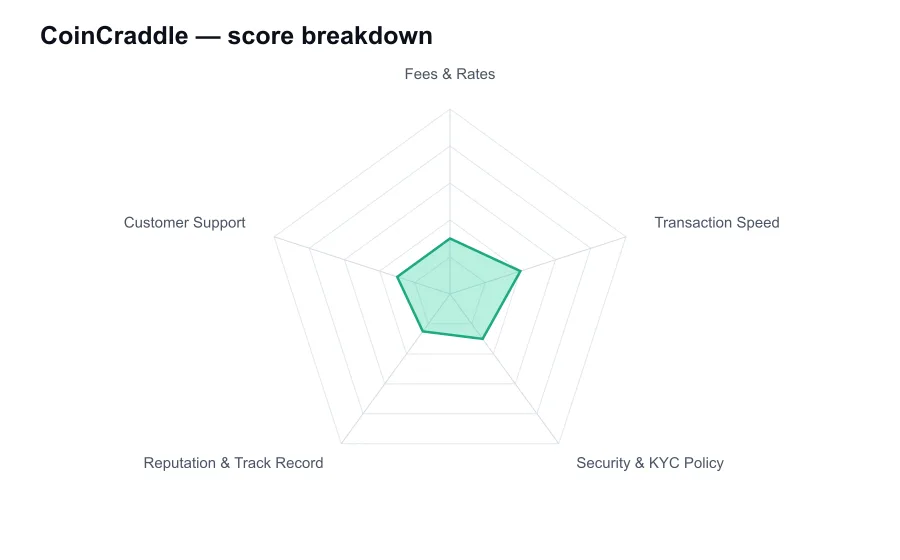
CoinCraddle scores 3.1/10 overall in our independent review, measured against every other provider we've compared, strongest on Transaction Speed (4.0/10) and weakest on Reputation & Track Record (2.5/10).
3.1/10 ★★★★★ How we score → Status: active (checked 2026-10-13T19:25:12.545Z) Visit official siteEditorial independence: our scores and rankings are produced using the fixed criteria above and are not influenced by advertisers. This is an independent ranking site and is not operated by, or affiliated with, any provider we list.
Affiliate disclosure: some links on this page may earn us a commission at no extra cost to you. This does not affect our rankings.
| Best for | Not for |
|---|---|
| May offer a simple swap-style workflow | Limited independently verifiable operating record |
| Could be tested with a very small transaction | Fee and policy transparency is insufficient |
What is CoinCraddle?
How CoinCraddle Works
- Confirm the provider's current terms and supported network
- Enter the asset pair and inspect the complete output quote
- Use a small test amount only
- Send funds to the stated deposit address on the exact network
- Keep transaction hashes and screenshots until settlement
Criteria & Scores
| Criterion | Score | Note |
|---|---|---|
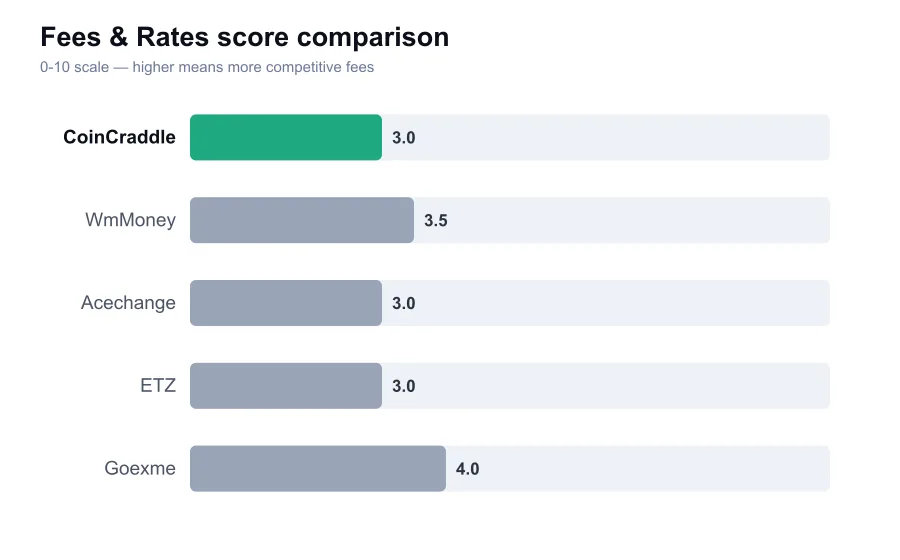
| Fees & Rates | 3.0 | Public pricing transparency is too limited to rate highly |
| Transaction Speed | 4.0 | No strong independent record of reliable settlement |
| Security & KYC Policy | 3.0 | Custody, controls, and incident history are not well verified |
| Reputation & Track Record | 2.5 | Limited independently verifiable public track record |
| Customer Support | 3.0 | Escalation quality is difficult to verify before use |
| Fact | Value | Source |
|---|---|---|
| Public track record | Limited independently verifiable evidence | - |
| Fee transparency | Insufficiently clear for a high rating | - |
| Recommended first transfer | Very small test amount only | - |
| Large transfer use | Not recommended | - |
| Reviewer risk view | High due to limited public verification | - |
KYC
| Requirement | optional |
|---|---|
| Notes | The provider's public KYC and hold procedures are not sufficiently clear to rely on a no-verification assumption. A transaction may still be subject to compliance review. |
How to Use CoinCraddle Safely
- Do not use CoinCraddle for meaningful or urgent funds
- Test with the smallest practical amount first
- Verify the domain and network before every transfer
- Save quotes, addresses, timestamps, and transaction hashes
- Use a better-known alternative if a transfer delay would harm you
- Never send crypto because of an unsolicited recommendation
In-Depth Review
CoinCraddle is one of those crypto exchange names that demands more caution than enthusiasm. Public, independently verifiable information about the provider is limited, and that is not a minor inconvenience in a business that asks people to send irreversible digital assets. A polished website, an attractive rate, and a chat widget are not a substitute for a clear operating identity.
I cannot place CoinCraddle in the same trust category as established exchanges such as Kraken, Coinbase, Bitstamp, or even long-running instant-swap providers with visible operational histories. Those companies have their own faults, but they leave a substantial public trail. CoinCraddle's limited footprint makes basic due diligence harder, including confirming ownership, customer protections, licensing claims, and the terms that apply if a transaction is delayed.
The service appears to present itself as a crypto exchange or swap option rather than a conventional full-service exchange with transparent order books. That distinction should shape expectations. If you send a coin to an instant exchange, you are relying on the operator to honor the quote and return the output. You are not simply matching with another trader through a visible market.
Fees are impossible to score generously where they are not clearly and consistently published. A platform may say it has low fees while embedding its revenue in the exchange rate. This is common across instant swaps, but a smaller provider has a higher burden to show the customer exactly what they are paying. If the final amount received is not clear before you deposit, stop there.
A reliable fee comparison needs more than a percentage. It needs the source amount, destination amount, network fee, service fee if any, and quote-expiry conditions. CoinCraddle should be able to give a user that information before funds are sent. If it cannot, or if the displayed result changes in a way that is not explained by market movement and blockchain fees, the service has failed a basic transparency test.
Speed claims deserve the same skepticism. Any crypto swap can look fast in ideal conditions. The user sends a popular asset on an uncongested chain, the deposit confirms, liquidity is available, and the payout wallet receives its transaction. Problems appear during volatility, when a deposit arrives late, when a network is congested, or when a compliance system pauses a transfer. A provider with little public history has not earned the benefit of the doubt on those edge cases.
The technical basics are non-negotiable. Users need to know which networks are supported, whether a token deposit address is chain-specific, how many confirmations are required, and what happens if they send the wrong asset. A company can make a mistake once. A customer cannot reverse a mistaken blockchain transfer. Clear transaction instructions are therefore part of security, not merely interface design.
CoinCraddle's security profile is difficult to assess because there is not enough independently verifiable information about its custody arrangements, corporate controls, incident history, or compliance process. That uncertainty is itself a risk factor. Lack of a known breach is not evidence of strong security, especially for a small service with little public reporting.
The KYC position also needs to be explicit. If CoinCraddle markets privacy or fast swaps, users should still assume that suspicious, high-value, or sanctioned-address exposure could trigger questions or a hold. A provider that does not publish a clear policy creates a nasty trap. Customers may believe they are using a frictionless service, then discover after depositing that the operator wants documents before releasing funds.
This is where established competitors have an advantage. They may require more information up front, but their terms, legal entities, help centers, and support procedures are easier to inspect. A user may dislike KYC, yet certainty is often preferable to discovering an undocumented review process after an irreversible deposit has already been made.
Reputation is CoinCraddle's weakest category. I found no broad, durable public record that would justify high confidence. That does not prove the provider is fraudulent or incapable of completing a swap. It does mean there is insufficient evidence to recommend it for meaningful amounts. In crypto, the absence of a serious reputation is not neutral. It shifts the risk onto the customer.
Customer support has the same problem. A provider can promise 24-hour support, but the relevant question is whether it resolves a wrong-network deposit, a missing payout, or a compliance hold with traceable answers. Small services often perform fine until a transaction breaks. With CoinCraddle, I would not assume there is a robust escalation process unless the company demonstrates it before money is sent.
If you are determined to test CoinCraddle, use a tiny amount that you can afford to lose, select a common asset on a clearly identified network, and record every screen before payment. Do not make it your first destination for funds from a hardware wallet, a business treasury, or an exchange withdrawal that cannot be recalled. Never send an amount based solely on a promotional rate or an unsolicited recommendation.
My verdict is blunt. CoinCraddle has not provided enough public evidence to earn trust ahead of better-known alternatives. The service may complete routine transactions, but prospective users should not confuse possibility with reliability. Until it develops a more transparent operating record, publishes clear policies, and builds independent reputation over time, the rational choice is to use a provider with more accountability. There are too many established routes for moving crypto to justify taking unexplained counterparty risk here.
Pros & Cons
| Pros | Cons |
|---|
Verdict
Frequently Asked Questions
Is CoinCraddle a well-established crypto exchange?
It does not have a broad, independently verifiable public track record comparable to major exchanges or long-running swap providers. That is a significant risk factor for users.
Are CoinCraddle fees clearly published?
Public fee transparency is limited. Before sending funds, users should confirm the exact source amount, expected output, network charge, any service fee, and quote conditions.
Should I use CoinCraddle for a large crypto swap?
No. The provider's limited verifiable reputation and unclear operational record make it unsuitable for substantial, urgent, or irreplaceable transfers.
What is the safest way to test CoinCraddle?
Use a very small amount of a common asset, choose the exact supported network carefully, save all transaction hashes and screenshots, and wait for full settlement before sending more.
Can a no-KYC swap service still hold a transaction?
Yes. Even services that advertise simple swaps can pause a transaction for compliance or risk checks. Users should never assume that a deposit cannot be reviewed or delayed.
What details should be checked before sending crypto to a swap service?
Check the exact network, deposit address, minimum amount, expected output, confirmation requirement, quote expiry, refund policy, and support contact before broadcasting.