1WM
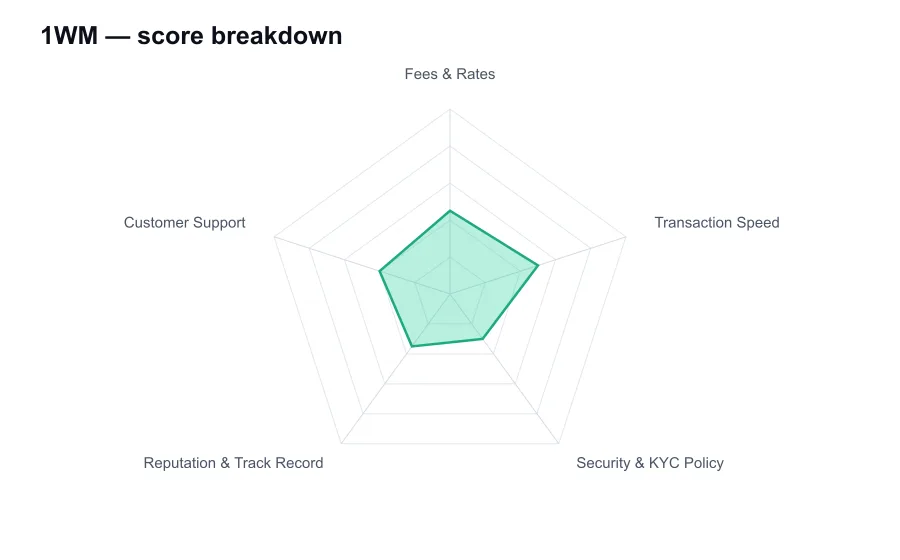
1WM scores 4.0/10 overall in our independent review, measured against every other provider we've compared, strongest on Transaction Speed (5.0/10) and weakest on Security & KYC Policy (3.0/10).
4.0/10 ★★★★★ How we score → Status: active (checked 2026-10-13T19:37:17.939Z) Visit official siteEditorial independence: our scores and rankings are produced using the fixed criteria above and are not influenced by advertisers. This is an independent ranking site and is not operated by, or affiliated with, any provider we list.
Affiliate disclosure: some links on this page may earn us a commission at no extra cost to you. This does not affect our rankings.
| Best for | Not for |
|---|---|
| Direct exchange-oriented service model | Limited verifiable public documentation |
| May suit small e-money to crypto conversions | No independently confirmed fee schedule |
What is 1WM?
How 1WM Works
- Choose the payment and payout direction
- Enter the amount and review the quoted receive amount
- Provide the destination wallet or payment details
- Send funds using the stated payment instructions
- Wait for confirmation and payout
- Move received crypto to a self-controlled wallet
Criteria & Scores
| Criterion | Score | Note |
|---|---|---|
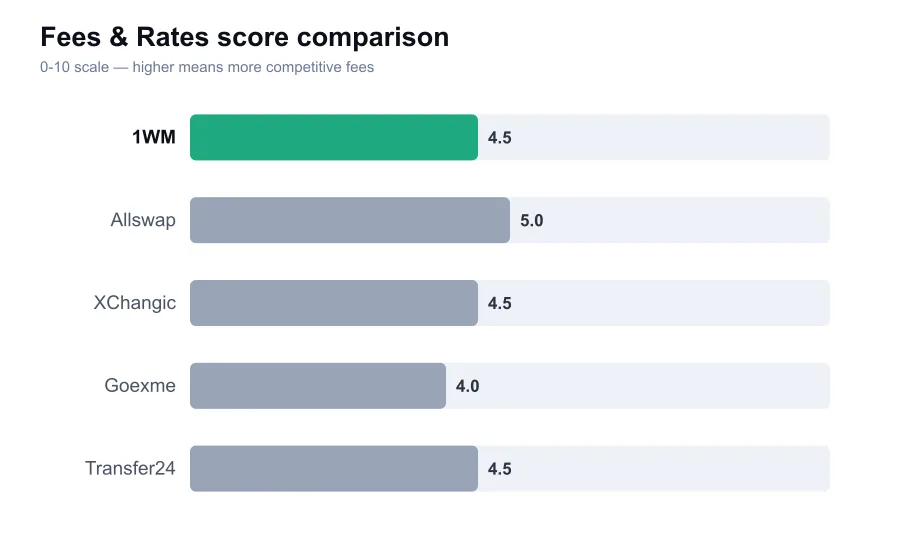
| Fees & Rates | 4.5 | Effective spread is harder to verify than a posted fee. |
| Transaction Speed | 5.0 | Simple orders may be quick, manual reviews can delay them. |
| Security & KYC Policy | 3.0 | Limited independently verifiable security documentation. |
| Reputation & Track Record | 3.5 | Public track record is difficult to assess with confidence. |
| Customer Support | 4.0 | Test support before trusting a meaningful transfer. |
| Fact | Value | Source |
|---|---|---|
| Entity class | E-money exchanger | - |
| Transaction model | Direct conversion quote | - |
| Recommended custody use | Transaction-only | - |
| Public fee schedule | Not independently verified | - |
| KYC policy | Verify before payment | - |
KYC
| Requirement | tiered |
|---|---|
| Notes | Identity or payment-ownership checks may be requested depending on the order and payment route. Confirm the rule before sending funds. |
How to Use 1WM Safely
- Start with a small test order
- Compare the final received amount with alternatives
- Save the quote, order number, and payment receipt
- Use a wallet address you control
- Do not leave funds with the exchanger after completion
In-Depth Review
1WM appears to operate in the e-money and cryptocurrency exchange segment rather than as a conventional custodial exchange with an order book. That distinction matters. A visitor is usually looking for a direct conversion between payment systems, electronic money balances, and digital assets, not a place to trade spot markets all day. It occupies a niche that can be useful, but it is also a niche where disclosure standards are often poor.
The first problem with assessing 1WM is the thin public record. I could not independently confirm a clearly documented corporate identity, licensing position, audited reserves policy, or a consistently maintained public fee schedule. That does not automatically make a service unsafe, but it does put the burden on the customer to verify every detail before sending money. For a financial intermediary, that is not a small concern.
Its appeal is straightforward: these services can be quicker and less intimidating than opening an account at a large exchange. You choose a direction, submit the requested amount, send funds, and receive the converted balance or cryptocurrency. For someone moving a modest WebMoney, bank, card, or crypto balance, that can feel refreshingly direct. The trade-off is that the convenience is often purchased with weaker transparency.
Fees are the hardest category to score fairly here because a listed rate is not always the actual cost. An exchange quote can include the platform's spread, payment processor cost, network fee, and a margin for price movement. A customer who compares only the displayed amount against the nominal market price can underestimate what they are paying. In this segment, the effective rate is usually more important than a headline commission.
I would not use 1WM for a large transfer unless the final received amount has been checked against at least two alternatives. Compare the quote with a major exchange, a reputable peer-to-peer desk, and another established e-money exchanger. If 1WM's rate is materially worse, speed alone is not enough to justify it. A small premium for convenience is normal. An opaque premium is not.
Transaction speed depends heavily on the payment rail. Crypto deposits can be processed after the required blockchain confirmations, while electronic money transfers may be faster if both sides are automated. The weak point is manual review. An order can look instant until the operator asks for clarification, a proof of payment, or an identity document. The service should state that possibility before payment, not after funds have been sent.
The absence of clearly verifiable service-level commitments makes speed a middling score rather than a strong one. A provider can complete an uncomplicated order quickly and still be a poor choice for urgent transfers if it offers no reliable escalation path when something breaks. Fast routine execution and dependable problem handling are different things. Too many small exchangers blur that line.
Security is where 1WM raises the most questions. I could not verify a public explanation of custody arrangements, wallet security, account protection features, or an incident disclosure record. Customers should assume that funds are exposed to the normal risks of a custodial exchange flow until the conversion is complete. That means sending only the amount necessary for the order, never treating the service as a wallet, and avoiding pre-funding balances.
Its KYC position should also be confirmed before creating an order. Some exchange services advertise a light-touch flow but reserve the right to request identification, proof of source of funds, or payment ownership evidence if an order is flagged. That is common in financial services, yet it becomes contentious when the policy is vague. A customer needs to know whether refusal to provide documents means cancellation, delay, or a returned payment.
Reputation is limited by the lack of a large, independently verifiable track record. I would give more weight to recent, detailed user reports that describe the full order path, including a problem case, than to short five-star comments. Reviews saying "fast" or "good service" tell you very little. Look for evidence that support resolved a wrong memo, a delayed confirmation, or an address issue without disappearing.
Customer support is another area where a small operator can either distinguish itself or fail badly. A visible contact channel is helpful, but a support score should reflect response quality, not the existence of a chat button. Before using 1WM for a meaningful amount, send a specific pre-sale question about the payment method, expected completion time, and what happens if the sender's name differs from the account holder's name. The reply will tell you a lot.
I would approach any first order as a test. Use a small amount, preserve screenshots of the quoted terms, save the order number, and ensure the destination wallet is under your control. If the service handles that test cleanly, you have learned something useful. If it changes terms, pushes communication off the official channel, or cannot explain a delay, stop there.
1WM may suit users who understand exchange-rate risk and need a small, one-off conversion between e-money and crypto. It does not offer the level of public accountability I would expect before moving substantial funds. Larger regulated exchanges and well-documented payment providers are less convenient for some routes, but their trade records, security controls, and dispute procedures are generally easier to examine.
My view is blunt: 1WM has a potentially useful role as a transactional utility, not as a place to build trust through a large balance. The pricing may be acceptable on a particular route, and an order may complete quickly, but the public information gap holds the score down. Treat each quote as a separate decision. If transparency matters more than speed, choose a provider with clearer ownership, fee disclosures, and security documentation.
Pros & Cons
| Pros | Cons |
|---|
Verdict
Frequently Asked Questions
Is 1WM a trading exchange with an order book?
It appears to fit the e-money exchanger model, where users request a direct conversion, rather than a conventional spot exchange with a visible order book.
Should I keep cryptocurrency on 1WM after an exchange?
No. Treat a direct exchanger as a transaction service and withdraw received cryptocurrency to a wallet you control as soon as the order is completed.
How should I compare a 1WM quote?
Compare the exact amount you will receive, after network costs and payment charges, against at least two alternatives. A stated fee alone may not show the full spread.
Can an order be delayed for verification?
It can happen with this type of service, especially where payment ownership or source-of-funds checks are triggered. Confirm the policy before sending funds.
What is the safest first transaction size?
Use only a small test amount that you can afford to have delayed while you assess quote accuracy, communication quality, and payout timing.