Acechange
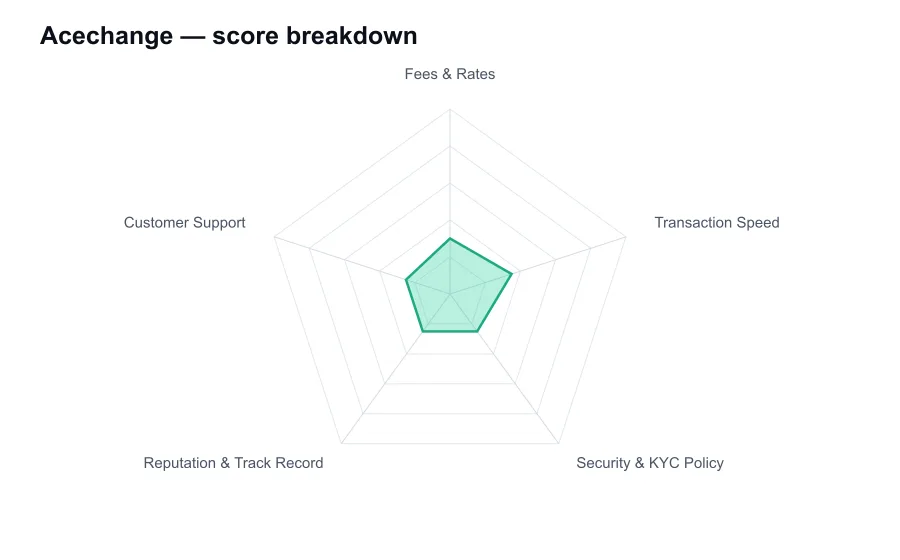
Acechange scores 2.8/10 overall in our independent review, measured against every other provider we've compared, strongest on Transaction Speed (3.5/10) and weakest on Customer Support (2.5/10).
2.8/10 ★★★★★ How we score → Status: active (checked 2026-10-13T19:43:41.519Z) Visit official siteEditorial independence: our scores and rankings are produced using the fixed criteria above and are not influenced by advertisers. This is an independent ranking site and is not operated by, or affiliated with, any provider we list.
Affiliate disclosure: some links on this page may earn us a commission at no extra cost to you. This does not affect our rankings.
| Best for | Not for |
|---|---|
| Simple instant-swap service model | Public company identity is difficult to verify |
| May suit a small test conversion | No dependable published fee structure |
What is Acechange?
How Acechange Works
- Choose the asset you want to send and receive
- Enter a receiving wallet address and select the exact network
- Review the quoted output amount and any displayed network fee
- Send the stated amount to the generated deposit address
- Track the blockchain transaction and wait for the payout
Criteria & Scores
| Criterion | Score | Note |
|---|---|---|
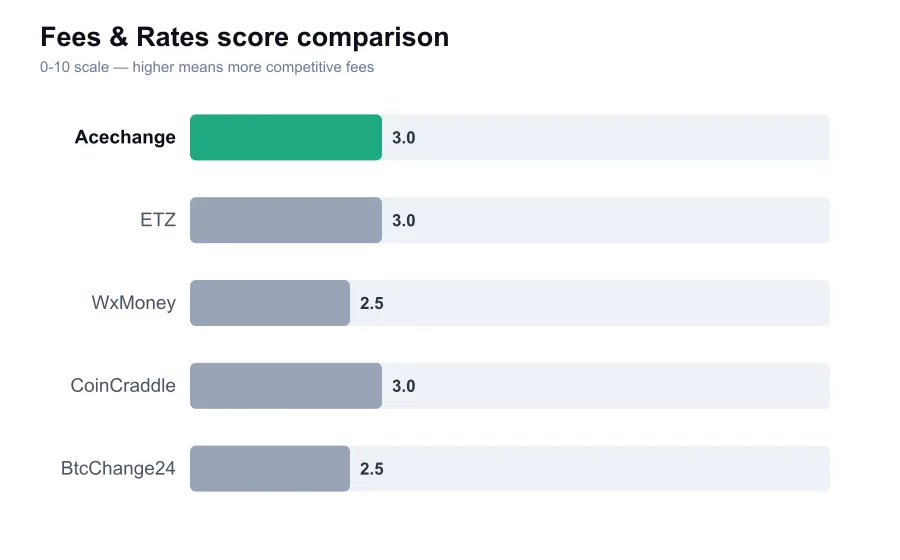
| Fees & Rates | 3.0 | No dependable public fee schedule or spread disclosure found |
| Transaction Speed | 3.5 | No verifiable settlement target or confirmation policy |
| Security & KYC Policy | 2.5 | Security controls and KYC escalation policy are unclear |
| Reputation & Track Record | 2.5 | Limited independently verifiable operating history |
| Customer Support | 2.5 | No established public support record located |
| Fact | Value | Source |
|---|---|---|
| Service type | Instant crypto exchanger | - |
| Published flat fee | Not independently verified | - |
| Public company profile | Not independently verified | - |
| Public security audit | Not independently verified | - |
| Detailed KYC policy | Not independently verified | - |
KYC
| Requirement | optional |
|---|---|
| Notes | Do not treat optional KYC as guaranteed no-KYC. Instant exchangers may request documents after transaction screening, and a detailed Acechange review policy could not be independently verified. |
How to Use Acechange Safely
- Test with a very small amount before any larger transfer
- Compare the final payout against two established alternatives
- Confirm the token network, not just the asset ticker
- Keep the order ID and both transaction hashes
- Never send funds after a support contact changes the deposit address
In-Depth Review
Acechange appears to sit in the small, lightly documented end of the instant-exchange market. It presents itself as a place to convert one digital asset into another without opening a full trading account, rather than as a conventional exchange with an order book, custody account, or regulated brokerage structure. That can be a useful service model, but Acechange has a basic problem before a customer even reaches the swap screen: its public identity is hard to verify independently.
That lack of a clearly established corporate footprint matters more here than it would for a hobby wallet or a small open-source project. An instant exchanger receives a customer's funds first, controls the route through liquidity providers, and decides whether a transaction requires review. Users need to know who is behind that process, where the service is incorporated, and how disputes are handled. I could not establish a reliable public company profile, a long operating record, or a consistently documented official domain that would give Acechange the standing of services such as ChangeNOW, FixedFloat, or SimpleSwap.
The fee picture is similarly thin. Instant exchanges rarely charge in the clean, exchange-style format of a 0.1 percent maker fee and 0.2 percent taker fee. Their economic cost is usually embedded in the quoted conversion rate, supplemented by network fees and, sometimes, a spread from the liquidity partner. That model is legitimate if the quote is competitive and the provider clearly identifies whether it is fixed or floating. Acechange does not offer enough dependable public documentation for a reviewer to state a standard percentage or say with confidence how its spread compares over time.
That puts the burden on the customer to do a real quote comparison before sending anything. Check Acechange's output against at least two recognizable instant exchangers for the same amount, pair, and network. A quote that looks cheap at a glance can still produce less because the service has built margin into the exchange rate. Small swaps can disguise this. A 1 percent worse rate on a modest test transaction may not look alarming, but the same spread becomes expensive on a four-figure conversion.
Speed is another area where marketing language is less useful than the transaction design. A straightforward swap from a liquid coin such as BTC, ETH, USDT, or LTC can theoretically settle once the deposit receives the required confirmations and a liquidity venue fills the trade. On common networks, that often means minutes rather than days. But no reliable service-level target, confirmation policy, or published incident record is available for Acechange. A customer therefore has no strong basis for predicting the timing of a delayed order.
Network choice can make that uncertainty worse. USDT sent over Tron, Ethereum, BNB Smart Chain, Solana, or another network is not interchangeable, even though the asset label says USDT. If an exchanger's deposit page does not make the network unusually clear, there is a serious risk of a costly mistake. I would never use an unfamiliar provider for a complicated route involving a token, a bridge-like transfer, or a newly launched chain. Stick to a small, liquid pair if you decide to test the service at all.
Acechange's security position is difficult to assess because there is little public evidence of its operating controls. I could not verify a published security architecture, formal audit material, an identifiable leadership team, proof-of-reserves reporting, or a detailed policy for handling compromised transactions. Instant exchangers do not need proof of reserves in the same way as a custodial exchange, since a well-run service should keep customer exposure brief. Still, customers need more than a promise that funds are secure.
The KYC question deserves particular caution. Many instant exchangers advertise a low-friction experience, then reserve the right to request identity documents if automated screening flags a transaction, a wallet address, a jurisdiction, or a compliance rule. That is not inherently unreasonable. The problem is that a vague review policy can leave money in limbo while a customer discovers the requirements only after sending it. I could not verify a detailed public KYC escalation policy for Acechange, so no one should assume that every transaction will be document-free.
That creates a practical risk that is easy to miss. If the service asks for identity verification after receiving a deposit, can it return the original asset? Is a return subject to a fee? What happens if the sending wallet is owned by someone else or the customer cannot satisfy the request? Established providers explain these points in terms of service and have visible support histories. With Acechange, the available public record is too limited to inspire the same confidence.
Reputation is where Acechange falls furthest behind its better-known rivals. A young or small provider can earn trust through transparent operators, reputable monitoring-site listings, detailed terms, sustained independent reviews, and responsive public support. I could not verify enough of that material to describe Acechange as an established market participant. A lack of public complaints is not proof of quality either. It can simply mean the service has limited usage, changed domains, or has not attracted much scrutiny.
Customer support is difficult to score positively for the same reason. A contact form or chat widget is not evidence of good support. What matters is whether customers can reach a real team during a stuck exchange, whether the team can explain a transaction hash in plain language, and whether it has a documented process for returns and compliance reviews. Without a visible support record or published escalation route, a user is taking a chance at exactly the moment support becomes important.
I would also be wary of paying from an exchange withdrawal directly into an unfamiliar instant swap. Exchanges may delay or cancel withdrawals, require travel-rule information, or reject a destination after the customer has locked a quote. Use a self-custody wallet first if the route is legitimate, and make sure you control the refund address. This gives you a clearer transaction trail and reduces the chance that three separate companies each point to another party when something goes wrong.
Acechange is not a service I would use for a large conversion, a time-sensitive payment, or a first attempt at moving funds across chains. The issue is not a proven technical failure. It is that too many of the facts a prudent customer needs remain unverified. In crypto, opacity is itself a material risk. A lower advertised rate does not compensate for uncertainty around identity checks, refunds, support, and accountability.
My view is straightforward. Treat Acechange as unproven unless you can independently validate its live domain, legal terms, destination address, and support channel before use. If you still want to test it, use an amount you can afford to have delayed and compare the received amount against a recognized alternative. Most users will be better served by a provider with a documented company history and a large body of recent, attributable customer feedback.
Pros & Cons
| Pros | Cons |
|---|
Verdict
Frequently Asked Questions
Is Acechange a conventional crypto exchange with an order book?
It appears to operate as an instant exchanger rather than a conventional spot exchange. Users would normally select a pair, send a deposit, and receive the output asset rather than place maker or taker orders.
Does Acechange publish a flat percentage fee?
I could not verify a dependable public flat-fee schedule. With this type of service, the cost may be embedded in the quoted exchange rate plus network fees, so compare the final output amount before sending.
Can a swap be held for KYC review?
Do not assume every swap is KYC-free. Instant exchangers commonly reserve the right to request documents after automated compliance checks, and I could not verify a detailed Acechange escalation policy.
Should I send a large amount to Acechange first?
No. Given the limited independently verifiable information, a small test transaction is the maximum prudent approach. Do not use it for a time-critical or large conversion.
Why does network selection matter for an Acechange swap?
Assets such as USDT exist on several incompatible networks. Sending USDT on the wrong network can prevent automatic processing, and recovery may be impossible or require manual support.
What should I save if a transaction is delayed?
Save the order ID, deposit address, receiving address, transaction hash, amount, selected network, and screenshots of the quote. Those records are essential if support needs to trace a deposit.