1Mile
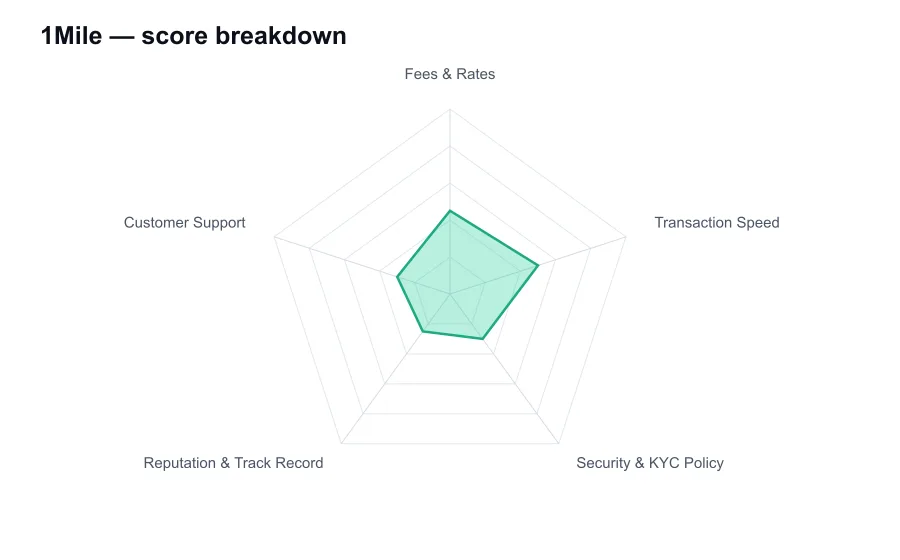
1Mile scores 3.7/10 overall in our independent review, measured against every other provider we've compared, strongest on Transaction Speed (5.0/10) and weakest on Reputation & Track Record (2.5/10).
3.7/10 ★★★★★ How we score → Status: active (checked 2026-10-13T19:35:26.929Z) Visit official siteEditorial independence: our scores and rankings are produced using the fixed criteria above and are not influenced by advertisers. This is an independent ranking site and is not operated by, or affiliated with, any provider we list.
Affiliate disclosure: some links on this page may earn us a commission at no extra cost to you. This does not affect our rankings.
| Best for | Not for |
|---|---|
| Potentially simple wallet-to-wallet conversion flow | Very limited independently verifiable public history |
| No advanced trading interface required | No strong basis for trusting large transfers |
What is 1Mile?
How 1Mile Works
- Select the source and destination cryptoassets
- Enter a wallet address on the correct destination network
- Review the displayed receive estimate and rate terms
- Send funds to the deposit address for that order
- Track the transaction using its order ID and wallet hash
Criteria & Scores
| Criterion | Score | Note |
|---|---|---|
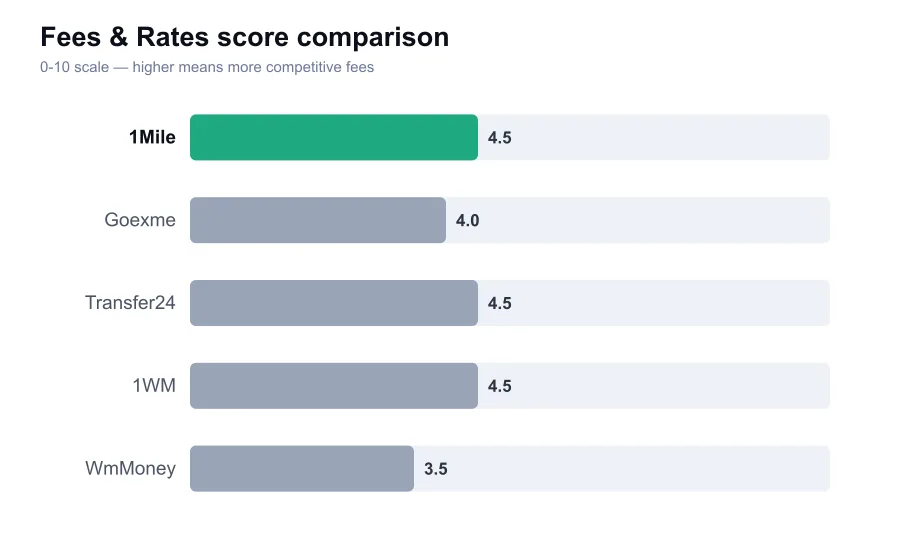
| Fees & Rates | 4.5 | Judge fees by the final receive quote. |
| Transaction Speed | 5.0 | Execution depends on confirmations and liquidity. |
| Security & KYC Policy | 3.0 | Limited independently verifiable security disclosure. |
| Reputation & Track Record | 2.5 | Insufficient public track record for confidence. |
| Customer Support | 3.0 | Verify response quality before a first deposit. |
| Fact | Value | Source |
|---|---|---|
| Service category | Instant crypto exchange provider | - |
| Transaction flow | Deposit, conversion, withdrawal | - |
| Pricing check | Compare final receive amounts | - |
| Public documentation | Limited independent verification available | - |
| First transaction | Use a small test amount | - |
KYC
| Requirement | optional |
|---|---|
| Notes | Do not treat an account-light swap flow as a guarantee that verification will never be requested. Review the provider's current terms before funding an order. |
How to Use 1Mile Safely
- Start with a transaction small enough to lose
- Compare final quotes from at least two established providers
- Confirm token and network compatibility on both sides
- Keep screenshots, order IDs, and transaction hashes
- Test the support channel before initiating a larger swap
In-Depth Review
1Mile is presented as a crypto exchange provider, but it does not have the level of transparent, independently documented market presence that readers should expect before trusting a financial service. That places it in a difficult category. It may offer a functional swap flow, yet a reviewer cannot responsibly treat a lightly documented brand as equivalent to Binance, Kraken, Coinbase, or even a well-known instant exchange with years of public order history.
For a user, the practical question is simple. What happens after funds leave your wallet? A good exchange provider answers that with clear terms, named operating entities, transparent fees, visible order tracking, and support channels that work when an order fails. A weak provider asks for trust first and supplies documentation later. With 1Mile, the information gap is too large to ignore.
The apparent use case is a direct crypto conversion rather than advanced exchange trading. That can be convenient. A wallet-to-wallet swap service removes the friction of opening a custodial account, moving money into an exchange wallet, placing an order, and requesting a withdrawal. For a small conversion, that is often exactly what a user wants.
Convenience is not the same as value. Instant exchanges frequently make money through a blend of quoted spread, partner-liquidity pricing, and network costs. The number that matters is the final amount expected at your destination address. Do not judge a service by a marketing claim about low fees if the actual receive quote loses badly against two or three competing providers.
I would be especially careful about rate language. A fixed-rate order should explain the time window and the conditions under which the quoted amount is honored. A floating-rate order should make clear that the receive amount can move while your deposit is confirming. Those are standard mechanics, but they are often the source of disappointed customer complaints.
Speed depends on several stages. The sending wallet must broadcast the transaction. The source network must confirm it. The provider must obtain liquidity and execute the swap. The destination network must then confirm the outgoing transfer. A quick web page says little about those stages. Bitcoin, Ethereum, and less-liquid tokens can all introduce delay for different reasons.
A serious service should expose that process through a status page. It should show whether the deposit is pending, confirmed, being exchanged, sent, or held for review. That status needs to be attached to an order identifier that support can recognize. If a service cannot provide basic transaction visibility, it is not ready for funds that matter.
Security deserves a conservative score because I could not establish detailed, independently verifiable public information about 1Mile's operational security, leadership, reserve handling, or long-term complaint-resolution record. A swap service does not need to publish every internal control. It does need to give customers enough information to determine who they are dealing with and what recourse exists if the automated flow breaks.
KYC should also be treated cautiously. Some swap providers allow an order to begin without registration but can request identity documents later under anti-money-laundering procedures. That distinction matters. A person who cannot or will not complete a potential review should not send funds on the assumption that a lightweight front end guarantees an unrestricted transaction.
Reputation is earned slowly. Established services accumulate verifiable reviews, public support interactions, regulatory disclosures where relevant, incident responses, and years of onchain transaction history. 1Mile does not have a comparably strong body of evidence available to support a high reputation score. The absence of public controversy is not proof of reliability. Sometimes it simply means the service has little visible usage.
Customer support is where small providers can still distinguish themselves. A live response that identifies the correct network, asks for the transaction hash, and explains a delay is useful. An email address alone is not a support system. Before a first deposit, ask a precise question about a proposed pair and see whether the reply gives operational detail rather than generic reassurance.
There is no sensible reason to make your first transaction with a lightly documented provider a large one. Send a small amount that you can afford to lose, verify the destination asset arrives, and test the full support route if possible. If the service handles that cleanly, it has earned the chance to process another modest swap. Trust should grow from evidence, not from a polished interface.
Users should also remember that crypto transfers are unforgiving. A token sent on the wrong chain may be unrecoverable. A mistyped wallet address may be final. A transaction to a deposit address from a previous order may not be credited. These risks exist with every provider, but they are more concerning where the support and operating history are less established.
My assessment is deliberately restrained. 1Mile may be usable for a carefully tested, low-value conversion, but there is not enough independently verifiable information for a stronger recommendation. Better-known services may cost slightly more on a particular route, yet a clear history, accessible support, and transparent policies can be worth more than a marginally better quote.
Pros & Cons
| Pros | Cons |
|---|
Verdict
Frequently Asked Questions
Why is 1Mile's reputation score low?
The score reflects the limited independently verifiable public operating history and dispute-resolution evidence available for the service, not a claim that every transaction will fail.
How should I test a 1Mile swap?
Use a small amount, save the order ID and transaction hash, verify the destination network carefully, and wait until the funds arrive in your own wallet before using a larger amount.
What should a 1Mile order page clearly show?
It should show the source and destination assets, network, deposit address, quoted receive amount, rate type, order ID, and a meaningful status trail after the deposit is broadcast.
Can a transaction be held after I send it?
It can happen with many instant exchange providers if automated compliance or risk systems flag a transfer. Read current terms before sending and do not assume an account-free flow cannot be reviewed.
Why compare several live quotes?
A swap's cost can be hidden in the exchange rate, liquidity-provider spread, and network fees. The final amount expected in your wallet is more useful than a headline fee claim.