Trocador
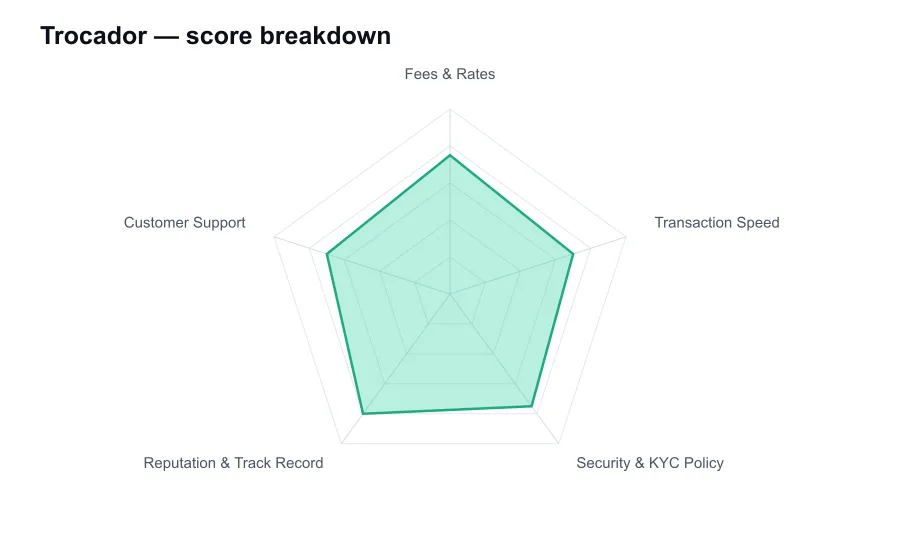
Trocador scores 7.5/10 overall in our independent review, measured against every other provider we've compared, strongest on Reputation & Track Record (8.0/10) and weakest on Customer Support (7.0/10).
7.5/10 ★★★★★ How we score → Status: active (checked 2026-10-13T19:33:16.508Z) Visit official siteEditorial independence: our scores and rankings are produced using the fixed criteria above and are not influenced by advertisers. This is an independent ranking site and is not operated by, or affiliated with, any provider we list.
Affiliate disclosure: some links on this page may earn us a commission at no extra cost to you. This does not affect our rankings.
| Best for | Not for |
|---|---|
| Compares quotes from multiple exchange partners | Partner quality and speed vary materially |
| KYC-status information for routes | An aggregator cannot override partner compliance holds |
What is Trocador?
How Trocador Works
- Choose the asset and network you want to send
- Choose the asset and network you want to receive
- Review partner routes, payout estimates, rate type, and KYC labels
- Select a provider and enter your receiving wallet address
- Send the required amount to the generated deposit address
- Use the order reference and transaction hash to track the payout
Criteria & Scores
| Criterion | Score | Note |
|---|---|---|
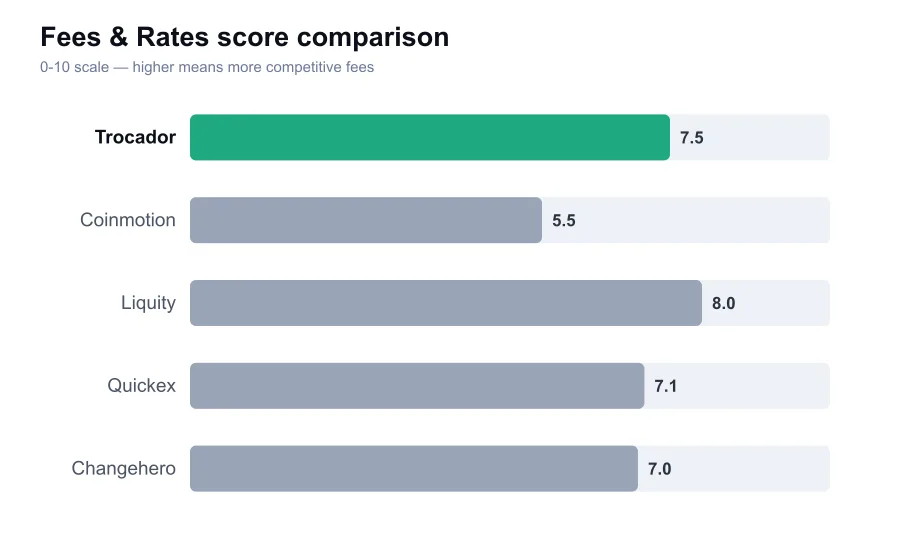
| Fees & Rates | 7.5 | Multi-provider quote comparison can expose better routes. |
| Transaction Speed | 7.0 | Speed varies by selected partner and input blockchain. |
| Security & KYC Policy | 7.5 | Useful KYC route labels and no standing user balance. |
| Reputation & Track Record | 8.0 | Well known among privacy and Monero swap users. |
| Customer Support | 7.0 | Useful mediation, though partners control execution. |
| Fact | Value | Source |
|---|---|---|
| Service model | Instant exchange aggregator | - |
| Route comparison | Multiple partner providers | - |
| KYC information | Route and provider status labels | - |
| Premium option | Paid fee-discount membership | - |
| Custody model | No conventional customer balance | - |
KYC
| Requirement | optional |
|---|---|
| Notes | Trocador displays partner and route KYC information. Requirements are determined by the selected provider and can change for exceptional compliance reviews. |
Supported Assets
How to Use Trocador Safely
- Read the selected provider's KYC label before depositing
- Prefer a familiar provider over a tiny price advantage
- Confirm the rate type and payment window
- Save the Trocador order reference and blockchain transaction hash
- Verify the asset network at both ends of the swap
In-Depth Review
Trocador is not a conventional instant exchange in the same sense as Swapuz or MoneroBridge. It is an exchange aggregator. The site gathers quotes from multiple partner providers, lets the user choose a route, and sends the user into a wallet-to-wallet conversion flow. That distinction is important because Trocador's core value is comparison, not the claim that one in-house liquidity engine is always best.
For privacy-oriented crypto users, Trocador has become one of the more recognizable names in the swap market. It has long taken Monero seriously rather than treating it as an inconvenient token to be removed at the first sign of regulatory pressure. That makes it particularly useful for users moving between XMR and Bitcoin, Litecoin, stablecoins, or other assets. It also does not turn the service into a magic privacy shield. The selected exchange partner and the input chain still matter.
The interface is simple enough for a newcomer, but the results table rewards an informed user. Routes can differ by expected payout, speed, rate type, provider, KYC likelihood, and available limits. This is much more useful than accepting the first quote from a single exchanger. It lets a user reject a slightly better price if the provider has an unclear record or a higher chance of compliance friction.
Trocador's KYC indicators are one of its genuinely useful features. The site distinguishes providers and routes by their stated verification policies, helping users avoid blindly selecting a service that may ask for documents after funds have been deposited. That is better than the vague no-KYC marketing common in this sector. It still cannot guarantee that no exchange will ever investigate a transaction, since fraud screening and legal obligations can override a normal route policy.
Fees need a careful reading. Trocador's economics are partly reflected in partner quotes and its own service fee structure, rather than appearing as a clean exchange-trading commission. The effective cost is the final amount received. Compare it against direct provider quotes, because aggregation is valuable only if the improved search genuinely offsets any added margin. In many cases it does. In some cases, going direct to the chosen provider may be cheaper.
The platform also offers a Premium option that can reduce or remove its own fee in exchange for a paid subscription. That will make sense only for frequent users who have actually measured their swap volume and savings. Casual users should not subscribe because a badge sounds reassuring. Run a few comparisons first. If the best route changes across providers, the real value may be the search tool rather than a fee discount.
Speed is more variable than on a single-provider site because it is determined by the selected partner, the input chain, and available liquidity. Trocador makes that variability visible instead of pretending every swap is equal. A fast route on Litecoin or a stablecoin chain may complete quickly. A Bitcoin deposit sent during congestion, or an XMR transaction routed through a slower provider, can take much longer. That is normal, not necessarily a failure.
The user should pay close attention to the route card before clicking through. A route that says fixed rate, no KYC, and a reputable partner is often worth a small difference in output. The lowest number should not automatically win. A cheaper route through a little-known provider with a vague policy creates a risk that is hard to price, especially if the transaction is large or time-sensitive.
Trocador does not hold a normal customer account balance, which is a meaningful security positive. The user funds a transaction address and receives the output to a chosen wallet. Yet it is not a decentralized exchange and does not remove execution risk. The partner handles the conversion. Trocador is an intermediary and support layer around that relationship, so a problem can involve both Trocador and the selected exchanger.
Its reputation is stronger than many instant exchangers because it has a clear, visible role in the privacy and Monero communities and because its comparison model is easy to understand. It has also faced the ordinary criticism that comes with being an aggregator: a good interface cannot fully insulate customers from an individual partner's delay, KYC request, or poor handling of an exception. That criticism is fair. The partner list is only as good as its weakest route.
Support is one area where Trocador tends to be more useful than a bare-bones swap widget. The site provides transaction tracking and can assist with partner issues, though it cannot simply override an exchange partner's compliance decision or force an immediate payout. A user should approach support with the order reference, transaction hash, timestamps, and screenshots of any relevant status. That makes resolution far more likely.
Trocador's limitations are mostly the price of its model. It cannot promise the same route quality every day, and users still need to understand network-specific deposits, payment windows, and rate risk. A user who wants a single accountable counterparty with regulated custody and phone support should not use an aggregator for an important conversion. There are better tools for that job.
For users who are already comfortable with self-custody, Trocador is among the more sensible places to start a swap search. It gives useful context around the quote, especially its partner and KYC information. I would rather see a user compare several routes here than send funds to the first obscure instant exchanger found through an ad or a social-media post.
My verdict is positive, with a condition. Trocador is excellent as a decision tool and often a good execution path for modest to medium wallet swaps. It is not a substitute for personal due diligence, and it is not a guarantee that a third-party provider will behave perfectly. Choose partners deliberately, keep records, and use the platform's transparency rather than treating it as a reason to stop thinking.
Pros & Cons
| Pros | Cons |
|---|
Verdict
Frequently Asked Questions
Is Trocador an exchange or an aggregator?
Trocador is an aggregator. It compares routes from exchange partners and helps initiate a wallet-to-wallet swap, rather than operating like a conventional order-book exchange.
What do Trocador's KYC labels mean?
The labels indicate a partner route's stated verification posture. They help users compare likely requirements, but they cannot guarantee a transaction will never be reviewed for fraud or compliance reasons.
Why can two Trocador routes have different payouts?
Each route uses a different exchange partner, liquidity source, fee structure, and sometimes rate type. Compare the provider, estimated time, rate type, and KYC label, not just the receive amount.
Can Trocador fix a partner's frozen transaction?
Trocador can help mediate and track the case, but the exchange partner controls the deposited funds and its compliance decision. Save the order reference and deposit transaction hash.
What is Trocador Premium for?
Premium is a paid option intended to reduce Trocador's own fee for frequent users. It is most relevant to people whose repeated swap volume exceeds the subscription cost.
Is Trocador useful for Monero swaps?
Yes. Trocador is particularly well known among Monero users because it compares providers that support XMR routes and displays route-level information that helps assess them.
Should I always choose the cheapest route?
No. A slightly higher quote from a familiar provider with a fixed rate and clearer KYC policy can be safer than the cheapest route from an unknown partner.