Spark
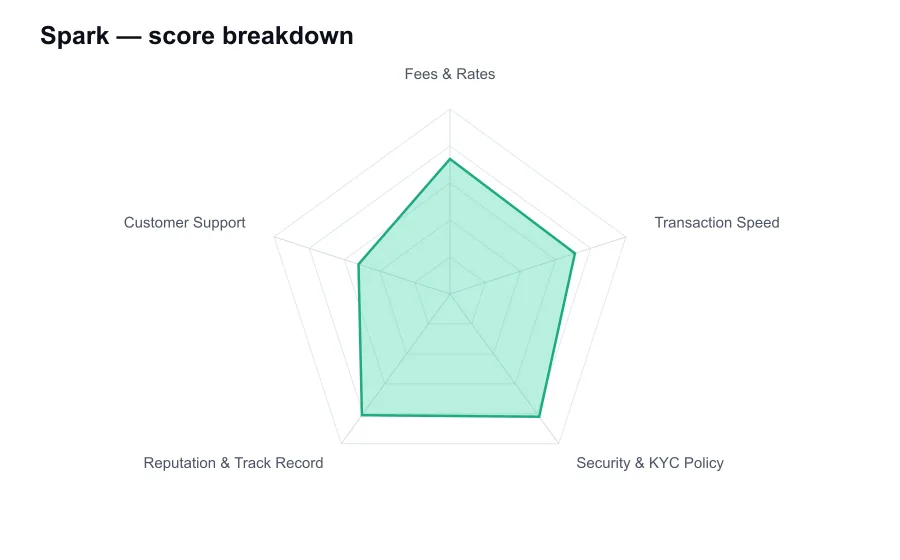
Spark scores 7.4/10 overall in our independent review, measured against every other provider we've compared, strongest on Security & KYC Policy (8.2/10) and weakest on Customer Support (5.2/10).
7.4/10 ★★★★★ How we score → Visit official siteEditorial independence: our scores and rankings are produced using the fixed criteria above and are not influenced by advertisers. This is an independent ranking site and is not operated by, or affiliated with, any provider we list.
Affiliate disclosure: some links on this page may earn us a commission at no extra cost to you. This does not affect our rankings.
| Best for | Not for |
|---|---|
| Established Sky ecosystem | Not a full-service spot exchange |
| Transparent on-chain lending | Liquidation risk for borrowers |
Criteria & Scores
| Criterion | Score | Note |
|---|---|---|
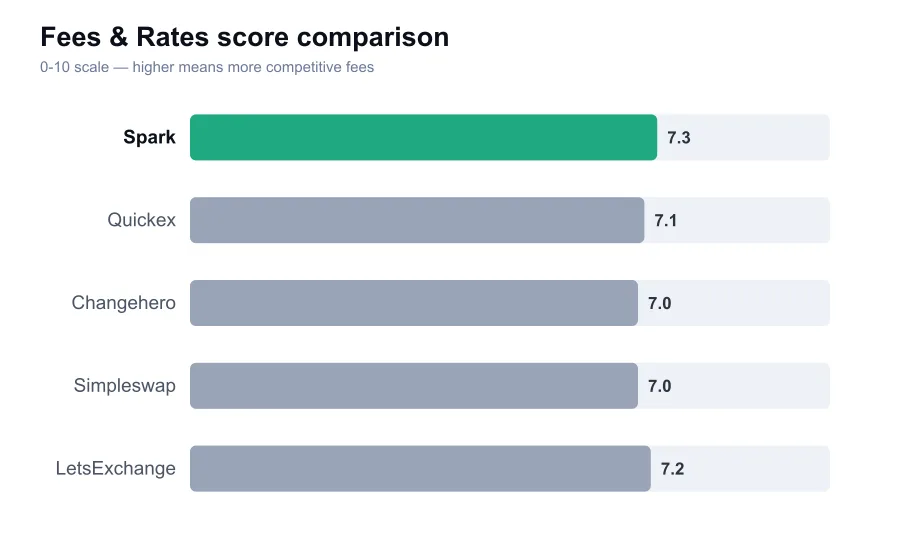
| Fees & Rates | 7.3 | No retail trading commission, but variable borrow rates apply |
| Transaction Speed | 7.1 | On-chain execution, with network congestion as the constraint |
| Security & KYC Policy | 8.2 | Established Sky ecosystem and transparent collateral mechanics |
| Reputation & Track Record | 8.1 | Built on a mature MakerDAO and Sky heritage |
| Customer Support | 5.2 | Documentation and community support, not a help desk |
In-Depth Review
Spark is not a conventional crypto exchange, despite being grouped with trading providers in some directories. It is a DeFi lending protocol connected to the Sky ecosystem, formerly known as MakerDAO. Its main job is to let users supply supported assets, borrow against collateral, and access stablecoin liquidity. That makes it a serious on-chain financial tool, but not a place for casual spot traders expecting a broad list of coins and simple buy buttons.
The protocol's identity is one of its biggest strengths. Spark grew out of the infrastructure and risk culture surrounding DAI, now joined by USDS within the rebranded Sky ecosystem. This is a materially different pedigree from an anonymous yield site that appeared during a bull market. Its core purpose is clear: offer money-market functionality, particularly for users who want to borrow stablecoins against high-quality crypto collateral.
The fee discussion starts with an important correction. Spark does not charge a flat retail exchange commission every time a user clicks a trade. Supply rates, borrowing rates, liquidation penalties, and transaction gas are the costs that matter. Borrowing rates are variable and are set through protocol parameters. The displayed annual percentage rate can be attractive, but it is not a permanent promise and should never be treated as one.
Supplying stablecoins can produce yield, while borrowing USDS or DAI against collateral creates a cost. The apparent simplicity hides a real risk calculation. A borrower has to watch the health factor, collateral price, interest accumulation, and the protocol's changing parameters. Borrowing cheaply is useful only if the collateral remains safely above liquidation territory. Anyone using leverage because a dashboard makes it look easy is playing with a sharper instrument than they realize.
On Ethereum mainnet, network fees can be a meaningful annoyance. Opening a position, approving a token, repaying debt, and withdrawing collateral are separate on-chain actions, and each can cost money during congestion. Spark has also expanded access through supported networks and integrations, which can reduce friction, but users must confirm the exact deployment and supported asset before moving money. Cross-chain assumptions cause expensive mistakes.
Transaction speed is governed mostly by the blockchain, not by a support queue. On an active network, a supply or borrow transaction can be visible quickly and final after the normal confirmation process. There is no bank-style manual withdrawal review. Still, speed is not the same as convenience. A congested Ethereum blockspace market can make a routine adjustment expensive, and a user facing a rapidly falling collateral price may discover that even a fast protocol cannot remove market risk.
Spark's security case is considerably stronger than that of a little-known swap site. The protocol is tied to an ecosystem with years of experience managing collateralized stablecoin risk, public governance, and substantial value secured. Smart contract audits, formal risk processes, and transparent on-chain positions are meaningful advantages. They do not eliminate the possibility of a bug, oracle failure, governance mistake, or cascading liquidation. DeFi security is reduced risk, not guaranteed safety.
There is generally no conventional KYC gate for interacting directly with the protocol through a compatible wallet. That makes Spark accessible to global self-custody users, but it also means there is no account representative who can stop a bad transaction. The wallet is the account. Lost keys, malicious approvals, phishing sites, and a poorly understood liquidation remain the user's responsibility.
Spark is strongest with major collateral and stablecoin use cases. It is not trying to compete with a centralized exchange's hundreds of speculative listings. That restraint is a positive. Restrained asset support can look boring next to an exchange listing meme coins every week, but it reduces exposure to the worst kinds of liquidity and listing risk. The trade-off is obvious: traders seeking broad asset discovery will find Spark narrow.
The protocol's public reputation is good within DeFi, especially among users who understand MakerDAO's long operational history. It is not immune to criticism. Governance-led systems can be complex, parameter changes can be hard for retail users to follow, and Sky's branding transition has caused confusion for people accustomed to DAI and MakerDAO terminology. Yet the underlying institutional memory is far more credible than that of most new lending apps.
Customer support is Spark's weak point, although calling it bad misses the structure of the product. Users can rely on documentation, governance forums, community channels, and interface guidance, but they should not expect a call center to unwind an on-chain liquidation. That is standard for permissionless DeFi. It is still a serious drawback for people who need responsive one-to-one help during a stressful market event.
There is also a practical difference between using Spark safely and using it aggressively. Supplying a supported stable asset and monitoring the position is relatively straightforward. Borrowing at a high loan-to-value ratio to buy more volatile crypto is not. The latter can turn a modest market move into a liquidation, and no favorable historical reputation changes that arithmetic. Conservative collateral buffers are more important than squeezing out the highest advertised rate.
Spark fits crypto-native users who understand collateralized debt and want transparent on-chain stablecoin markets. It is particularly compelling for users already in the Sky ecosystem. It does not suit first-time buyers, people who need fiat withdrawals, or investors unwilling to monitor a loan. Those users should not mistake the lack of KYC for a lack of complexity.
My judgment is favorable, with a clear condition: use Spark for lending and borrowing, not as if it were a general exchange. It has stronger foundations, clearer risk controls, and a better track record than the average DeFi yield product. But it also gives users direct exposure to smart contract and liquidation risk, with limited human support if things go wrong. For disciplined DeFi users, that trade is often reasonable. For everyone else, it is probably unnecessary.
Pros & Cons
| Pros | Cons |
|---|
Verdict
Frequently Asked Questions
Is Spark a crypto exchange?
Not in the usual centralized-exchange sense. Spark is primarily a DeFi lending and borrowing protocol. It supports collateral and stablecoin liquidity rather than a large retail spot-market catalogue.
Does Spark require KYC?
Direct protocol interaction through a self-custody wallet generally does not use conventional KYC. Third-party wallets, ramps, and regional services can have separate requirements.
Can I lose collateral on Spark?
Yes. If the value of pledged collateral falls and your position reaches its liquidation threshold, the protocol can liquidate collateral to cover the debt. Maintain a conservative buffer.