Liquity
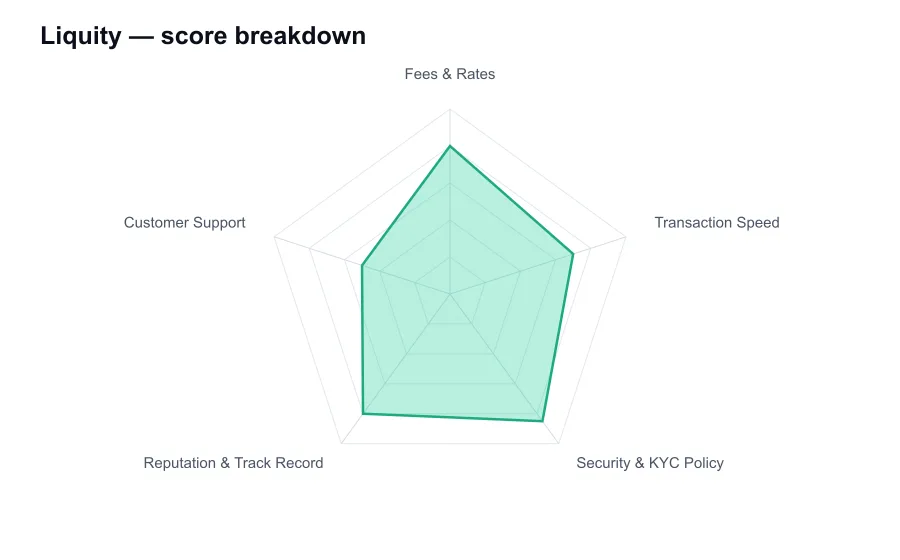
Liquity scores 7.6/10 overall in our independent review, measured against every other provider we've compared, strongest on Security & KYC Policy (8.5/10) and weakest on Customer Support (5.0/10).
7.6/10 ★★★★★ How we score → Status: active (checked 2026-10-13T19:35:26.914Z) Visit official siteEditorial independence: our scores and rankings are produced using the fixed criteria above and are not influenced by advertisers. This is an independent ranking site and is not operated by, or affiliated with, any provider we list.
Affiliate disclosure: some links on this page may earn us a commission at no extra cost to you. This does not affect our rankings.
| Best for | Not for |
|---|---|
| Permissionless borrowing with self-custody | Liquidation risk can be severe in a fast selloff |
| V1 minimum collateral ratio of 110% | Ethereum gas can make urgent actions expensive |
What is Liquity?
How Liquity Works
- Connect a self-custody wallet to a Liquity interface
- Choose a collateral branch and deposit collateral
- Set a debt amount and a conservative collateral ratio
- Confirm the onchain transaction and receive stablecoins
- Monitor the position and add collateral or repay as needed
- Repay the debt to close the position and withdraw collateral
Criteria & Scores
| Criterion | Score | Note |
|---|---|---|
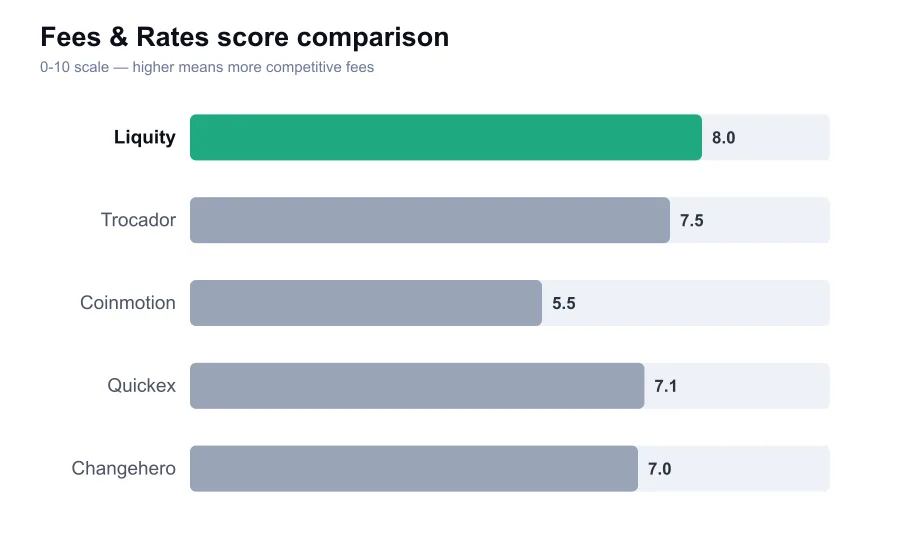
| Fees & Rates | 8.0 | V1 borrowing fee had a 0.5% minimum. |
| Transaction Speed | 7.0 | Onchain execution follows network confirmation times. |
| Security & KYC Policy | 8.5 | Permissionless contracts, but liquidation risk is real. |
| Reputation & Track Record | 8.0 | Established DeFi borrowing protocol since 2021. |
| Customer Support | 5.0 | Documentation-led support, no transaction reversals. |
KYC
| Requirement | none |
|---|---|
| Notes | Liquity's protocol contracts do not require identity verification. Blockchain transactions are public, and interfaces or related services may apply separate terms. |
Supported Assets
Transaction Limits
| Notes | Borrowing capacity is constrained by collateral value, the applicable collateral ratio, protocol rules, and available liquidity rather than a conventional daily account limit. |
|---|
How to Use Liquity Safely
- Keep collateral well above the minimum ratio
- Hold ETH for gas before opening a position
- Use only the official interface or a verified front end
- Check the stablecoin market price before borrowing or repaying
- Revoke unfamiliar wallet permissions and protect seed phrases
- Never assume a liquidation can be reversed
In-Depth Review
Liquity is not a conventional crypto exchange. It is a decentralized borrowing protocol that lets users deposit supported collateral and borrow a stablecoin against it. The original system became known for ETH-backed LUSD loans, while Liquity V2 introduced BOLD, a stablecoin designed around user-selected borrowing rates and multiple collateral branches. Its market position is unusual, and far more interesting than another generic lending app.
The basic proposition is appealing to experienced DeFi users. Instead of selling collateral to raise liquidity, a user opens a position, deposits collateral, receives stablecoins, and later repays the debt to recover the collateral. There is no bank-style credit assessment. The protocol uses blockchain collateral and its own rules. That makes it accessible, but it also shifts the risk squarely onto the borrower.
Liquity's original V1 model had a minimum collateral ratio of 110 percent for ETH-backed Troves. That is capital-efficient compared with many overcollateralized DeFi loans, but it is also aggressive. A borrower at 111 percent is one sharp ETH move away from liquidation. The protocol's low minimum is a feature for disciplined users, not permission to borrow recklessly.
Fees are one of Liquity's strongest points, though readers should understand what that means in practice. V1 charged a borrowing fee that varied with the protocol's base rate, subject to a 0.5 percent minimum, rather than imposing an ongoing interest rate in the conventional sense. Redemptions also influenced the base-rate mechanism. This was cheaper and cleaner than many lending venues for borrowers who understood the system.
Liquity V2 changes the economics. Borrowers choose an annual interest rate for their BOLD debt, and that rate affects their position in the redemption queue. Low rates look attractive until redemptions occur, because lower-rate debt is generally more exposed. This is a sophisticated mechanism, not a cosmetic choice in the interface. Anyone opening a V2 position should understand the trade-off before chasing the lowest displayed rate.
The protocol also uses a Stability Pool design. Users can deposit its stablecoin into the pool and, when positions are liquidated, absorb debt in exchange for collateral gains. That can be an attractive yield source, but it is not a savings account. Depositors are accepting liquidation exposure and a changing asset mix. The pool can work exactly as designed while a depositor still experiences a loss in dollar terms during volatile markets.
Transaction speed is governed by the underlying chain, not by a central Liquity support desk. Opening a position, adjusting collateral, repaying debt, or redeeming stablecoins is an onchain action. On Ethereum, that means users need ETH for gas and must be prepared for congestion and costly execution at busy times. Liquity V2's deployment architecture includes collateral branches, but the same rule remains, blockchain settlement is final once confirmed.
The smart-contract approach has real advantages. There is no central company approving individual loans, holding a customer service queue for ordinary withdrawals, or imposing a routine account freeze. A user who controls the connected wallet controls the position. That is genuine self-custody, and it is a major distinction from centralized lenders that can pause accounts or change withdrawal rules.
It does not remove security risk. Smart contracts can have bugs, oracle systems can fail, interfaces can be spoofed, and users can sign malicious wallet prompts. Liquity has a stronger security reputation than most new DeFi projects because the protocol was built around immutable-contract principles and has undergone public security review. Still, audited code is risk reduction, not an insurance policy. The 2022 era provided more than enough reminders that DeFi risk can surface outside a protocol's core code.
Liquity's KYC position is simple from a protocol perspective. The contracts do not ask a borrower to upload identification. A user interacts through a compatible wallet. That does not guarantee anonymity in the broader sense, since blockchain activity is public and front ends, wallet providers, fiat on-ramps, and local law may create their own compliance obligations.
Reputation is a genuine Liquity strength. It launched in 2021, has remained one of the more recognizable decentralized borrowing protocols, and its LUSD design earned respect among DeFi users for avoiding dependence on a centralized issuer. The protocol is not as large or as liquid as the biggest lending systems in every market cycle, but its survival through several difficult periods gives it more credibility than the usual short-lived yield product.
Support is intentionally limited because Liquity is a protocol, not a broker. Documentation, community channels, and third-party front-end guidance can help, but nobody can reverse a wallet signature, undo a liquidation, or retrieve funds sent to the wrong address. That can feel harsh for users accustomed to centralized exchange support. It is also the honest consequence of permissionless execution.
The sharpest risk is liquidation. Users should not focus only on the stated minimum collateral ratio. A prudent borrower leaves a substantial buffer, monitors the collateral price, and keeps funds available to add collateral or repay debt. A position that looks safe at 160 percent can become uncomfortable quickly during a market crash, especially if Ethereum gas costs rise just as everyone tries to adjust positions.
For stablecoin users, BOLD and LUSD also deserve independent scrutiny. Stablecoins can trade above or below one dollar, particularly during stress, liquidity shortages, or a rush to exit DeFi positions. A user borrowing a stablecoin must think about the repayment asset's market price, not merely its intended peg. Borrowing 10,000 stablecoins is not the same as receiving a guaranteed 10,000 dollars of liquidity.
Liquity is excellent at what it is built to do, permissionless collateralized borrowing with rules that are visible in code. It is not a beginner-friendly exchange, a guaranteed-yield account, or a place for casual users to experiment with their rent money. For capable DeFi borrowers who understand liquidation mathematics, it remains one of the more thoughtful protocols in the category. For everyone else, the clean interface can hide a level of risk that deserves more respect.
Pros & Cons
| Pros | Cons |
|---|
Verdict
Frequently Asked Questions
What was Liquity V1's minimum collateral ratio?
Liquity V1 used a 110% minimum collateral ratio for ETH-backed Troves. Falling below the required threshold can lead to liquidation.
Does Liquity require KYC?
The Liquity protocol does not require users to submit identity documents to interact with its contracts. Your wallet activity remains public onchain, and other services may have their own checks.
Why would a V2 borrower choose a higher interest rate?
In Liquity V2, the chosen rate affects redemption exposure. A very low rate can make debt more exposed in the redemption queue, so the lowest rate is not automatically the safest choice.
Can Liquity support undo a liquidation?
No. Liquidations are executed by smart-contract rules after onchain conditions are met. There is no central support team able to reverse a completed blockchain transaction.
What does the Stability Pool do?
It absorbs debt from liquidated positions in exchange for collateral gains. Depositors can earn from the mechanism, but they accept liquidation exposure and may end up holding a changing collateral mix.
Is LUSD or BOLD guaranteed to equal one dollar?
No. Both are designed as dollar-pegged stablecoins, but market prices can move above or below one dollar during stress, changing liquidity conditions, or heavy selling.