LetsExchange
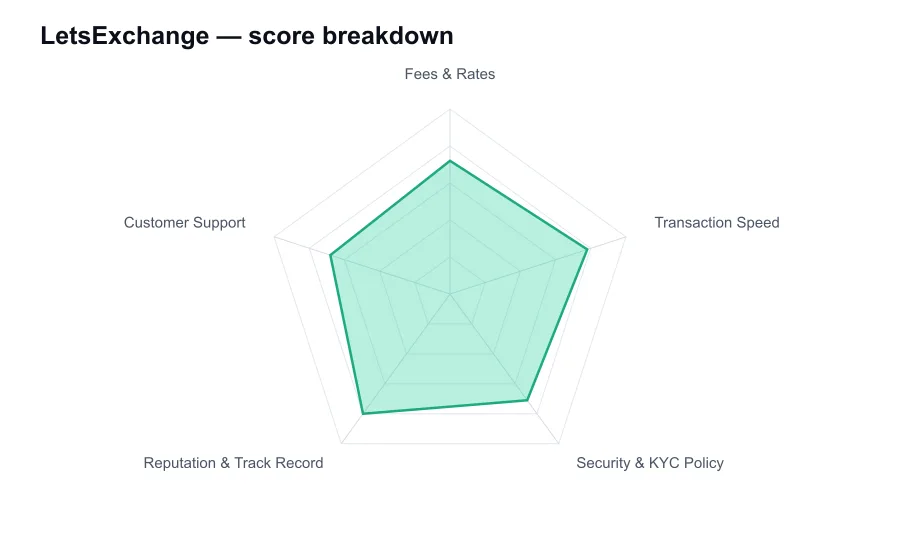
LetsExchange scores 7.4/10 overall in our independent review, measured against every other provider we've compared, strongest on Reputation & Track Record (8.0/10) and weakest on Customer Support (6.8/10).
7.4/10 ★★★★★ How we score → Visit official siteEditorial independence: our scores and rankings are produced using the fixed criteria above and are not influenced by advertisers. This is an independent ranking site and is not operated by, or affiliated with, any provider we list.
Affiliate disclosure: some links on this page may earn us a commission at no extra cost to you. This does not affect our rankings.
| Best for | Not for |
|---|---|
| Very broad coin and network coverage | Final pricing can be less transparent than a flat fee |
| Fixed and floating rate choices | KYC may be requested for flagged transactions |
Criteria & Scores
| Criterion | Score | Note |
|---|---|---|
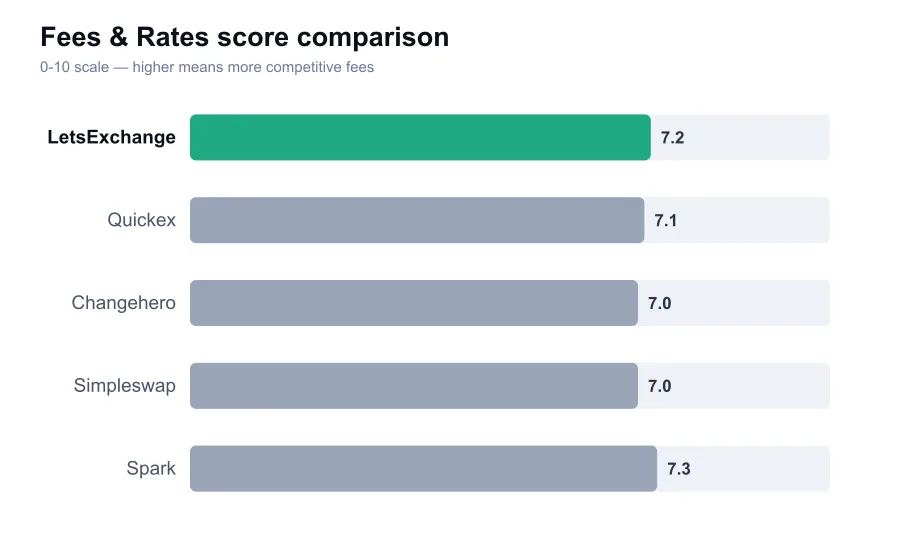
| Fees & Rates | 7.2 | Competitive quotes, but spreads vary by route |
| Transaction Speed | 7.8 | Fast on liquid pairs after confirmations |
| Security & KYC Policy | 7.1 | No routine account, but compliance holds can occur |
| Reputation & Track Record | 8.0 | Established aggregator with broad integrations |
| Customer Support | 6.8 | Live chat helps, complex cases can drag |
In-Depth Review
LetsExchange is one of the larger instant crypto swap aggregators, sitting somewhere between a simple retail exchange widget and a routing engine that searches liquidity across partner exchanges. You do not open a trading account, study order books, or leave assets on a custodial platform for days. Pick a pair, send coins, and receive another asset at a destination wallet. That simplicity is the appeal, and it has helped LetsExchange become much more visible than many anonymous swap sites.
The service supports a very wide list of coins, tokens, and networks. For someone holding a less common asset, that breadth can be genuinely useful. LetsExchange often finds routes that a single venue cannot offer directly. It also has API and widget products for wallets, affiliate sites, and crypto businesses, which explains why its name appears behind some third party swap interfaces. This is not just a consumer facing exchange with a basic landing page.
Fees are where shoppers need to slow down. LetsExchange does not present itself as a flat fee service with a clean percentage that applies to every swap. Its quote includes the exchange rate, network costs, and the spread or fee embedded in the route. That is common among instant exchanges, but it makes a quick comparison harder. A route that looks excellent for BTC to ETH may be less attractive for a smaller token or a thinly traded network.
The practical move is to compare the final receive amount against ChangeNOW, StealthEX, ChangeHero, and a major exchange if you already have an account there. LetsExchange can be competitive, particularly on popular pairs and when its routing partners have deep liquidity. It is not reliably the cheapest choice. On some transactions, especially small ones where network fees matter, the difference between quoted outcomes can be larger than a newcomer expects.
There are floating and fixed rate options for supported pairs. A floating rate exchange follows the market while the transfer is processed, so the final amount can move if the asset is volatile. Fixed rate swaps cost a little more at times, but they are sensible for people who need a predictable result. The catch is that a fixed quote has a time limit and a required deposit amount. Sending late, or sending an incorrect amount, can turn a supposedly simple swap into a support case.
Speed is usually good rather than miraculous. A straightforward, liquid swap can complete in several minutes after the deposit receives enough confirmations. Bitcoin deposits naturally take longer than a quick Polygon, Tron, or Binance Smart Chain transfer. The service can only move as quickly as the source network, the destination network, and its selected liquidity partner allow. A claim of instant exchange should be read as no manual trading interface, not as a guarantee of instant blockchain settlement.
LetsExchange is strongest on ordinary swaps where both sides are liquid and the user sends the exact quoted amount. It is less graceful with awkward cases: underpayments, delayed deposits, memo mistakes, network congestion, or tokens with low liquidity. Those cases are not unique to LetsExchange, but aggregation introduces another layer between the customer and the venue handling execution. That can make the explanation of a delay feel less direct than it would at a single exchange.
The platform is noncustodial in the normal instant swap sense. It does not operate as a long term wallet where customers maintain a trading balance. Still, users send funds to an exchange address during the transaction, so noncustodial should not be mistaken for trustless. You are relying on LetsExchange and its partners to complete the route. That is a different risk profile from signing a trade directly through an onchain decentralized exchange.
LetsExchange advertises no mandatory account registration and can process many swaps without routine KYC. Its terms and compliance language also make clear that transactions can be flagged under anti money laundering procedures. In a flagged case, the company may request identity documents or source of funds information before releasing or returning assets. This is an industry reality, but people choosing an instant exchange specifically to avoid verification should understand the distinction before sending funds.
Its security story is adequate, not exceptional. The lack of a permanent custodial balance reduces exposure to an exchange insolvency scenario, and no account means fewer password and account takeover concerns. Yet the company does not offer the kind of independently audited proof of reserves, regulated custody disclosures, or mature security reporting that would justify treating it like a top tier centralized exchange. Verify the destination address yourself and use a test transaction for unfamiliar networks.
Reputation is one of LetsExchange's better attributes. It has operated for years, maintains public product documentation, and has built recognizable integrations across the crypto wallet and swap ecosystem. That is a meaningful step above brand new exchange sites that appear with little company history. Public review sites contain plenty of successful swap reports, but they also contain complaints about delayed orders, rate movement, and verification requests. Neither set should be ignored.
I would not rank LetsExchange alongside Kraken or Coinbase for institutional transparency, regulatory clarity, or recourse. That would be the wrong comparison. Against the instant swap field, though, it is an established operator with a real product footprint. The broad asset list is an advantage, but it also means its execution quality depends heavily on which route the system selects. A familiar brand name does not make every listed pair equally strong.
Support is available through live chat and email, and the site has a help center covering common issues such as confirmation delays and incorrect deposits. In ordinary cases, that is enough. The quality test arrives when an order has been held by a partner or needs a manual refund. Some users report responsive handling, while others describe repetitive requests for information or waiting longer than they expected. That unevenness is frustrating but fairly typical for this category.
My take is that LetsExchange is a capable choice for users who value token coverage and a straightforward checkout more than absolute fee certainty. Check the quote against at least one rival, choose fixed rate when a precise outcome matters, and never send funds before reading the order details. It is a respectable aggregator, not a magic tunnel around market risk, blockchain delays, or compliance checks. Used carefully, it earns its place near the front of the instant exchange market.
Pros & Cons
| Pros | Cons |
|---|
Verdict
Frequently Asked Questions
Does LetsExchange require KYC?
It does not normally require account registration or routine KYC for standard swaps. Transactions flagged by compliance systems may be paused while identity or source of funds documents are requested.
How long does a LetsExchange swap take?
Many liquid swaps finish within minutes after the deposit confirms. Bitcoin, congested networks, low liquidity assets, and manual reviews can make an order take substantially longer.
Are LetsExchange rates fixed?
Supported pairs can offer fixed rate or floating rate quotes. Fixed quotes are time limited and require sending the exact requested amount.