Curve
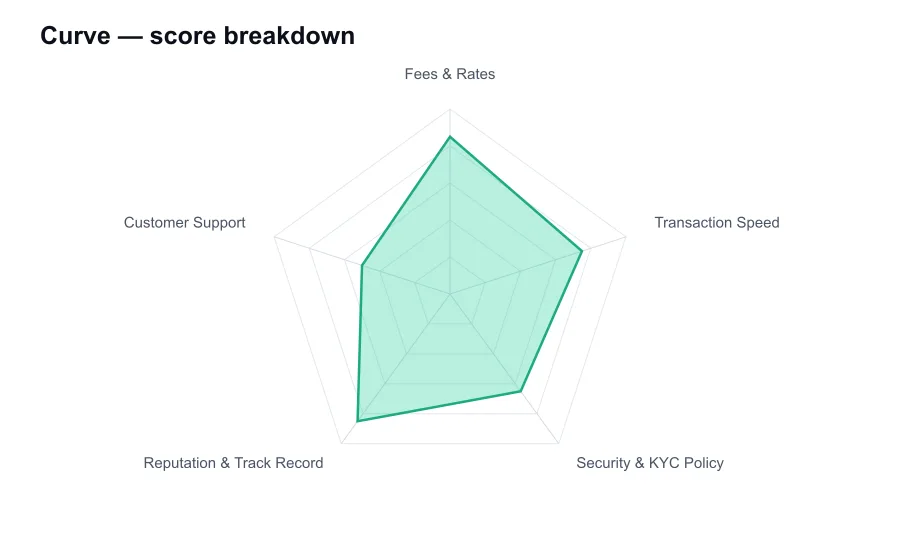
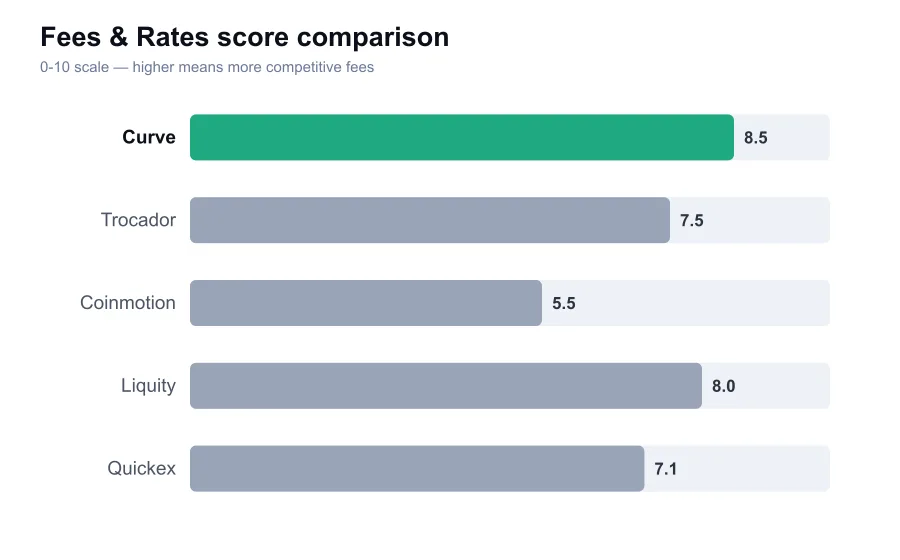
Curve scores 7.5/10 overall in our independent review, measured against every other provider we've compared, strongest on Fees & Rates (8.5/10) and weakest on Customer Support (5.0/10).
7.5/10 ★★★★★ How we score → Visit official siteEditorial independence: our scores and rankings are produced using the fixed criteria above and are not influenced by advertisers. This is an independent ranking site and is not operated by, or affiliated with, any provider we list.
Affiliate disclosure: some links on this page may earn us a commission at no extra cost to you. This does not affect our rankings.
| Best for | Not for |
|---|---|
| Excellent stablecoin and correlated-asset swap liquidity | Major 2023 exploit remains a material security concern |
| Low fees in many established pools | Liquidity provision can hide depeg exposure |
Criteria & Scores
| Criterion | Score | Note |
|---|---|---|
| Fees & Rates | 8.5 | Classic pools often use low fees, with pool-specific dynamic pricing |
| Transaction Speed | 7.5 | Quick on L2s, Ethereum execution depends on gas and blocks |
| Security & KYC Policy | 6.5 | Audited and battle-tested, but serious exploit history matters |
| Reputation & Track Record | 8.5 | A foundational DeFi protocol with years of market relevance |
| Customer Support | 5.0 | Community support only, with no transaction recovery service |
In-Depth Review
Curve is one of DeFi's foundational automated market makers, built primarily for assets that should trade near the same price. Stablecoins, wrapped versions of major assets, liquid staking derivatives, and yield-bearing tokens are where it has historically excelled. While Uniswap became the household name for token swaps, Curve became the specialist venue for low-slippage stablecoin liquidity and deep onchain foreign exchange between dollar-pegged assets.
Its signature stableswap invariant is the reason it matters. Traditional constant-product pools can create excessive slippage when exchanging assets that are meant to remain close in value, such as USDC and DAI. Curve's design concentrates liquidity near the peg, giving traders better execution while still allowing prices to move when a stablecoin becomes stressed. That structure helped Curve become central infrastructure for stablecoin trading.
Fees are usually competitive. Many classic Curve pools have historically charged a 0.04% swap fee, though the precise fee can vary by pool and pool design. Newer implementations can use dynamic fees that increase when the pool is imbalanced or market conditions justify greater protection for liquidity providers. That is sensible risk management, but users should inspect the actual pool rather than assume every Curve trade carries the same cost.
The visible fee is only part of the deal. A stablecoin swap can be cheap on Curve while still carrying significant depeg risk in the underlying assets. A discounted stablecoin is not necessarily a bargain. It may be the market warning you that redemption, custody, collateral, or liquidity conditions have changed. Curve is very good at exchanging assets. It cannot make a troubled asset safe.
Curve is fast in the way most onchain exchanges are fast: it settles at the speed of the network hosting the pool. On Ethereum mainnet, a transaction can be quick in normal conditions but costly during congestion. On Arbitrum, Optimism, Polygon, Base, Avalanche, and other supported environments, small swaps are usually far cheaper and feel close to instant. Cross-chain movement remains a separate process with bridge risk and additional timing.
For large stablecoin trades, Curve can still be one of the best places to start a quote comparison. Its deepest pools have often been used by aggregators such as 1inch and Paraswap because the pricing is hard to beat near parity. The right choice is not always Curve directly, especially if an aggregator can split an order between Curve and other venues, but ignoring Curve's liquidity is a mistake.
Security is where the review becomes less comfortable. Curve has been heavily audited and has operated since 2020, but it has also experienced serious incidents. In July 2023, a vulnerability affecting certain Vyper compiler versions led to reentrancy exploits against several Curve pools, with losses measured in tens of millions of dollars. That was a painful reminder that even mature protocols can be exposed by dependencies below the application layer.
Curve and affected parties worked through recovery efforts, white-hat returns, and governance responses, but the event should remain part of any honest assessment. The protocol did not disappear, and its resilience deserves credit. Still, a long history and multiple audits do not erase smart contract risk. Its ecosystem is technically complex, with factories, gauges, gauges incentives, pool variations, and integrations that can be difficult for ordinary users to evaluate.
KYC is not required for normal Curve swaps or liquidity provision. Users connect a self-custody wallet and interact with contracts. That preserves permissionless access, but it also means there is no central party to reimburse a bad transaction, recover a seed phrase, or reverse an approval. Anyone using Curve should verify the official interface, inspect transaction prompts, and revoke unused approvals periodically.
Curve's reputation is unusual. It is both an old guard DeFi protocol and a system that has repeatedly been at the center of complicated liquidity, governance, and token incentive dynamics. CRV emissions and vote-escrow governance created the so-called Curve Wars, where protocols competed for control over rewards. That mechanism was innovative and influential, though it also made Curve feel more like financial infrastructure for sophisticated participants than a clean retail product.
The crvUSD stablecoin and LLAMMA lending mechanism expanded Curve's ambitions beyond swaps. LLAMMA is designed to manage collateral liquidations gradually around price ranges rather than relying only on a single abrupt liquidation event. It is an inventive design, but it is not simple. Users borrowing against volatile collateral should study how soft liquidations work before treating crvUSD lending as a conventional loan.
Support is limited in the way decentralized protocols usually are. Curve has documentation, community governance forums, Discord and social channels, but no conventional customer service department. Community members can help identify a transaction or explain a pool, yet they cannot change blockchain finality. The volume of impersonators around a famous DeFi brand makes official-channel verification especially important.
Liquidity providers face their own risks. Curve pools can earn fees and CRV incentives, but returns may be offset by depegs, changing pool balances, incentive reductions, and impermanent-loss-like exposure. Stable pools reduce volatility relative to random token pairs, not eliminate it. A pool holding three supposed dollars can become a pool holding mostly the one dollar asset that the market no longer wants.
Curve remains indispensable infrastructure, but it is not a carefree exchange for newcomers. Its fees and liquidity can be exceptional for stable assets, and its place in DeFi history is deserved. The security record is mixed enough to demand caution, particularly around newer pools and complex products. I would happily use established Curve pools for well-researched swaps, often through an aggregator. I would be much more selective about providing liquidity or using advanced borrowing tools unless I had a clear reason and understood the downside.
Pros & Cons
| Pros | Cons |
|---|
Verdict
Frequently Asked Questions
What are Curve swap fees?
Many classic Curve pools have used a 0.04% swap fee, but fees vary by pool and dynamic-fee design. Check the specific pool before trading or providing liquidity.
Does Curve require KYC?
No routine KYC is required for normal wallet-based swaps and liquidity provision. Transactions are public on the relevant blockchain and cannot be reversed.
Was Curve hacked?
Certain Curve pools were exploited in July 2023 through a Vyper compiler vulnerability that enabled reentrancy attacks. The incident caused substantial losses and remains relevant to risk assessment.