SecureShift
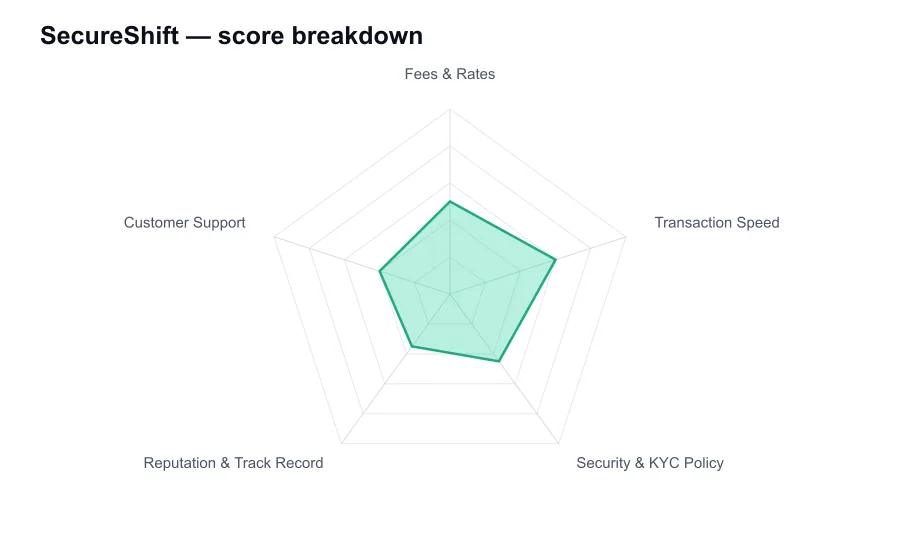
SecureShift scores 4.7/10 overall in our independent review, measured against every other provider we've compared, strongest on Transaction Speed (6.0/10) and weakest on Reputation & Track Record (3.5/10).
4.7/10 ★★★★★ How we score → Visit official siteEditorial independence: our scores and rankings are produced using the fixed criteria above and are not influenced by advertisers. This is an independent ranking site and is not operated by, or affiliated with, any provider we list.
Affiliate disclosure: some links on this page may earn us a commission at no extra cost to you. This does not affect our rankings.
| Best for | Not for |
|---|---|
| Simple swap-focused user journey | Limited public reputation data |
| No trading account appears necessary for a basic exchange | Fee and spread transparency is weak |
Criteria & Scores
| Criterion | Score | Note |
|---|---|---|
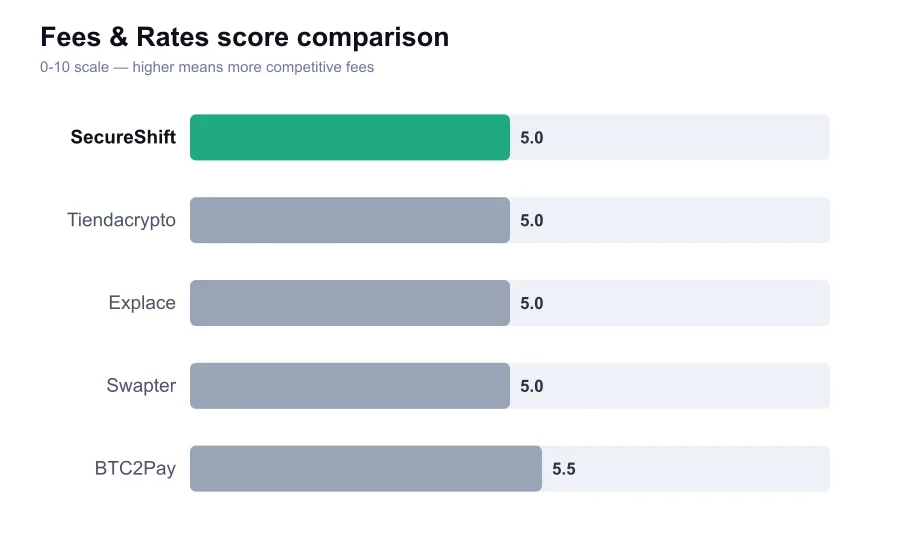
| Fees & Rates | 5.0 | Compare final receive quotes, pricing transparency is limited. |
| Transaction Speed | 6.0 | Potentially quick for liquid pairs, network delays still apply. |
| Security & KYC Policy | 4.5 | Small-ticket testing is sensible given limited public evidence. |
| Reputation & Track Record | 3.5 | Limited independently verifiable operating track record. |
| Customer Support | 4.0 | Support depth is not well demonstrated publicly. |
In-Depth Review
SecureShift presents itself as a lightweight crypto swap service for people who want to move between assets without opening an account at a large exchange. That places it in a crowded corner of the market, alongside instant-swap brands such as ChangeNOW, SimpleSwap, and StealthEX. The appeal is obvious: pick a pair, send coins, receive the converted asset. The problem is that SecureShift has a much thinner public footprint than those established names, and that affects almost every part of the review.
The service feels designed for occasional swaps rather than for active traders. There is no serious trading terminal, no order book, no visible advanced order functionality, and no reason to treat it as a replacement for Coinbase Advanced, Kraken Pro, or Binance. Its use case is narrower. It is for somebody holding one asset in a self-custody wallet who wants another without depositing funds onto a conventional exchange.
Pricing is the first area where a buyer should slow down. SecureShift's quoted output is more meaningful than any advertised fee because the practical cost is likely embedded in the exchange rate, network charge, and liquidity-provider spread. That is standard in this sector, but it makes comparison difficult. A swap can look cheap until you compare the final amount with a live quote from a larger competitor or a decentralized route.
I would not assume a zero-fee headline means a zero-cost transaction. Instant exchangers commonly earn through the spread, and the spread can widen sharply on thin pairs, volatile assets, or smaller transaction sizes. SecureShift does not have the kind of deeply documented fee schedule and public liquidity disclosures that let a reviewer confidently calculate its normal markup. For small convenience swaps, that may be acceptable. For a four-figure conversion, it is not good enough to take on faith.
The sensible approach is to obtain a quote, then compare the receive amount with at least two alternatives before sending funds. Check both a centralised venue and a comparable instant exchanger. If the gap is a few dollars, convenience may justify it. If it is materially wider, SecureShift has not given the user a compelling reason to pay extra merely for a simplified interface.
Speed depends less on the brand than on the route behind the swap. Bitcoin confirmations, Ethereum gas conditions, wallet compliance checks, and liquidity-provider settlement all matter. A simple swap involving liquid assets can complete within minutes after the incoming transaction confirms. A transaction involving Bitcoin, USDT on a congested network, or a less common token can take much longer. SecureShift should be judged by the realistic completion estimate shown before payment, not by a vague promise of instant exchange.
There is a key distinction between fast processing and fast blockchains. No service can make a Bitcoin deposit final before the network has provided enough confirmations. It also cannot guarantee a quick completion if its liquidity partner pauses a trade for risk review. Users who need a deadline, such as someone moving collateral or paying a merchant, should leave a generous buffer and avoid treating an instant-swap quote as a guaranteed settlement service.
Security is where SecureShift's limited public history becomes a real drawback. A non-custodial flow is generally preferable to leaving balances on an obscure exchange, because funds are sent for a specific conversion rather than held indefinitely in an account. Still, non-custodial does not mean risk-free. You are trusting the operator to deliver the quoted output, protect transaction data, and handle exceptions fairly.
The service should also be assumed to operate a risk-based compliance process, as most crypto exchange providers do. A platform may advertise a quick registration-free flow, yet still pause a transaction if its automated checks flag the source address or transfer pattern. That is not inherently improper, but users need a clear written process for what happens next, what documents may be requested, and how refunds are handled. SecureShift does not have the transparency record I would want before sending a large amount.
Do not use a newly discovered swap site for your first large transfer. Test the exact network, asset, and destination wallet with a small amount. Save the quoted rate, transaction ID, destination address, and screenshots of the order page. That advice sounds basic, but it is the difference between having evidence during a dispute and merely having a wallet hash with no context.
Reputation is SecureShift's weakest category. It does not have the broad independent review volume, long operating history, or public-facing leadership profile that gives a user confidence in a mature financial service. Absence of a major public controversy is not the same thing as a demonstrated record of reliable execution. In crypto, a quiet reputation can mean a clean operation, but it can also mean the business has not handled enough visible volume to be tested.
That matters most in edge cases. Any exchange service can complete an ordinary ETH to USDC conversion. The real test is whether it responds quickly when the user selects the wrong network, sends below a minimum, triggers a compliance flag, or receives less than expected due to a market movement. SecureShift has not accumulated enough publicly verifiable evidence for me to call it dependable under stress.
Support appears to be an online-ticket proposition rather than a full-service operation with phone access and a mature help centre. That is common for small crypto services, but it leaves customers exposed if a transfer is pending. Before using it, look for a visible support contact, transaction-status tools, clear refund instructions, and a way to cite an order ID. If those basics are absent at the moment you need help, walk away.
SecureShift is not automatically a bad choice, but it is a cautious choice rather than a confident recommendation. It may suit a small, routine swap where the quote is competitive and you have already tested the flow. It has not earned the trust required for large conversions, urgent transfers, or assets that cannot easily be recovered after an error. For those jobs, a better-known exchange or a highly documented swap provider is the safer bet.
My view is blunt: SecureShift has the convenience profile of an instant exchanger without yet showing the public evidence that makes an instant exchanger easy to recommend. Treat it as a small-ticket tool, verify every quote, and keep records. Until its reputation and operational transparency are stronger, the prudent user should value established alternatives more highly than a clean interface.
Pros & Cons
| Pros | Cons |
|---|
Verdict
Frequently Asked Questions
Should I use SecureShift for a large crypto swap?
No. Start with a small test transfer and use a more established provider for large or time-sensitive conversions.
Are SecureShift fees easy to verify?
The practical cost should be judged from the final receive amount, including spread and network charges, against competing live quotes.
Can a no-account swap still trigger verification?
Yes. Crypto swap services may pause transactions for compliance review even where routine registration is not required.