BTC2Pay
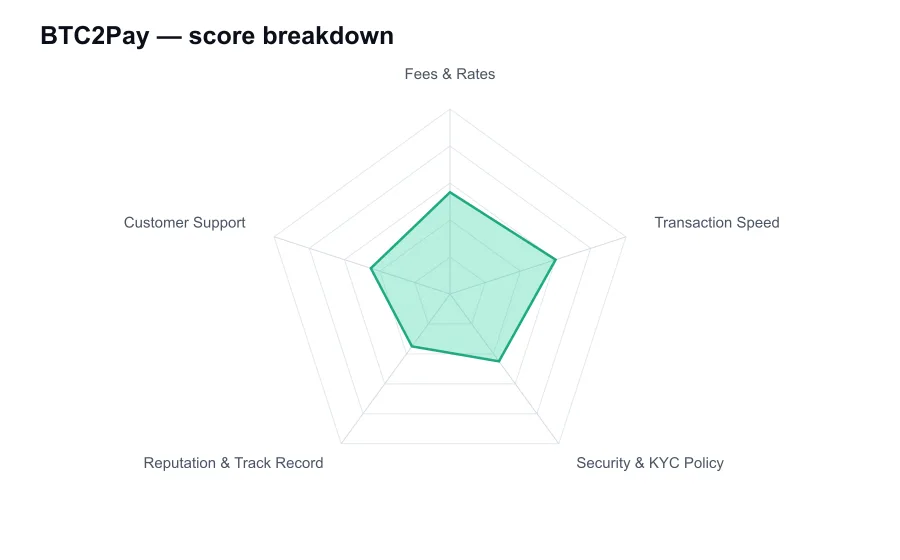
BTC2Pay scores 4.9/10 overall in our independent review, measured against every other provider we've compared, strongest on Transaction Speed (6.0/10) and weakest on Reputation & Track Record (3.5/10).
4.9/10 ★★★★★ How we score → Visit official siteEditorial independence: our scores and rankings are produced using the fixed criteria above and are not influenced by advertisers. This is an independent ranking site and is not operated by, or affiliated with, any provider we list.
Affiliate disclosure: some links on this page may earn us a commission at no extra cost to you. This does not affect our rankings.
| Best for | Not for |
|---|---|
| Simple wallet-to-wallet swap flow | Limited public company and security detail |
| Potentially low-friction for routine swaps | Quotes do not fully itemize all costs |
Criteria & Scores
| Criterion | Score | Note |
|---|---|---|
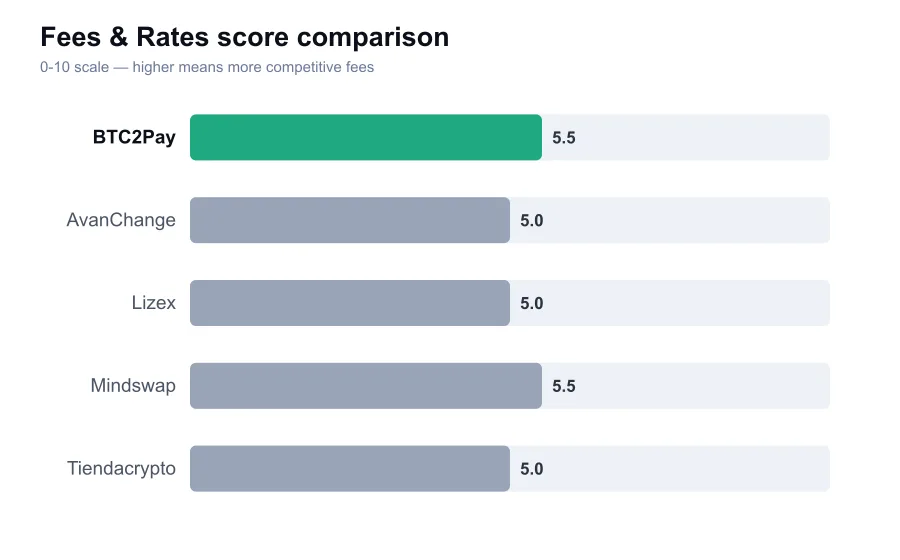
| Fees & Rates | 5.5 | Quotes can be competitive, but cost disclosure is limited |
| Transaction Speed | 6.0 | Fast on liquid routes, dependent on network confirmations |
| Security & KYC Policy | 4.5 | Low-friction swaps, but limited public security transparency |
| Reputation & Track Record | 3.5 | Small public footprint and limited long-term evidence |
| Customer Support | 4.5 | Online support model with little visible escalation detail |
In-Depth Review
BTC2Pay appears to sit in the small, privacy-focused corner of the instant crypto exchange market. It is aimed at someone who wants to swap one coin for another without opening a trading account, studying a depth chart, or handing over a full identity file for an ordinary transaction. That proposition still has an audience, particularly among experienced self-custody users. The problem is that BTC2Pay is a much less visible name than ChangeNOW, SimpleSwap, FixedFloat, or even the better-established regional swap services.
The site experience is built around a familiar quote-and-send flow. Pick the asset you are sending, select what you want to receive, enter a destination address, and fund the generated deposit address. There is little apparent interest in turning the service into a broad brokerage or portfolio platform. Some people will appreciate that restraint. Others will find the thin product footprint worrying, because a simple interface is only reassuring if the operator behind it has earned trust.
BTC2Pay's pricing is difficult to assess with the precision I would expect from a mature exchange. The displayed quote is the practical fee a customer pays, but the spread, network charge, liquidity cost, and service margin are not always separated cleanly enough to let users compare like for like. That does not automatically mean the rate is bad. It does mean that the headline amount deserves checking against at least one competing instant exchanger before you hit send.
For small swaps, the effective cost can be reasonable if the route has good liquidity and the blockchain fee is modest. For Bitcoin, Ethereum, and popular stablecoin pairs, I would expect users to test BTC2Pay's quote against ChangeNOW and SimpleSwap. A difference of one or two percent is not unusual across this market, especially during volatility. If BTC2Pay is offering the better payout, use the better payout. Loyalty to a quote widget makes no sense.
The fee issue gets sharper with small transactions. A fixed or elevated blockchain fee can eat a noticeably large share of a $30 or $50 exchange, particularly on Ethereum mainnet. BTC2Pay does not appear to give the kind of detailed cost breakdown that helps a newcomer understand this before depositing. That is a weakness. A serious exchange service should distinguish its own margin from the unavoidable cost of moving funds through a network.
Speed is mostly determined by the asset, the confirmation requirement, and the liquidity route rather than by the polished appearance of the exchange page. A swap involving fast networks can complete in minutes once the deposit is detected. Bitcoin transactions can take materially longer, especially if the sender chooses a low mining fee. BTC2Pay should not be judged for Bitcoin congestion, but it should set clear and realistic expectations about confirmation stages and payout status.
The service model also creates a familiar risk: once coins are sent to an instant exchange, the customer depends on the operator and its providers to complete the second leg. There is no order book where a user can cancel an unfilled order, and there is no custody dashboard built for long-term balances. That is normal for this category, but it makes address checking essential. A mistaken destination address or unsupported memo can turn a quick swap into a support case.
BTC2Pay's apparent low-friction approach will appeal to users who dislike routine account registration. Still, no-KYC should never be read as no-compliance. Like other swap providers, BTC2Pay can request identification or source-of-funds information if a transaction triggers compliance controls, blockchain monitoring, or a liquidity-provider review. Anyone who needs a guaranteed identity-free transaction should not assume that any centralized exchange service can honestly promise that.
The bigger security question is not whether the checkout page looks secure. It is whether the company provides enough transparent information about its legal entity, operating history, custody arrangements, security controls, and dispute process. BTC2Pay does not have the public institutional profile that lets a reviewer confidently point to audited reserves, a lengthy regulatory record, or widely documented security engineering. That does not prove misconduct. It does limit the amount of confidence a prudent user should assign to it.
I would be especially cautious with large transfers. A small test transaction is sensible for any new instant exchange, but it is more important with a lightly documented provider. Verify the destination address, check whether the rate is fixed or floating, save the order ID, and do not send more than you can afford to have delayed. Those aren't glamorous precautions, but they are the practical difference between using a swap service carefully and treating it like a bank.
Reputation is BTC2Pay's weakest area. It does not have the long public record, broad independent review base, or recognizable management footprint that supports confidence in major exchanges. Search results and scattered comments can be useful signals, but they are not the same as years of independently scrutinized operations. I found too little robust, durable public evidence to rank BTC2Pay near the established leaders in its category.
That lack of visibility matters most when something goes wrong. A smooth swap tells you very little about how an operator handles an AML hold, a disputed rate, a delayed provider, or a missing tag. The test of a service is its difficult cases. BTC2Pay does not yet have enough accessible public evidence of those cases being resolved consistently for me to call its support reputation strong.
Support appears to be centered on online contact rather than an expansive public help operation. That is common for smaller crypto services, but users should expect a more limited safety net than they would receive from a regulated local exchange with phone support and named escalation paths. Before placing a meaningful transaction, look for current support hours, ticket channels, and the wording around transaction reviews. If those basics are unclear, stop there.
BTC2Pay can work for a technically capable person making a modest, straightforward swap and willing to compare the live quote. It is not where I would start a first-time buyer, a business settling invoices, or anyone moving a large sum. The lack of deep public transparency outweighs the convenience of a low-friction exchange flow. Treat it as a tool for small, deliberate transactions, not as a trusted financial relationship.
Pros & Cons
| Pros | Cons |
|---|
Verdict
Frequently Asked Questions
Does BTC2Pay require KYC?
Its exchange flow may not require routine account verification for ordinary swaps, but compliance checks can still trigger an ID or source-of-funds request. Never assume a centralized swap is guaranteed KYC-free.
Are BTC2Pay rates fixed?
Check the specific order screen. Instant exchanges can use either floating quotes or a fixed-rate option, and a floating payout can change if the market moves before the swap is processed.
Should I use BTC2Pay for a large transaction?
I would not make it my first choice for a large transfer. Start with a small test, compare alternatives, and use a provider with a deeper public track record for substantial sums.