Explace
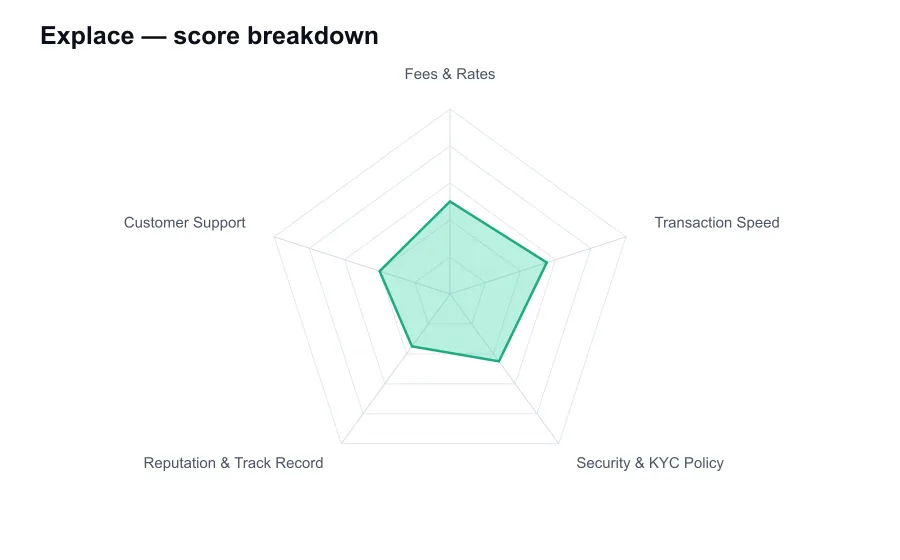
Explace scores 4.6/10 overall in our independent review, measured against every other provider we've compared, strongest on Transaction Speed (5.5/10) and weakest on Reputation & Track Record (3.5/10).
4.6/10 ★★★★★ How we score → Status: active (checked 2026-10-13T19:50:26.014Z) Visit official siteEditorial independence: our scores and rankings are produced using the fixed criteria above and are not influenced by advertisers. This is an independent ranking site and is not operated by, or affiliated with, any provider we list.
Affiliate disclosure: some links on this page may earn us a commission at no extra cost to you. This does not affect our rankings.
| Best for | Not for |
|---|---|
| Simple wallet-to-wallet swap flow | Thin public track record compared with established competitors |
| No trading terminal required | Quote composition is less transparent than an order book |
What is Explace?
How Explace Works
- Choose the crypto asset to send and the asset to receive
- Enter a receiving wallet address and any required memo
- Review the displayed estimated output
- Send the deposit to the address generated for the order
- Wait for deposit confirmation and payout processing
- Confirm receipt in your external wallet
Criteria & Scores
| Criterion | Score | Note |
|---|---|---|
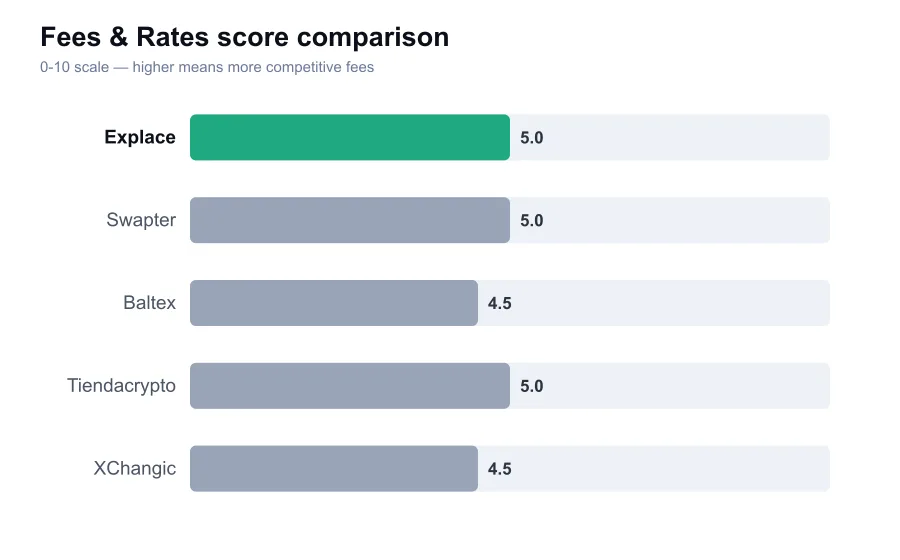
| Fees & Rates | 5.0 | Quote-based pricing needs careful comparison before sending |
| Transaction Speed | 5.5 | Standard instant-swap flow, limited public execution evidence |
| Security & KYC Policy | 4.5 | Custody exists during the swap and policies need scrutiny |
| Reputation & Track Record | 3.5 | Limited independently verifiable public track record |
| Customer Support | 4.0 | Support quality is difficult to verify on edge cases |
| Fact | Value | Source |
|---|---|---|
| Service model | Instant crypto exchange | - |
| Trading interface | No public order book | - |
| Custody pattern | Funds held during swap only | - |
| Pricing display | Quote-based output amount | - |
| Execution method | Deposit then payout | - |
KYC
| Requirement | tiered |
|---|---|
| Notes | Do not treat an account-light swap flow as a promise of anonymous use. Review the provider's current AML terms before depositing, as verification can be requested in some cases. |
How to Use Explace Safely
- Run a small test swap before using a new provider for a large amount
- Compare the final output against at least two established alternatives
- Verify token contract and network, not just the ticker symbol
- Include a required destination tag or memo where applicable
- Keep screenshots, the order reference, and the deposit hash
In-Depth Review
Explace is a smaller instant cryptocurrency exchange service, not a major centralized trading venue with deep public order books and institutional infrastructure. Its pitch is familiar: choose a coin pair, provide a payout address, send the deposit, and receive the converted asset without maintaining a trading account. That can be useful, but Explace sits in the harder-to-assess end of the market because it has far less public operating history and independent coverage than Changelly, Kraken, or Binance.
The first thing a prospective user should understand is that a clean website does not equal a mature exchange operation. Instant exchangers depend on their own systems, external liquidity providers, wallet infrastructure, compliance vendors, and blockchain nodes. A problem at any point can delay a swap. With a well-known company, there is at least a long public trail to judge. With Explace, the trail is much thinner, and that should affect how much money you are willing to send.
The interface follows the standard instant-swap format. Users select the sending asset and the receiving asset, see an estimated output, then transfer coins to a one-time deposit address. There is no visible order book for judging market depth, no professional trading terminal, and no reason to expect the execution controls offered by a large exchange. It is a convenience product for conversions, not a serious venue for active traders.
Pricing is where the lack of transparency becomes important. Explace presents a quoted receive amount, but a user should not assume that quote can be reduced to one simple published percentage. In the instant exchange model, cost can include a stated service charge, partner spread, price movement on a floating order, and network fees. If the platform does not clearly separate these components before you pay, the only honest way to judge price is to compare the final output against two or three alternatives.
That comparison is especially important for stablecoins and liquid majors. A BTC to USDT or ETH to USDC conversion should be cheap on a deep exchange, so a wide Explace quote is hard to excuse. Smaller tokens are different. Finding a convenient route between niche assets may justify paying more, particularly if you do not want to move money across several accounts. Convenience has a price, but users should know the size of it before they commit.
Transaction speed can be perfectly acceptable when the pair is liquid and the deposit has confirmed. The service cannot process an inbound transaction until the relevant chain accepts it, and Bitcoin or congested Ethereum transfers will naturally take longer. The concern is not ordinary blockchain waiting. The concern is how the provider behaves when an order falls outside the happy path, such as a delayed deposit, a failed payout, a sudden rate move, or an unsupported memo requirement.
Explace does not have the same volume of documented user experience as larger competitors. That means there is less evidence of catastrophic failure, but it also means there is less evidence that the support process handles difficult cases consistently. This is not a minor distinction. A swap service looks good when everything is automatic. Its quality becomes visible only when the deposit arrives late, the recipient chain pauses, or a customer entered the wrong destination tag.
KYC should be approached cautiously. Services marketed as quick exchanges often avoid mandatory account creation for ordinary orders, yet retain the ability to request verification under anti-money-laundering procedures. Users should read the terms and AML policy before depositing, rather than relying on a broad no-registration impression. If a service can hold a transfer while it requests documents, then users need to know that before choosing it for a time-sensitive swap.
From a security perspective, the instant-exchange model has one benefit. You do not need to leave a large standing balance in an account, which limits exposure to an account takeover or exchange insolvency involving your stored funds. But your deposit is still entrusted to the provider during processing. There is no smart contract that makes a typical centralized instant swap fully trustless. You are relying on the operator to complete the payout correctly.
The practical safeguards are basic but important. Use your own wallet, confirm every character of the receiving address, and check whether an asset needs a destination tag or memo. XRP, XLM, TON, and similar assets can be unforgiving if the routing data is omitted. Do not send a large first transaction merely because the quote looks attractive. A small test swap tells you more about execution, support responsiveness, and network handling than a marketing page ever will.
Reputation is Explace's weakest area, largely because it is comparatively obscure. A small provider can be honest and functional, but it has not earned the same presumption of reliability as a company with a decade of documented operation. I would not equate a lack of major headlines with proof of safety. It may simply mean the customer base and public scrutiny are limited.
Support is another area where conservative expectations are sensible. Email and chat support are useful for ordinary questions, but the real test is whether the operator can identify a transaction by hash, explain the status clearly, and provide a realistic timeline. If your money is on hold, generic replies are not enough. Before using Explace for anything important, see whether its help materials explain failed deposits, incorrect network submissions, refunds, and compliance checks in concrete terms.
Explace can make sense for someone who wants a quick, small conversion and has already checked that its output is competitive. It does not make sense as a substitute for an exchange account, a business payment rail, or a place to process large conversions. The risk is not necessarily that every order will fail. The risk is that an uncommon problem leaves you relying on a smaller operator with limited independently verifiable track record.
My take is blunt. Explace may be usable, but it has not earned the trust premium that would justify sending a large amount without a test. Treat it as a convenience tool, not financial infrastructure. If the quote is materially better than established rivals, ask why and test it carefully. If the quote is similar, I would choose the provider with stronger documentation, longer history, and a more visible support record.
Pros & Cons
| Pros | Cons |
|---|
Verdict
Frequently Asked Questions
Is Explace an order-book crypto exchange?
No. Explace follows an instant-swap model. Users receive a quote, deposit the selected asset to an address, and receive the converted asset in an external wallet.
How should I judge an Explace quote?
Compare the final amount you will receive with at least two alternatives. The effective cost may include provider spread, market movement on floating quotes, and network fees.
Should I use Explace for a first large transaction?
No. Its public track record is limited compared with larger providers. A small test transaction is the sensible way to verify the asset route, timing, and payout address.
Why does a crypto swap need blockchain confirmations?
Explace must detect and confirm your deposit before completing the exchange. The wait depends on the source network, fee conditions, and the asset being sent.
What should I check for XRP or XLM withdrawals?
Confirm whether the recipient wallet requires a destination tag or memo. Missing routing information can delay crediting and may require manual support intervention.
Can an instant exchanger request identity documents?
Potentially, yes. Many instant exchange services reserve the right to apply AML checks. Read Explace's current terms and policy before sending a time-sensitive or substantial transfer.