Pegasusswap
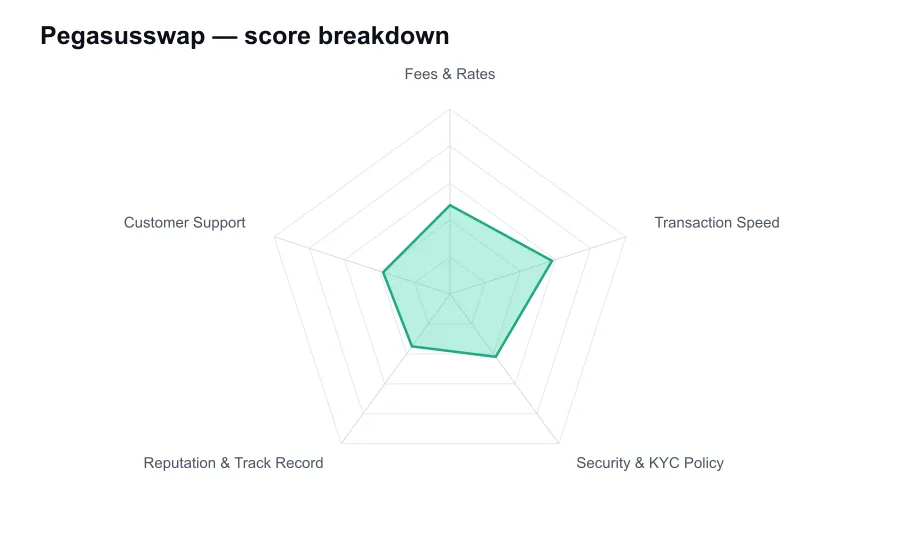
Pegasusswap scores 4.5/10 overall in our independent review, measured against every other provider we've compared, strongest on Transaction Speed (5.8/10) and weakest on Reputation & Track Record (3.5/10).
4.5/10 ★★★★★ How we score → Visit official siteEditorial independence: our scores and rankings are produced using the fixed criteria above and are not influenced by advertisers. This is an independent ranking site and is not operated by, or affiliated with, any provider we list.
Affiliate disclosure: some links on this page may earn us a commission at no extra cost to you. This does not affect our rankings.
| Best for | Not for |
|---|---|
| Potential self custody swap flow | Limited public track record |
| No typical account onboarding | Liquidity and pricing require careful verification |
Criteria & Scores
| Criterion | Score | Note |
|---|---|---|
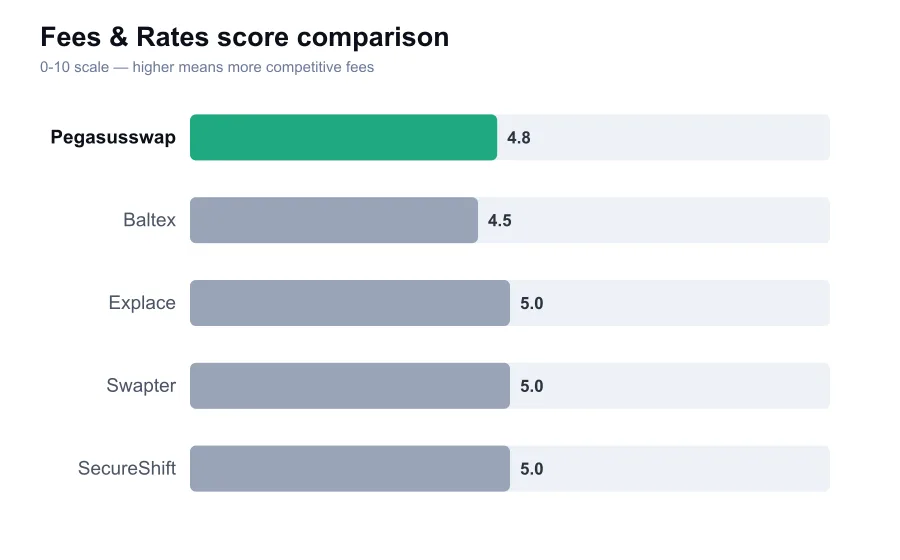
| Fees & Rates | 4.8 | Pool fees and slippage need independent checking |
| Transaction Speed | 5.8 | Chain settlement can be quick, liquidity is variable |
| Security & KYC Policy | 4.2 | Self custody model, limited public assurance |
| Reputation & Track Record | 3.5 | Thin independently verifiable market history |
| Customer Support | 3.8 | Do not expect major exchange level help |
In-Depth Review
Pegasusswap occupies a much more uncertain corner of the crypto exchange market than the big instant swap brands. The name has been associated with decentralized swap products and smaller ecosystem focused trading tools, rather than a globally recognized exchange with deep public documentation. That difference matters. A polished swap screen can make any platform look familiar, but liquidity, contract quality, ownership, and support capacity are what decide whether it deserves a user’s money.
The first problem for a prospective customer is information depth. Pegasusswap has not established the same broad, easily verifiable public track record as LetsExchange, Godex, Trocador, Uniswap, or PancakeSwap. Its visibility is limited, and detailed independent coverage is thin. That does not prove misconduct. It does mean users should stop treating it as a default recommendation until they have verified the current domain, active contracts, supported chain, and official social channels.
If Pegasusswap is being used as a decentralized exchange interface, the fee discussion starts with the underlying smart contract and network, not merely the front end. A swap normally includes a liquidity provider fee, price impact, and the chain’s gas cost. Those charges can be modest on low cost networks, then become ugly when liquidity is shallow or the token has a wide spread. A listed pair is not evidence that trading it is cheap.
The platform does not have the kind of fee transparency I expect from a mature venue. Larger decentralized exchanges generally publish pool fee tiers, router behavior, and clear contract addresses. Centralized instant exchange services at least show a final quote before deposit. With Pegasusswap, a user should independently inspect the transaction preview in their wallet and calculate the expected receive amount before approving anything. If the interface cannot clearly show price impact and minimum received, walk away.
The hidden cost on small swap platforms is often slippage. A token can appear to have an attractive displayed price while the available pool cannot absorb even a modest trade without moving the market. Automated market maker mechanics are unforgiving in that situation. Traders should test with a tiny amount, set conservative slippage, and avoid obscure pairs entirely if pool depth is not transparent. No fee percentage compensates for losing several percent to bad execution.
Speed can be quick in the narrow technical sense. A decentralized swap settles once the transaction is included on the relevant blockchain, which can take seconds or minutes on a responsive low fee network. But fast confirmation is not the same as good execution. A transaction that confirms rapidly at a terrible rate is still a poor trade. Delays may also come from wallet approval steps, RPC problems, congestion, or a front end that is no longer being actively maintained.
Pegasusswap does have one potential advantage over custodial swap sites if its decentralized model is functioning as intended. You connect a self custody wallet and authorize a smart contract rather than deposit coins into a company account for manual processing. There is no normal exchange login, no custody balance, and usually no routine KYC form. For people who understand wallet security, that structure is preferable to sending assets into an opaque centralized service.
That advantage has sharp limits. Smart contract risk replaces counterparty custody risk, and a small protocol gives users fewer reasons to assume its contracts have been thoroughly audited or battle tested. I could not treat Pegasusswap as having the security assurance of a major audited protocol merely because it uses decentralized language. Users need to locate the exact contract address from official sources, check approvals, and confirm whether an audit is current and relevant to the deployed code.
The no KYC angle is also frequently misunderstood. A decentralized interface generally does not ask for identity documents, but blockchain transactions remain public and wallet providers or front ends can restrict access by jurisdiction. More importantly, a lack of KYC says little about safety. It only changes the onboarding model. Privacy minded users should care just as much about malicious token approvals, phishing domains, and whether the site asks a wallet to sign an unusual message.
Reputation is Pegasusswap’s weakest area. A trusted exchange builds confidence through years of uninterrupted operation, public technical records, clear governance, known teams or accountable entities, reliable market data, and a meaningful volume of independent user experience. Pegasusswap does not offer the same level of evidence. The absence of a large complaint trail is not reassuring by itself, because low visibility can simply mean a small user base.
This is why comparisons with Uniswap or PancakeSwap are useful. Those platforms also carry smart contract and token risks, but their contracts, analytics, community scrutiny, and market history are much easier to inspect. Pegasusswap asks the user to do more investigative work for less obvious benefit. Unless it provides access to a genuinely unique pool or ecosystem asset, the case for choosing the lesser known venue is weak.
Customer support is another concern. Decentralized swaps are inherently difficult to reverse, and a small protocol rarely has the staffed support operation needed to handle wallet, transaction, and token disputes around the clock. Documentation and a responsive official community channel matter far more here than marketing promises. If a transaction fails, a user may need to read the block explorer, adjust gas, or revoke an approval without meaningful human help.
I would be especially cautious about links shared through Telegram, X, Discord, or search ads. Swap brands are common phishing targets, and a smaller name gives impostors more room to blend in. Bookmark the verified site after checking official channels. Never approve unlimited token spending if a limited approval is possible, and revoke old approvals once a trade is done. These are sensible habits everywhere, but they are essential with low profile protocols.
Pegasusswap may be usable for experienced onchain participants who have independently verified the current contracts and understand the specific chain it serves. It is not a service I would recommend to beginners, people converting a large amount, or anyone who wants a clear responsible company behind a transaction. The potential convenience of a no account swap does not overcome the thin public record. Until stronger evidence of liquidity, audits, and sustained operation emerges, caution is the rational position.
Pros & Cons
| Pros | Cons |
|---|
Verdict
Frequently Asked Questions
Does Pegasusswap require KYC?
A decentralized wallet based swap flow normally does not require conventional KYC. Users should still verify the current service terms and availability in their jurisdiction.
Is Pegasusswap safe to use?
It should not be assumed safe solely because it is decentralized. Verify the official domain, contract address, liquidity, audit status, and wallet approval request before using it.
Why can a Pegasusswap trade cost more than expected?
Pool fees, network gas, price impact, and slippage can all reduce the amount received. Thin liquidity is often the biggest issue on lesser known swap venues.