Swapter
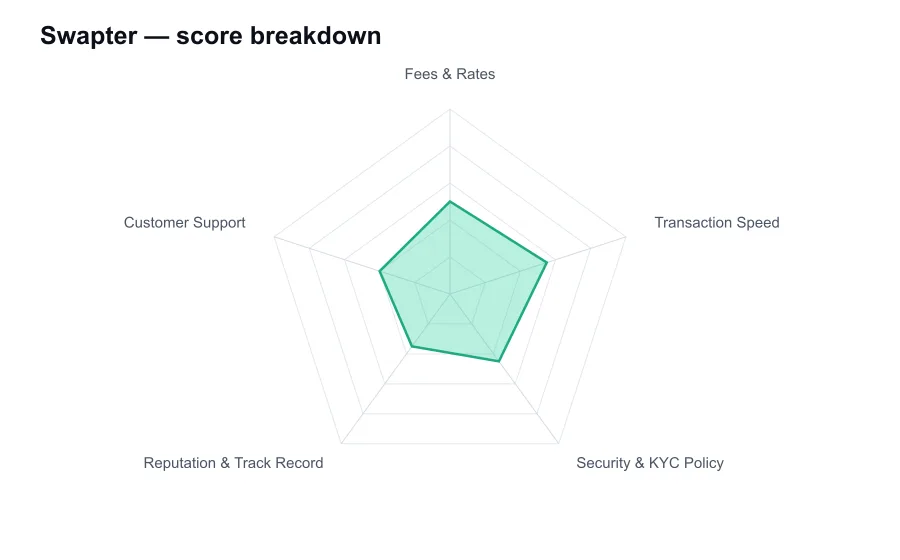
Swapter scores 4.6/10 overall in our independent review, measured against every other provider we've compared, strongest on Transaction Speed (5.5/10) and weakest on Reputation & Track Record (3.5/10).
4.6/10 ★★★★★ How we score → Status: active (checked 2026-10-13T19:50:26.079Z) Visit official siteEditorial independence: our scores and rankings are produced using the fixed criteria above and are not influenced by advertisers. This is an independent ranking site and is not operated by, or affiliated with, any provider we list.
Affiliate disclosure: some links on this page may earn us a commission at no extra cost to you. This does not affect our rankings.
| Best for | Not for |
|---|---|
| Straightforward wallet-to-wallet swap process | Limited public operating track record |
| No professional trading interface needed | All-in pricing requires manual comparison |
What is Swapter?
How Swapter Works
- Select the source and destination cryptocurrency
- Enter the payout wallet address and any required memo or tag
- Review the quoted output and order details
- Send the source asset on the exact requested network
- Wait for blockchain confirmations and order processing
- Receive the converted asset in the destination wallet
Criteria & Scores
| Criterion | Score | Note |
|---|---|---|
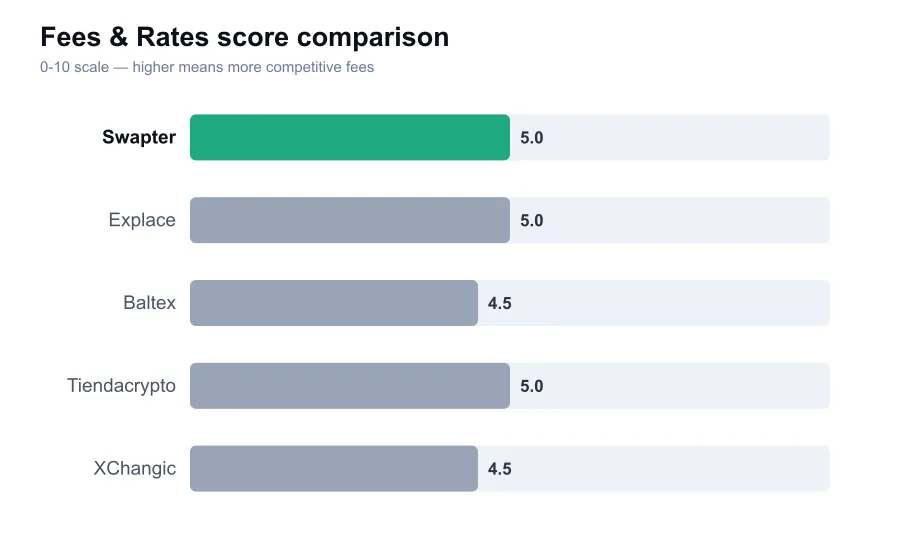
| Fees & Rates | 5.0 | Effective cost must be judged from the final quote |
| Transaction Speed | 5.5 | Normal instant-swap timing, dependent on chain confirmations |
| Security & KYC Policy | 4.5 | Temporary custody and possible compliance intervention |
| Reputation & Track Record | 3.5 | Smaller public footprint than established swap providers |
| Customer Support | 4.0 | Limited independent evidence on difficult-case support |
| Fact | Value | Source |
|---|---|---|
| Service model | Instant crypto exchange | - |
| Execution flow | Deposit then wallet payout | - |
| Trading interface | No public order book | - |
| Custody pattern | Temporary during transaction | - |
| Pricing method | Quote-based conversion | - |
KYC
| Requirement | tiered |
|---|---|
| Notes | An account-light exchange flow should not be treated as guaranteed anonymous use. Users should review current terms and be prepared for possible AML verification in exceptional cases. |
How to Use Swapter Safely
- Test a new swap route with a small amount first
- Compare the exact payout amount with alternative providers
- Confirm the website domain before creating an order
- Match the token network exactly, especially for stablecoins
- Keep the order reference and deposit transaction hash until paid
In-Depth Review
Swapter is a smaller instant crypto exchange that aims to make coin-to-coin conversions quick and uncomplicated. It is not a decentralized exchange, despite the wallet-to-wallet feel of its interface, and it is not a conventional centralized exchange with an order book. The model is straightforward: choose a pair, obtain a quote, send the deposit to Swapter's generated address, and receive the destination asset. That simplicity is attractive, but the service belongs in the higher-caution tier of the instant swap market.
The company is far less established in public view than Changelly or Alfacash. That does not automatically make it unsafe. Small providers can offer good execution and attentive support. It does mean the burden shifts to the user to verify the route, test the service, and avoid treating a polished exchange widget as evidence of deep reserves or mature risk controls. For a provider handling irreversible crypto transfers, limited public history is a real disadvantage.
Swapter's main value proposition is convenience. Users can exchange assets directly from a self-custody wallet without opening a full account, funding a custodial balance, or learning an advanced trading interface. That is useful for someone who needs a quick conversion from Bitcoin to Ethereum, from a stablecoin to a network token, or from one supported asset to another. It is much less useful for anyone who cares about precise execution, charting, limit orders, or audited liquidity.
Fees are best assessed from the quote, not from a marketing claim. An instant exchanger can charge through an explicit fee, the spread between market price and its quoted rate, network costs, or all three. A customer who sees a no-fee label but receives materially less than the market value has still paid. Before confirming a Swapter order, compare the expected output with a large exchange and at least one rival swap service. That takes a minute and can save far more than it costs.
Floating-rate orders need particular care. The amount displayed when you start may not be the amount received if the market moves while your deposit is awaiting confirmations. Fixed-rate orders can reduce that uncertainty, if available for the selected pair, though the protection often carries a wider spread. There is no universally better option. A floating route can be sensible in a stable market, but I would favor certainty for a larger transfer or a payment where the recipient expects an exact amount.
Swapter's transaction time depends heavily on the sending blockchain. A fast chain can make the process feel nearly immediate after confirmation. Bitcoin can make the same service feel slow, especially during a fee spike. Ethereum token transfers may be delayed by congestion or an underpriced gas setting. The provider should show order status clearly, but users need to distinguish a genuine service delay from an incoming deposit that has not been confirmed.
The more difficult question is what happens when an order does not complete normally. Small instant exchangers are judged on their handling of wrong-network deposits, delayed confirmations, failed payout nodes, and compliance flags. Swapter has much less independently documented evidence on those cases than large competitors. That is why I would use a test transaction, even if the interface looks familiar and the quote is appealing.
The service can be attractive to privacy-minded users because it may not require account registration for a standard exchange. That should not be interpreted as an absolute no-KYC guarantee. Centralized swap operators can use transaction monitoring and request identity verification when they consider it necessary. A person moving funds that might trigger compliance review should choose a provider with transparent policies and be prepared for that possibility.
Security is also about what Swapter does not do. It does not need to retain your assets indefinitely in a personal exchange balance, which is better than parking coins on an unknown platform. Yet the deposit is entrusted to it during each transaction. This is custodial execution for a short period, not a trustless atomic swap. Keep that distinction clear, especially if you are moving funds that you cannot afford to have delayed.
The site should be used with the same discipline you would apply to any exchange that generates a deposit address. Verify the domain before entering wallet information. Check the receiving address character by character. Ensure that USDT or USDC is being sent over the network requested by the order. And never assume a token with the same ticker is the same asset. These errors create more losses in instant exchanges than many users realize.
Swapter's reputation is still developing. There is little substitute for years of reliable withdrawals, public incident handling, and a substantial body of independently verifiable customer experience. A lack of a famous scandal is positive, but it is not enough for a high reputation score. Established competitors have their own flaws, including KYC holds and pricing complaints, yet they give users more data to evaluate before trusting them with a deposit.
Support is likely to matter only if something goes wrong, which is precisely why it should affect the decision now. The best support interaction provides a specific order status, acknowledges the blockchain transaction hash, and tells you what action is required. The worst provides generic reassurance while an irreversible transaction remains unresolved. With Swapter, I would save every detail from the start and avoid any conversion whose timing is critical.
Swapter is reasonable for technically competent users making small or medium swaps on well-understood routes. It may be more convenient than opening a new account at a centralized exchange. I would avoid it for a first large conversion, for business payments, and for obscure cross-chain routes where recovery may be difficult. Convenience does not compensate for uncertain recourse.
My final view is cautious but not dismissive. Swapter offers the core functionality users expect from an instant exchange, and its wallet-first format can be genuinely useful. It has not built enough visible track record for me to recommend it ahead of long-running competitors when the price is similar. Test it, compare the all-in quote, and use self-custody. If the amount matters enough that a delay would hurt, choose a larger venue.
Pros & Cons
| Pros | Cons |
|---|
Verdict
Frequently Asked Questions
Is Swapter a decentralized exchange?
No. Swapter uses an instant-exchange deposit and payout process. The user sends funds to an address generated for the order, so the provider has temporary control during execution.
How can I tell whether a Swapter quote is expensive?
Compare the exact output amount with a major exchange and another instant swap provider. The effective cost can appear in the quote spread, network costs, or a service charge.
Should I send a large amount to Swapter first?
No. Swapter has a smaller public footprint than long-running rivals. Test the exact asset and network route with a small transaction before relying on it for a larger amount.
Why has my Swapter order not completed immediately?
The deposit must receive blockchain confirmations before the swap can proceed. Bitcoin congestion, low transaction fees, or a busy token network can delay that step.
Can a no-account crypto swap still involve KYC?
Yes. A service can allow ordinary orders without account registration while retaining the right to request identity or source-of-funds information under AML procedures.
What is the biggest network mistake to avoid with Swapter?
Do not send a stablecoin or token on a different network from the one shown in the order. Matching a ticker such as USDT is not enough, the blockchain must match too.