Satoshitango
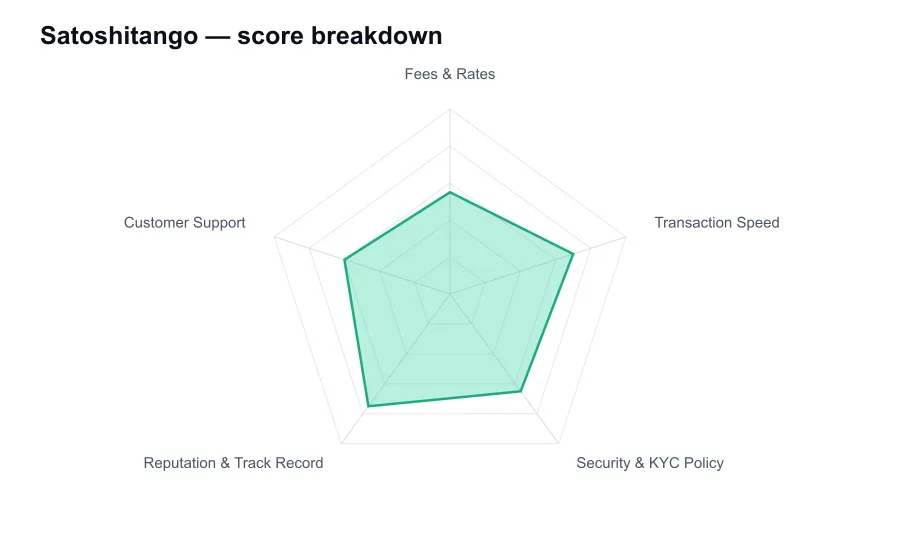
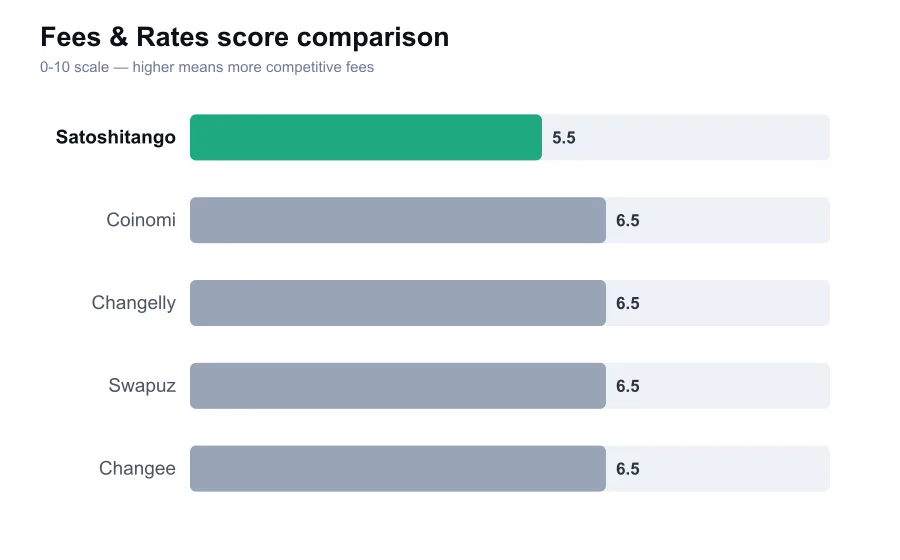
Satoshitango scores 6.5/10 overall in our independent review, measured against every other provider we've compared, strongest on Reputation & Track Record (7.5/10) and weakest on Fees & Rates (5.5/10).
6.5/10 ★★★★★ How we score → Status: active (checked 2026-10-13T19:31:16.128Z) Visit official siteEditorial independence: our scores and rankings are produced using the fixed criteria above and are not influenced by advertisers. This is an independent ranking site and is not operated by, or affiliated with, any provider we list.
Affiliate disclosure: some links on this page may earn us a commission at no extra cost to you. This does not affect our rankings.
| Best for | Not for |
|---|---|
| Longstanding Argentine crypto provider | Effective spreads are harder to compare than exchange fees |
| Built around Argentine peso payment rails | Not designed for advanced traders |
What is Satoshitango?
How Satoshitango Works
- Create an account and complete the required identity checks
- Add funds using an available local payment method
- Choose the crypto asset and review the displayed quote
- Confirm the purchase or sale
- Withdraw supported crypto to a personal wallet if needed
Criteria & Scores
| Criterion | Score | Note |
|---|---|---|
| Fees & Rates | 5.5 | Convenient quotes, but effective spreads are not very transparent |
| Transaction Speed | 7.0 | Local funding is usually practical after verification |
| Security & KYC Policy | 6.5 | Custodial service with identity checks and compliance controls |
| Reputation & Track Record | 7.5 | Established Argentine operator with a long local presence |
| Customer Support | 6.0 | Useful Spanish language help, but busy periods can slow replies |
KYC
| Requirement | mandatory |
|---|---|
| Notes | SatoshiTango is a custodial provider with identity verification and compliance monitoring. Additional information may be requested for higher risk or unusual transactions. |
Supported Assets
How to Use Satoshitango Safely
- Use a unique password and enable two factor authentication
- Make a small test withdrawal before moving a large balance
- Compare the displayed buy and sell quotes before trading
- Confirm the blockchain network matches your receiving wallet
- Move long term holdings to self custody
In-Depth Review
SatoshiTango is one of the older names in Argentina's retail crypto market. It started as a Bitcoin buying and selling service in Buenos Aires and expanded into a broader platform for crypto, pesos, stablecoins, payment services, and international transfers. That local focus is its whole reason to exist. It is built for people who live with capital controls, inflation, volatile exchange rates, and a banking system that does not always make moving money simple.
For an Argentine user, that positioning has real value. SatoshiTango understands local bank transfers, local tax documentation, and the practical appeal of holding USDT or Bitcoin rather than leaving every peso in cash. A large international exchange can offer deeper markets, but it often feels detached from how Argentines actually fund accounts and use digital dollars. SatoshiTango is more familiar territory, especially for a first crypto purchase.
The platform is not an exchange for fee obsessives. Its pricing is usually expressed through the quote a customer sees before accepting a purchase or sale, rather than through a clean, institutional style maker and taker table. That means the effective cost can combine spread, processing cost, and the price difference between the displayed buy and sell rates. This is convenient, but it makes meaningful comparison difficult.
That lack of transparency is my largest criticism. A user should not have to make a small test trade to estimate the real cost of converting pesos into USDT. On highly liquid pairs, the quote can be reasonable for a local convenience service. Yet regular traders can generally find tighter execution on Binance, Bitso, Ripio's trading service, or a local peer to peer market if they are careful. SatoshiTango charges for simplicity, and it does not hide that particularly well.
Withdrawal costs deserve the same attention. Blockchain withdrawal fees change with network conditions, and platforms often pass those costs along with a service margin. Before buying a modest amount of Bitcoin or Ether, check whether withdrawing it immediately will consume an uncomfortable share of the purchase. For smaller balances, keeping funds on the platform temporarily may be cheaper, but that creates a different risk. No centralized provider should become a long term wallet by default.
Speed is generally one of SatoshiTango's better traits. Argentine peso transfers can be credited relatively quickly during normal banking hours, and the purchase flow itself is simple once an account has passed verification. Crypto purchases are typically credited after the provider has accepted the payment. A blockchain withdrawal then depends on the asset and network chosen. Bitcoin can take an hour or longer for comfortable confirmations, while stablecoin transfers on faster networks can arrive much sooner.
The frustrating cases are usually not technological. A first deposit, a bank account mismatch, an unusually large transfer, or a compliance review can turn a supposedly quick transaction into a support ticket. That is not unique to SatoshiTango, but the company should be clearer about what triggers manual review and how long it usually takes. People using crypto to hedge a fast-moving peso market care about timing. A vague pending status is a poor answer when prices are moving sharply.
SatoshiTango is a custodial platform, which means the company controls customer wallets until a withdrawal is made. It uses account verification and has compliance procedures, so it should not be treated as a private, no-questions-asked Bitcoin venue. Identity checks are part of the service. Users should expect to provide personal details and possibly additional source-of-funds information when activity appears unusual or reaches higher risk thresholds.
That policy may frustrate users who came to crypto seeking privacy, but it is more honest than a service pretending that regulations do not exist. The real security question is whether SatoshiTango gives customers enough tools and enough transparency. Basic account security matters far more than the marketing copy. Use a unique password, turn on two factor authentication if available on your account, and do not approve login or withdrawal requests from a message claiming to be support.
The provider has one advantage that newer exchange brands cannot manufacture, it has survived multiple Argentine crypto cycles. It has operated through periods of currency stress, changing local rules, and repeated public arguments about the role of stablecoins. That does not make it risk free. It does mean there is a recognizable operating history, a public local identity, and a user base that has had time to test the service in ordinary conditions.
Its reputation is solid locally rather than global. You will not find the institutional depth, public proof-of-reserves culture, or international liquidity associated with the largest exchanges. You will find a company that has remained visible in Argentina for years and has built products around regional payment needs. For the intended customer, that matters more than having hundreds of obscure tokens. For a sophisticated trader, it will probably not be enough.
Support is best described as practical but uneven. Spanish language assistance and familiarity with local payment methods are meaningful benefits. A user whose bank transfer needs explanation is more likely to get a useful response here than from a global exchange's generic ticket queue. Still, reports of delayed answers during busy periods are unsurprising, and a financial service should not rely on social media escalation for routine account cases.
The mobile and web experience aim at accessibility, not at a professional trading terminal. That is the correct choice for its core audience. Buying Bitcoin, holding USDT, and converting back to pesos should not require understanding order book mechanics. The tradeoff is that users seeking advanced order types, API trading, detailed market data, or extensive altcoin access will quickly hit the platform's limits.
I would use SatoshiTango for a local Argentine on-ramp who values familiarity, local currency rails, and a straightforward route into major crypto assets. I would not use it as my primary trading venue, and I would not leave a large balance there merely because the interface makes it convenient. Its local usefulness is real. Its pricing opacity and custodial model are equally real, so use it purposefully rather than passively.
Pros & Cons
| Pros | Cons |
|---|
Verdict
Frequently Asked Questions
Is SatoshiTango mainly for Argentine users?
Yes. Its strongest use case is buying, selling, and using crypto with Argentine peso based payment methods and local banking familiarity.
Does SatoshiTango require identity verification?
Yes. It is a custodial, compliance focused provider, so users should expect identity checks and possible extra review for unusual activity.
Why can SatoshiTango's buy and sell prices differ noticeably?
The service commonly works from displayed quotes rather than a public order book. The gap can reflect spread, processing costs, and market conditions.
Can I withdraw crypto from SatoshiTango to my own wallet?
The platform supports crypto withdrawals for supported assets. Check the selected network, the withdrawal fee, and the destination address before confirming.
Is SatoshiTango a good place to hold crypto long term?
It is a custodial platform, so the provider controls the wallet keys while funds remain there. Long term holders should consider self custody after purchase.
Why might a peso deposit be delayed?
First time funding, bank account mismatches, larger transfers, or compliance checks can require manual review even if ordinary local transfers are often quick.