Changee
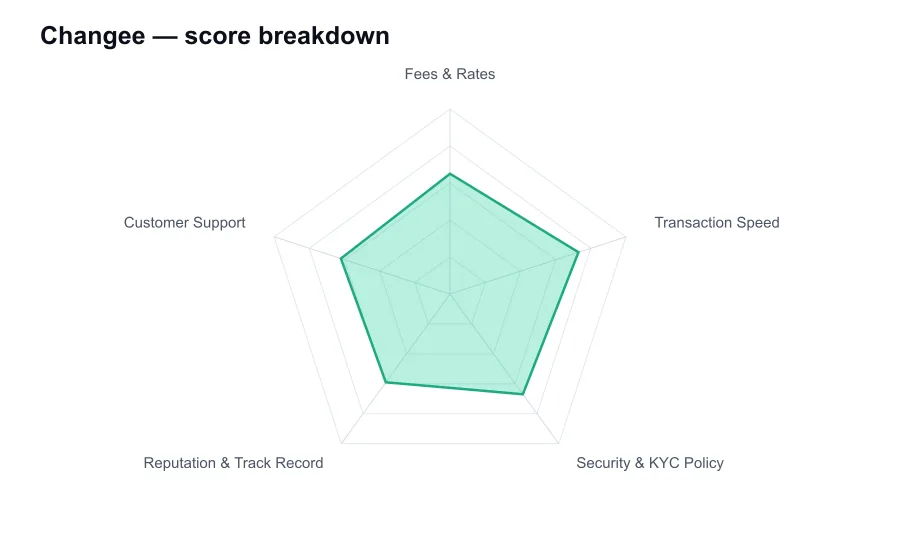
Changee scores 6.6/10 overall in our independent review, measured against every other provider we've compared, strongest on Transaction Speed (7.3/10) and weakest on Reputation & Track Record (5.9/10).
6.6/10 ★★★★★ How we score → Status: active (checked 2026-10-13T19:27:09.577Z) Visit official siteEditorial independence: our scores and rankings are produced using the fixed criteria above and are not influenced by advertisers. This is an independent ranking site and is not operated by, or affiliated with, any provider we list.
Affiliate disclosure: some links on this page may earn us a commission at no extra cost to you. This does not affect our rankings.
| Best for | Not for |
|---|---|
| No standard account registration | Final execution depends on market movement and routing |
| Simple wallet-to-wallet exchange flow | Less established reputation than the biggest rivals |
What is Changee?
How Changee Works
- Select the asset, amount, and network you want to send
- Select the asset and network you want to receive
- Paste and verify your destination wallet address
- Review the quoted output and create the exchange order
- Transfer the requested funds to Changee's deposit address
- Wait for confirmations and receive the converted asset
Criteria & Scores
| Criterion | Score | Note |
|---|---|---|
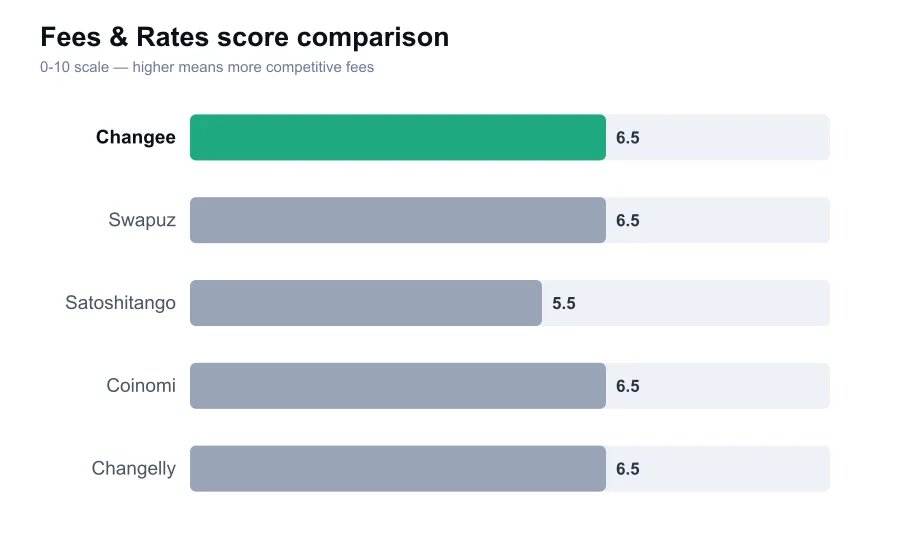
| Fees & Rates | 6.5 | Competitive live quotes, but pair-level pricing varies |
| Transaction Speed | 7.3 | Usually prompt after deposit confirmations |
| Security & KYC Policy | 6.7 | Non-custodial design with conditional AML checks |
| Reputation & Track Record | 5.9 | Developing public record versus older competitors |
| Customer Support | 6.2 | Best for well-documented order-specific tickets |
KYC
| Requirement | optional |
|---|---|
| Notes | Changee's normal flow does not require account registration. A transaction can be held for compliance review if automated AML screening identifies elevated risk. |
How to Use Changee Safely
- Compare the quoted final output rather than headline fees
- Use a test transaction on an unfamiliar network
- Do not send tokens on a network different from the order
- Keep the order ID and blockchain transaction hash
- Confirm the destination wallet supports the asset received
In-Depth Review
Changee is a non-custodial instant exchange designed for fast wallet-to-wallet crypto conversions. It is part of a crowded category where the user experience is nearly identical from one provider to the next: choose a pair, send a deposit, and wait for the output. Changee's job is therefore not to reinvent the process. Its job is to give a fair quote, route the order reliably, and be available when something goes wrong.
The service is clearly aimed at users who do not want a traditional exchange account. There is no trading chart, no maker and taker fee table, and no reason to leave assets parked on a platform. You enter the receiving address at the start, which is a good fit for users moving between self-custody wallets or converting assets before a transfer.
That simplicity has limits. Changee is not a venue for price discovery, recurring purchases, fiat deposits, derivatives, or active portfolio management. You are accepting a quoted conversion price from an intermediary. For a quick swap this is often sensible. For larger positions, a spot exchange with an order book can offer better control and more transparent execution.
Changee's prices are pair-specific. The quote includes the economic cost of liquidity and can include network costs, so a generic headline fee would not tell the whole story. The practical concern is whether the output remains competitive. Before confirming, compare the exact amount of destination coin against StealthEX, Quickex, and a liquid centralized exchange if you already have an account there.
I would not assume the cheapest-looking route is automatically cheapest. A low displayed service fee can be offset by a poor exchange rate, while a slightly higher visible cost may produce more final coins. The number that matters is what reaches your wallet. This is particularly important with stablecoins, where users often expect a near one-to-one conversion and can overlook network or routing costs.
Changee supports the familiar floating-rate approach used by many instant exchangers. A floating quote can move between order creation and execution, especially in volatile markets or on less liquid pairs. That is not a flaw by itself. It is the trade-off for allowing market movement while the deposit reaches the service. If precise output is essential, use a fixed-rate option only when it is available and check the conditions carefully.
Speed is good on ordinary routes, although the word instant needs translating. An order cannot settle before the incoming blockchain transaction has sufficient confirmations. Once that hurdle is cleared, a liquid conversion often takes minutes. A slow chain, a low network fee, an unusual token, or a blocked liquidity route can turn that into a much longer wait.
Changee's no-account format is genuinely convenient. It reduces data collection during a normal order and leaves no customer trading balance exposed to account takeover. The user still has to get the important details right. A wrong receiving address or an ERC-20 token sent over the wrong network can create a recovery problem that no amount of customer-service politeness will solve quickly.
KYC is best understood as conditional. Changee does not ordinarily require a user to register and submit identification before every swap. It can, however, pause a transaction that its compliance systems flag and request verification. That policy is standard in this corner of crypto, but it deserves plain language. Users seeking certainty that no documents will ever be requested should not send funds through any screened instant exchange.
The platform's public reputation is still developing. Changee has a visible operating product and a service model that experienced crypto users will recognize, but it does not have the lengthy, heavily scrutinized history of the sector's oldest names. The absence of a famous incident is not the same as proof that a provider has been tested through years of high-volume edge cases.
For that reason, I would use Changee selectively. It is reasonable for a normal-sized conversion after checking the rate and network. It is less attractive for a six-figure transfer, an obscure token, or a time-critical payment. Those cases call for a venue with deeper liquidity disclosure, formal support channels, and a stronger history of resolving complex operational failures.
Support is most useful if users approach it like a technical handoff. Supply the order ID, chain transaction hash, source and destination assets, networks, and destination address. A message saying only that an order is stuck gives an agent almost nothing to work with. Keep records before you send, because the generated deposit address and the exact quote are central to any investigation.
Changee does a better job than a barebones swap widget of presenting a straightforward consumer flow, but transparency remains its main weakness. It is easy to understand the steps, yet harder to independently inspect the underlying execution and markups. That is the difference between a convenient service and a venue that sophisticated users can audit.
My take is that Changee is a decent utility for users who understand instant-exchange risk and do not need an advanced platform. It should earn a place in a quote comparison, not a place of blind loyalty. If it returns the best verified output on a liquid pair, it can do the job well. If the difference is tiny, I would lean toward the provider with the stronger support history and wider public reputation.
Pros & Cons
| Pros | Cons |
|---|
Verdict
Frequently Asked Questions
Does Changee hold a customer trading balance?
Changee uses a one-off exchange flow. You provide an external receiving address for each order rather than maintaining a conventional custodial trading balance.
Does Changee charge the same fee on every pair?
No. Changee provides pair-specific live quotes. Compare the final amount you will receive, because liquidity costs and network fees can differ substantially by route.
Can the output amount change after I create a Changee order?
It can on a floating-rate order. The market may move while your deposit confirms and the conversion is completed. Review whether the order is floating or fixed before sending.
Why does the selected network matter on Changee?
The asset ticker alone is not enough. Sending USDT over the wrong chain, or choosing an incompatible destination network, can delay the order or make recovery difficult.
Can Changee request documents after a deposit arrives?
Yes. Standard swaps may not require registration, but AML screening can result in a verification request for an order that triggers risk controls.
What information should I retain for a support case?
Keep the Changee order ID, the deposit transaction hash, sent amount, selected networks, and the exact destination address. These are the key details for tracing an order.