Maple
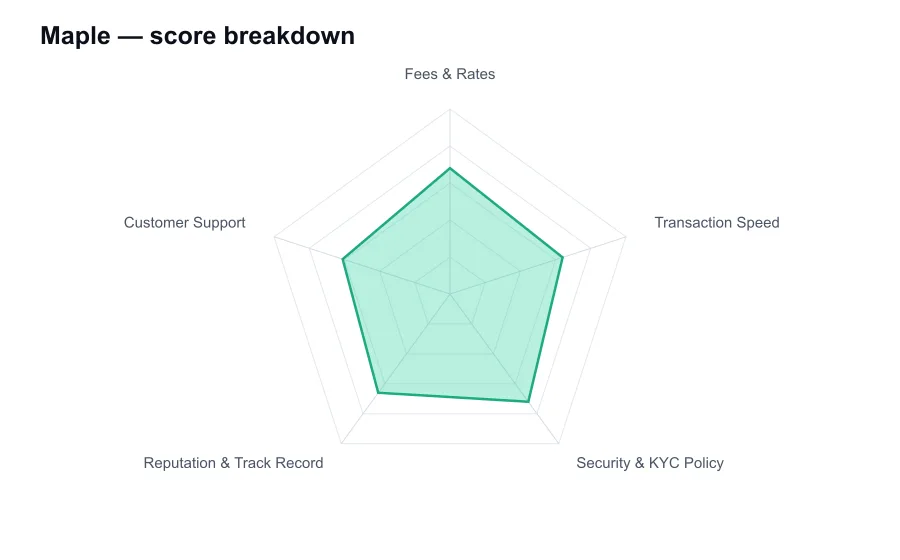
Maple scores 6.7/10 overall in our independent review, measured against every other provider we've compared, strongest on Security & KYC Policy (7.2/10) and weakest on Customer Support (6.1/10).
6.7/10 ★★★★★ How we score → Visit official siteEditorial independence: our scores and rankings are produced using the fixed criteria above and are not influenced by advertisers. This is an independent ranking site and is not operated by, or affiliated with, any provider we list.
Affiliate disclosure: some links on this page may earn us a commission at no extra cost to you. This does not affect our rankings.
| Best for | Not for |
|---|---|
| Established on-chain credit specialist | Past defaults remain important |
| Increasing focus on secured lending | Not a general crypto exchange |
Criteria & Scores
| Criterion | Score | Note |
|---|---|---|
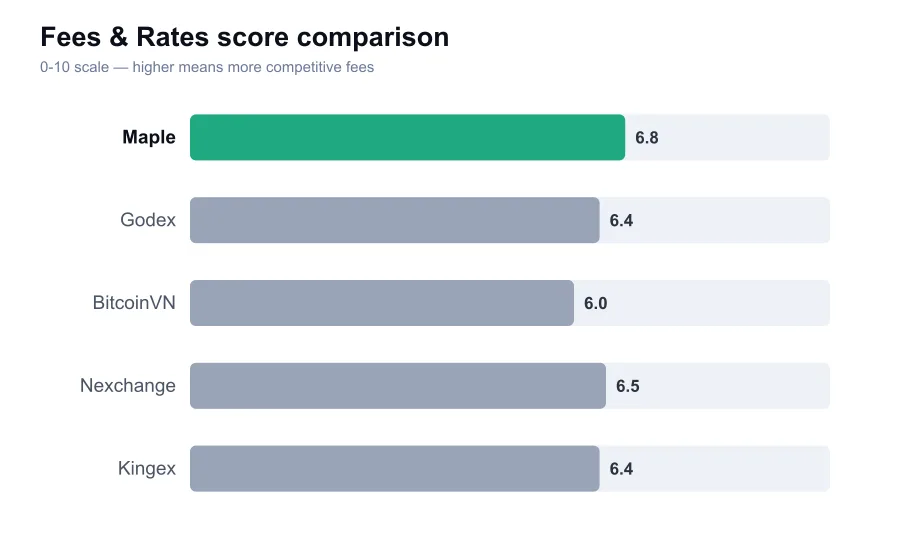
| Fees & Rates | 6.8 | Pool economics vary, so net yield needs careful reading |
| Transaction Speed | 6.4 | Fast on-chain actions, slower credit and redemption realities |
| Security & KYC Policy | 7.2 | Mature infrastructure, but lending risk remains material |
| Reputation & Track Record | 6.6 | Established brand, tempered by 2022 credit defaults |
| Customer Support | 6.1 | Best suited to informed and institutional users |
In-Depth Review
Maple is a credit-focused DeFi protocol, not a normal retail exchange. It became known for trying to bring undercollateralized and institutional-style lending on-chain, then had to confront exactly why traditional credit underwriting is difficult. That history is essential to any honest review. Maple offers sophisticated lending infrastructure and structured yield products, but it is not a plug-and-play savings account and should never be sold as one.
The protocol sits in a different market from Uniswap, Binance, or a consumer-facing broker. Rather than matching everyday buyers and sellers of hundreds of coins, Maple has concentrated on lending pools, digital-asset credit, secured lending, and institutional or accredited-user-oriented products in some jurisdictions. Its appeal is access to yield and credit markets with transparent blockchain settlement, usually through a more curated asset universe.
Fees are not as simple as a one-line swap commission. A lender's return is usually presented as an annualized yield, but the net result depends on pool terms, management fees where applicable, borrower performance, token incentives, and the asset's own risks. Borrowers face interest costs and negotiated or programmatic credit conditions. The exact economics vary by product, so anyone quoting a single Maple fee without naming the pool is oversimplifying the service.
That complexity is not an accident. Maple's products are intended to price credit risk, and credit is messy. A high yield can reflect a high-quality short-duration loan, but it can also compensate lenders for liquidity constraints, counterparty risk, and the possibility of impairment. The right question is not whether an advertised rate looks better than a bank account. The right question is who owes the money, what secures the obligation, and what happens if the borrower cannot pay.
Maple's past makes those questions unavoidable. The 2022 credit crisis exposed serious losses across undercollateralized DeFi lending, including defaults involving borrowers in Maple-linked pools. The damage was real, and it undermined the simplistic pitch that on-chain transparency alone makes unsecured lending safe. To Maple's credit, the protocol survived, adapted its approach, and moved toward more secured and institutionalized models. But a reviewer should not erase that chapter because later product materials are more polished.
The platform's later focus on secured lending and institutional capital is sensible. Collateral, clearer counterparties, bankruptcy-remote structures where used, and more deliberate underwriting are all improvements over loose crypto credit. They do not turn the product into a government-insured deposit. A lender still needs to understand legal jurisdiction, custody arrangements, redemption terms, and whether a position can be exited immediately or only through a limited liquidity process.
Speed is good at the transaction layer. Deposits, subscriptions, withdrawals where liquidity permits, and on-chain recordkeeping can move at blockchain speed. The economic process is slower. Credit origination, asset verification, pool management, and redemption liquidity are not instant-swap functions. This is appropriate for credit markets, but it frustrates anyone expecting to deposit in the morning and withdraw every dollar on demand that afternoon.
Maple's support for different networks and products may reduce transaction friction compared with Ethereum mainnet-only workflows, though the user must follow the exact instructions for the relevant pool. A cheap network transaction does not mean a position is instantly redeemable. That distinction deserves to be printed in large letters. On-chain settlement and underlying loan liquidity are two separate things.
Security is respectable on the technical and organizational side, with a visible team, established protocol history, audits and public documentation surrounding the product. The larger security risk is not merely a smart contract exploit. It is credit risk. A perfectly functioning contract can distribute losses correctly after a borrower default. Investors sometimes celebrate code audits while neglecting the far more important question of whether the underlying loan book deserves trust.
KYC depends on the Maple product and jurisdiction. Some institutional and permissioned offerings require eligibility checks and identity verification, while access to certain protocol interfaces or token functions may be more open. This is not a reliable no-KYC venue for users whose main goal is anonymity. That is arguably a benefit for the credit model, because professional lending needs enforceable counterparties more than it needs frictionless retail onboarding.
Maple's reputation is mixed but meaningful. It has a recognizable brand, serious backers and partners, and a record of continuing to build through adverse market conditions. At the same time, the defaults of the previous cycle remain a stain that a responsible investor should treat as evidence, not ancient history. Compared with a new anonymous yield platform, Maple is far more credible. Compared with a conservative money-market fund, it carries far more uncertainty.
Customer support is stronger in documentation and institutional communication than in handholding small retail users. That fits the target market. An institution or sophisticated lender can assess materials, ask structured questions, and make a deliberate allocation. A casual user who wants instant chat support for every wallet problem will find the experience less comforting. Smart contracts and pool terms ultimately govern the position, not a support agent's goodwill.
The ideal Maple user is not chasing a meme-token pump. It is a yield-focused investor or treasury manager who can evaluate credit risk, accept restrictions, and understand that returns are compensation for real exposure. Even then, diversification matters. Concentrating a large share of capital in one lending pool because its displayed annual percentage yield is high would be reckless.
My take is that Maple deserves respect, not blind trust. The protocol is one of the few DeFi credit names with a genuine history, recognizable lessons from failure, and an increasingly serious approach to secured lending. Its fees and operational structure are reasonable for the market it serves, but they are too complex for a retail user who wants simple exchange trading. Maple can belong in a sophisticated digital-asset allocation. It does not belong in the same mental category as a cash account.
Pros & Cons
| Pros | Cons |
|---|
Verdict
Frequently Asked Questions
Is Maple a crypto exchange?
No. Maple is primarily an on-chain credit and lending protocol. It is designed around lending pools and institutional-style digital-asset finance, not broad retail spot trading.
Are Maple yields guaranteed?
No. Yield depends on the product and carries risk, including borrower default, liquidity constraints, changing rates, and smart contract or operational risk.
Does Maple require KYC?
Requirements depend on the product and jurisdiction. Permissioned and institutional offerings can require identity and eligibility checks. Review the exact pool terms before depositing.