Moneta365
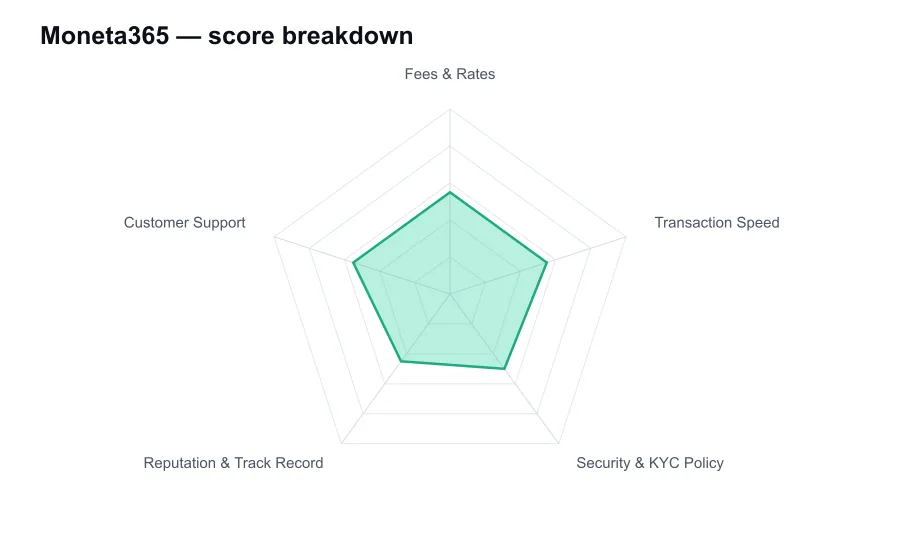
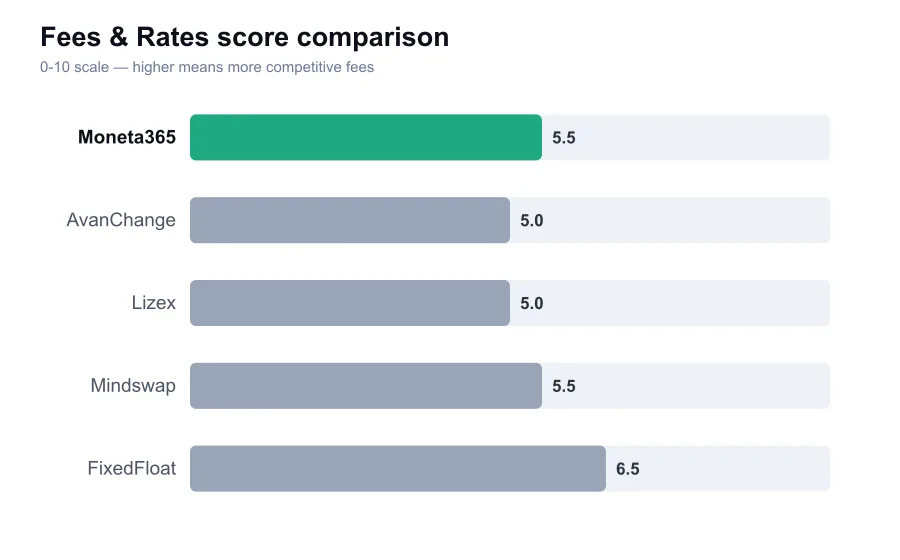
Moneta365 scores 5.2/10 overall in our independent review, measured against every other provider we've compared, strongest on Fees & Rates (5.5/10) and weakest on Reputation & Track Record (4.5/10).
5.2/10 ★★★★★ How we score → Status: active (checked 2026-10-13T19:33:16.569Z) Visit official siteEditorial independence: our scores and rankings are produced using the fixed criteria above and are not influenced by advertisers. This is an independent ranking site and is not operated by, or affiliated with, any provider we list.
Affiliate disclosure: some links on this page may earn us a commission at no extra cost to you. This does not affect our rankings.
| Best for | Not for |
|---|---|
| Useful for specific exchange and payment directions | Less transparent than major exchanges |
| Simple order-based conversion flow | Quote spread can be costly |
What is Moneta365?
How Moneta365 Works
- Select the source and destination payment directions
- Enter the required payout and contact details
- Review the exchange quote and order instructions
- Send the payment using the required amount and reference
- Keep proof of payment while the order is processed
- Confirm receipt in your wallet or destination payment account
Criteria & Scores
| Criterion | Score | Note |
|---|---|---|
| Fees & Rates | 5.5 | Rates are quote-based and may include a meaningful spread. |
| Transaction Speed | 5.5 | Processing depends heavily on payment rail and manual checks. |
| Security & KYC Policy | 5.0 | Payment-data exposure and limited public operational disclosure. |
| Reputation & Track Record | 4.5 | Small-service profile, less public track record than major exchanges. |
| Customer Support | 5.5 | Human support matters, but support depth is hard to verify. |
| Fact | Value | Source |
|---|---|---|
| Service model | Online order-based exchanger | - |
| Pricing model | Quote and spread based | - |
| Primary use | Crypto and e-money conversions | - |
| Trading model | No public order book | - |
| Processing dependency | Payment rail and order direction | - |
KYC
| Requirement | tiered |
|---|---|
| Notes | Information requirements can depend on the payment method, transaction amount, and anti-fraud review. Check the current terms before sending funds. |
How to Use Moneta365 Safely
- Start with the smallest practical test order
- Use only the official domain and verify payment instructions
- Compare the final payout with at least one alternative service
- Keep payment receipts, order ID, and transaction hashes
- Read the verification and refund terms before paying
- Do not leave funds with the exchanger after settlement
In-Depth Review
Moneta365 is a small online exchange service that sits closer to the traditional e-money exchanger model than to a modern crypto trading platform. Its practical purpose is conversion: a customer selects a payment direction, provides the required details, pays the order, and receives the destination asset or payment. That can be useful for a narrow set of transactions, but it is a very different proposition from using a large cryptocurrency exchange with deep markets and a fully developed account system.
The first thing I would stress is that Moneta365 should be judged as a manual or semi-manual exchanger, not as a place for price discovery. You are not placing an order into a public market. You are accepting a quoted deal with a service that may use its own reserves, counterparties, and payment procedures. That makes the exact order terms more important than the appearance of the website.
This model can work well for users who need a specific payment direction that major exchanges do not serve conveniently. Some customers want to move between digital currencies and electronic payment methods, or complete a local-currency exchange without becoming active traders. A specialist exchanger can make that feel simpler. The downside is that every additional payment rail introduces operational risk, banking delays, and a greater chance that a payment needs manual review.
Fees are usually embedded in the quoted rate instead of stated as a separate trading commission. That is the central issue with Moneta365. A customer should not assume a zero-fee-looking order is cheap. Compare the net output with another reliable exchanger and, where possible, with the cost of buying or selling through a regulated exchange plus a bank transfer. The difference can be substantial once spread, payment processing, and payout costs are included.
Moneta365 may be convenient, but convenience pricing is rarely the best pricing. The service is unlikely to beat a liquid order book for a common BTC, ETH, USDT, or fiat pair. It can still be reasonable if the alternative requires several transfers, account verification, or a payment method the customer cannot use. The important thing is to assess the completed amount received, not a headline exchange rate shown before all fields are filled.
Speed is highly dependent on the payment direction. A blockchain deposit can be visible quickly but may require confirmations. A bank payment, card-related payment, or electronic-money transfer can trigger delays outside the exchanger's control. Manual checks can add further time. I would treat any estimated processing period as an estimate, especially on weekends, holidays, or when a payment reference has been entered incorrectly.
The security posture requires more caution than a non-custodial crypto swap. In an e-money exchange flow, customers may provide payment details, personal identifiers, and in some cases proof related to the transaction. That creates privacy exposure beyond a simple wallet address. Use the official domain, verify the page has not been replaced by a phishing copy, and never send a payment based on instructions received through an unsolicited messenger account.
Identity verification should be considered possible, even if an order starts with minimal information. Payment providers and anti-fraud controls can require additional checks depending on the direction, amount, and source of funds. That is standard in money exchange services. It becomes a problem only when the policy is unclear or customers are surprised after sending money. Read the terms before starting, particularly the sections on verification, order cancellation, and refunds.
Moneta365 does not have the public institutional footprint of large regulated exchanges. I have not seen the kind of detailed audited financial reporting, reserve transparency, or broad regulatory documentation that would justify treating it as a major financial counterparty. That is a serious limitation for big transfers. Small exchange sites can be legitimate and useful, but the burden shifts to the customer to limit exposure and verify each transaction carefully.
Its reputation should therefore be treated as service-specific rather than assumed. Check current independent monitoring listings, recent user feedback, and the details of the route you are considering. Look for complaints that describe actual order IDs, response times, and resolutions, rather than anonymous one-line praise or attack posts. A small exchanger's reputation can change faster than that of a major company, particularly if a banking partner or payment method changes.
Support matters more here than it does in a simple Bitcoin-to-Monero swap. If a bank transfer is delayed, a payment processor rejects a transaction, or a receiving account detail is wrong, the case may need a person to intervene. Moneta365's support should be approached with clear evidence: order number, payment receipt, transaction hash where relevant, timestamp, and the exact payment method. Vague tickets waste time.
The service is not designed for traders. There are no advanced order types, no transparent market depth, no portfolio tools, and no reason to keep funds there after an order. That is not a criticism by itself. It is a reminder that the best use case is a specific conversion, completed and settled, with funds then returned to a wallet or payment account the user controls.
I would be particularly cautious about large first orders. Start with the smallest practical amount, confirm the exchange's payment references and destination details, and only then consider a larger transaction. This is sensible with any smaller money exchanger, but especially with one whose public history is less visible than global brands. A small test is cheap insurance against a misunderstood payment route.
My take is restrained. Moneta365 may solve a practical exchange problem for users who need its supported payment directions, and that is a legitimate service. It does not offer the transparency, deep liquidity, or public assurance needed to compete with major exchanges for mainstream crypto trading. Use it as a one-off conversion tool after checking the live quote and terms. Do not use it as a wallet, and do not make a large transfer your first interaction.
Pros & Cons
| Pros | Cons |
|---|
Verdict
Frequently Asked Questions
Is Moneta365 a crypto trading exchange?
No. It is better understood as an order-based online exchange service. Customers accept a quoted conversion rather than trade against a public order book with market depth.
Are Moneta365 fees shown separately?
The effective cost is generally reflected in the quoted exchange rate and final payout. Compare the net amount you will receive, rather than relying on a headline rate.
Why can a Moneta365 order take longer than a blockchain transfer?
The order may involve payment-provider processing, bank timing, blockchain confirmations, or manual checks. Those steps can take longer than the website order form itself.
Can Moneta365 request verification after I create an order?
It is possible. Payment and anti-fraud checks can depend on the transaction direction, amount, and payment method. Read the verification and refund terms before paying.
Should I make a large first transaction?
No. Use the smallest practical test transaction first. Confirm the payment reference, destination details, processing time, and support response before increasing the amount.
What records should I retain for a delayed order?
Keep the order number, payment receipt, timestamp, payment reference, wallet address, and any blockchain transaction hash. These are the facts support needs to investigate.