Mindswap
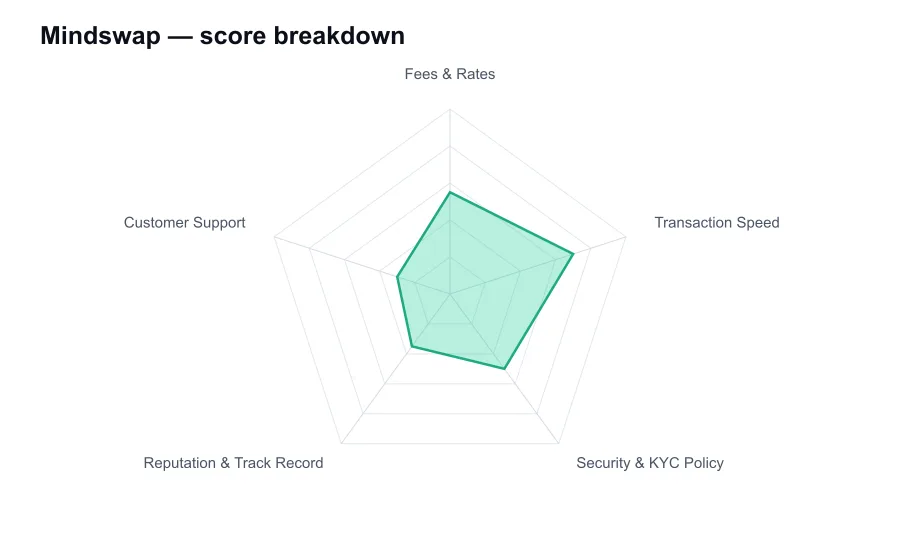
Mindswap scores 5.0/10 overall in our independent review, measured against every other provider we've compared, strongest on Transaction Speed (7.0/10) and weakest on Customer Support (3.0/10).
5.0/10 ★★★★★ How we score → Status: active (checked 2026-10-13T19:41:03.497Z) Visit official siteEditorial independence: our scores and rankings are produced using the fixed criteria above and are not influenced by advertisers. This is an independent ranking site and is not operated by, or affiliated with, any provider we list.
Affiliate disclosure: some links on this page may earn us a commission at no extra cost to you. This does not affect our rankings.
| Best for | Not for |
|---|---|
| Non-custodial wallet-based swaps | Liquidity may be thin |
| No standard account verification flow | Smart-contract and token approval risk |
What is Mindswap?
How Mindswap Works
- Open the verified Mindswap interface
- Connect a compatible self-custody wallet
- Choose the token pair and enter an amount
- Review route, output, price impact and gas
- Approve the token allowance if required
- Sign the swap and wait for blockchain confirmation
Criteria & Scores
| Criterion | Score | Note |
|---|---|---|
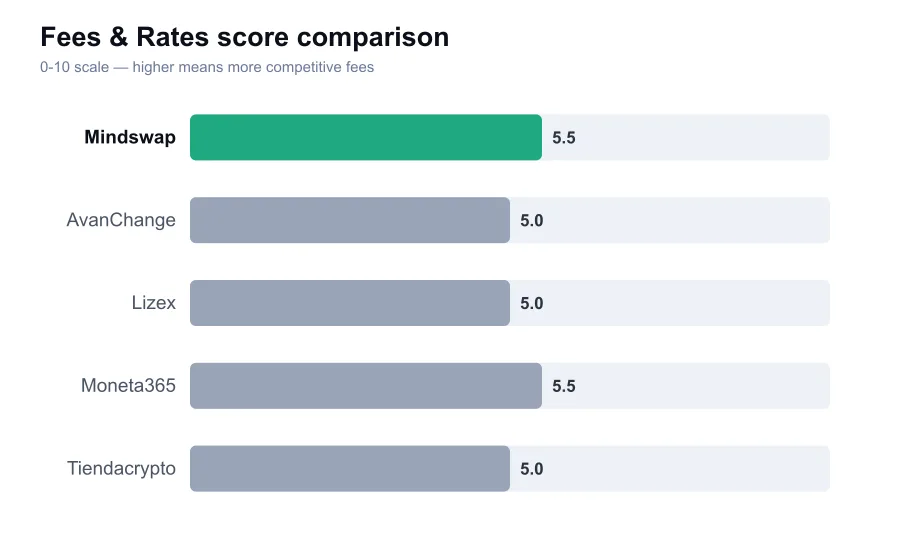
| Fees & Rates | 5.5 | Pool fees are separate from gas and slippage |
| Transaction Speed | 7.0 | Swaps settle with blockchain confirmation |
| Security & KYC Policy | 5.0 | Self-custody, with smart-contract risk |
| Reputation & Track Record | 3.5 | Small protocol with limited market standing |
| Customer Support | 3.0 | Community help cannot reverse transactions |
| Fact | Value | Source |
|---|---|---|
| Protocol type | Automated market maker DEX | Source |
| Custody model | User-controlled wallet | - |
| Account flow | Wallet connection | - |
| Settlement | On-chain smart contracts | - |
| Protocol token | MIND | - |
KYC
| Requirement | none |
|---|---|
| Notes | A standard DEX swap is wallet based rather than account based. Interface access may still be subject to separate geographic or compliance controls. |
Supported Assets
How to Use Mindswap Safely
- Verify the interface URL and contract address
- Use a hardware wallet for meaningful balances
- Check price impact before every swap
- Set limited token allowances where possible
- Keep slippage tolerance tight for liquid pairs
- Never sign a wallet request you do not understand
In-Depth Review
Mindswap is a decentralized exchange project associated with automated market maker trading and the MIND token. It belongs to the smaller end of DeFi, where the appeal is direct wallet-to-contract swaps rather than opening an account with a centralized company. That model can be useful, but Mindswap is not in the same reliability class as heavily used venues such as Uniswap, Curve or PancakeSwap.
The key distinction is liquidity. A decentralized exchange can have a functional interface, live pools and a token, yet still be a poor place to trade because there are too few assets in the pool. Thin liquidity turns an apparently cheap swap into an expensive one through price impact. Mindswap users should look at the expected output, price impact and pool depth before they approve anything, especially for MIND or small-cap assets.
The protocol model avoids a conventional maker and taker fee sheet. In an automated market maker, a swap usually pays a pool fee set by the relevant pool or protocol, plus the blockchain's network gas fee. That sounds simpler than a centralized exchange price schedule, but the true cost is often harder to see. Slippage, gas and token price impact can easily dominate the visible pool fee.
For a liquid major pair, compare Mindswap's quoted output against a route on a large aggregator and against the leading decentralized exchange on the same chain. Do not compare just the fee percentage. Compare the final number of tokens delivered. A route that charges a modest pool fee can still be far worse than a higher-fee route if its pool is shallow or its price oracle is stale.
Transaction speed is mostly determined by the chain and the wallet settings chosen by the user. Once a swap is broadcast, it is settled by smart contract execution after the transaction is included in a block. There is no exchange operations desk manually approving ordinary swaps. That is a real advantage over custodial platforms, because there is no deposit queue or internal withdrawal review for a normal trade.
It is also a limitation. A confirmed smart-contract swap cannot be reversed because a user clicked too quickly, selected the wrong token or accepted an absurd slippage tolerance. Centralized exchanges can sometimes investigate an account error. A decentralized protocol generally cannot. Mindswap's self-custody design means users retain control, but they also carry the operational consequences.
KYC is generally not part of the basic wallet connection and swap flow on a decentralized protocol. That may suit privacy-conscious users, but no-KYC access should never be confused with no risk. A wallet address is still publicly traceable on chain, and front ends can impose geographic or compliance restrictions independently of the contracts. The practical question is whether you understand the transaction you are signing.
Security depends on smart contracts, front-end integrity and the user's wallet hygiene. Even an audited contract is not a guarantee. Audits cover a particular code version and scope, while economic attacks, malicious token contracts and fake websites remain possible. I would want clear audit links, contract addresses and governance documentation before I regarded Mindswap as a place for anything beyond carefully sized DeFi activity.
Mindswap's reputation problem is scale and continuity. It has nowhere near the volume, developer scrutiny or long-lived user base that makes major DEXs easier to evaluate. Small protocols can work perfectly well for a niche community. They can also lose liquidity quietly, leave outdated documentation online, or expose users to a frontend that receives little maintenance. That is a different risk from a traditional exchange failure, but it can be just as costly.
Support is inherently limited in this format. There may be community channels and documentation, but there is no customer-service agent who can retrieve a mistaken on-chain payment or restore a compromised wallet. If a transaction succeeds according to the contract, the protocol normally regards the matter as finished. Anyone expecting exchange-style ticket support will be disappointed.
The MIND token deserves extra caution. Protocol tokens can offer governance or incentive utility, yet their price and liquidity are often much more fragile than their marketing suggests. Before buying one, check the contract address from an official source, inspect holder concentration and make sure there is a realistic exit route. A token that can be bought in a thin pool may be difficult to sell without severe slippage.
Wallet permissions are another practical hazard. Approving a token allowance is not the same action as making a swap. Unlimited approvals are convenient but increase exposure if a contract, interface or wallet is compromised later. Mindswap users should set limited approvals where their wallet permits it, then periodically revoke old allowances through a reputable allowance-management tool.
I like the principle behind a self-custody swap protocol. For an experienced user, direct settlement and the absence of an account custodian are valuable. Yet Mindswap does not provide enough evidence of sustained liquidity, public scrutiny or support depth to be a first-choice venue. It is a specialist tool, not a default exchange.
My recommendation is to use Mindswap only if you specifically need a pool or asset available there and have checked the contract, route and liquidity yourself. Keep the position modest, avoid experimental tokens unless you can afford a complete loss, and use a hardware wallet for meaningful balances. For routine swaps, a larger DEX with deeper liquidity or a reputable aggregator is usually the better call.
Pros & Cons
| Pros | Cons |
|---|
Verdict
Frequently Asked Questions
Does Mindswap require KYC for a basic swap?
A normal decentralized wallet-to-contract swap does not use a conventional account KYC flow. Your wallet address and transactions remain public on the relevant blockchain.
Why can a Mindswap trade cost more than the displayed pool fee?
The effective cost includes the pool fee, network gas and price impact. In a thin pool, slippage can be much larger than the visible fee.
Can Mindswap reverse a confirmed swap?
No. A confirmed on-chain swap is generally irreversible. Check token, amount, route and slippage before signing.
Should I grant unlimited token approval to Mindswap?
Limited approvals are safer where your wallet supports them. Unlimited allowances can increase losses if your wallet or an approved contract is compromised.
What should I check before buying MIND?
Verify the official contract address, pool liquidity, holder concentration and likely selling route. Small protocol tokens can have severe exit slippage.
Why is Mindswap support different from exchange support?
The protocol does not custody your wallet. Community channels may help explain a transaction, but they cannot retrieve a confirmed transfer or reset wallet access.