AvanChange
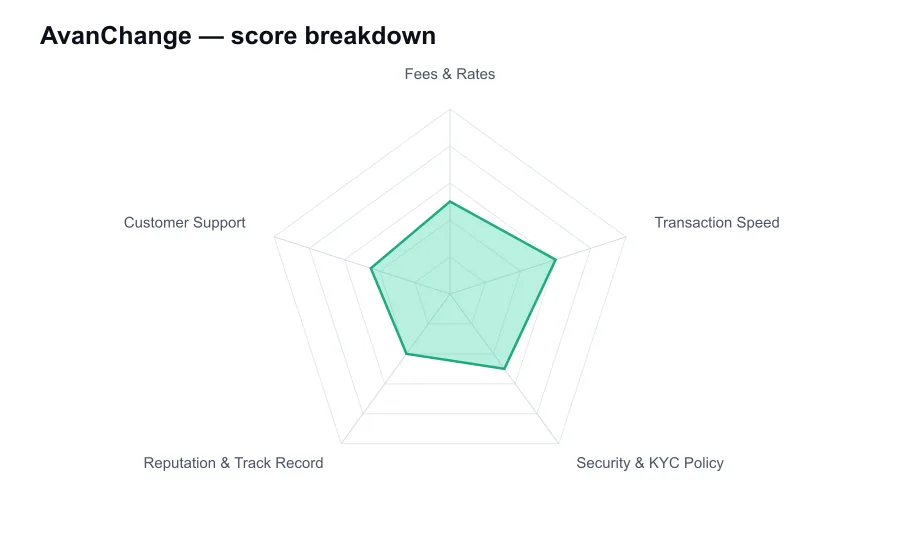
AvanChange scores 5.0/10 overall in our independent review, measured against every other provider we've compared, strongest on Transaction Speed (6.0/10) and weakest on Reputation & Track Record (4.0/10).
5.0/10 ★★★★★ How we score → Status: active (checked 2026-10-13T19:41:26.482Z) Visit official siteEditorial independence: our scores and rankings are produced using the fixed criteria above and are not influenced by advertisers. This is an independent ranking site and is not operated by, or affiliated with, any provider we list.
Affiliate disclosure: some links on this page may earn us a commission at no extra cost to you. This does not affect our rankings.
| Best for | Not for |
|---|---|
| Simple wallet-to-wallet conversion flow | Final pricing may include a spread |
| No need to maintain an exchange balance | Limited public reputation versus major rivals |
What is AvanChange?
How AvanChange Works
- Choose the asset pair and amount
- Select a fixed or floating quote if offered
- Enter a receiving wallet address and correct network
- Send the exact source amount to the generated deposit address
- Wait for blockchain confirmations and order processing
- Check the payout transaction in your receiving wallet
Criteria & Scores
| Criterion | Score | Note |
|---|---|---|
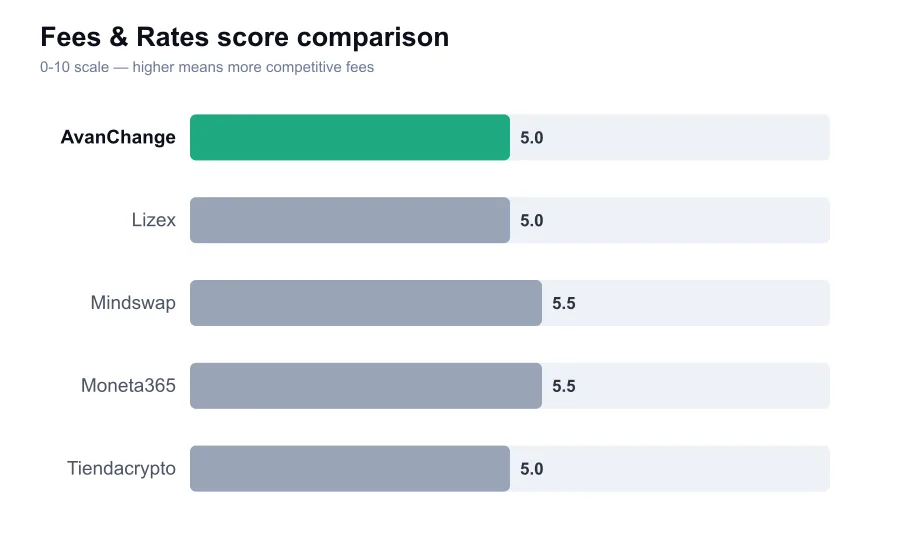
| Fees & Rates | 5.0 | Compare final quotes, spread can outweigh fees |
| Transaction Speed | 6.0 | Timing depends on confirmations and payout processing |
| Security & KYC Policy | 5.0 | Wallet-to-wallet flow, with possible compliance holds |
| Reputation & Track Record | 4.0 | Smaller public track record than major rivals |
| Customer Support | 4.5 | Order-specific support should be tested first |
| Fact | Value | Source |
|---|---|---|
| Service type | Instant crypto exchanger | Source |
| Typical custody model | Transaction-specific transfer | - |
| Rate models | Fixed or floating quote | - |
| Settlement flow | Blockchain deposit and payout | - |
| Standing balance | Not required for a swap | - |
KYC
| Requirement | optional |
|---|---|
| Notes | The normal flow is designed to be low friction, but a transaction may be reviewed for compliance and identity documents can be requested in some cases. |
Supported Assets
How to Use AvanChange Safely
- Confirm both asset and network before sending
- Compare the final output with another provider
- Start with a small test conversion
- Save the order ID and deposit transaction hash
- Never share a seed phrase with support
- Use a wallet you control for both sides of the swap
In-Depth Review
AvanChange is positioned as an online crypto exchange service rather than a full-featured trading venue with advanced order books. That distinction matters. A conversion service can be convenient for a quick asset swap, but it is a very different proposition from using Coinbase, Kraken or Binance for transparent market execution, account controls and deep liquidity. AvanChange should be judged as a lightweight exchanger, not as a major exchange.
The attraction is obvious. Services in this category usually aim to reduce a swap to a few steps: pick an asset pair, enter an amount, provide a receiving address and send funds. For users who already hold crypto in a wallet, that can feel simpler than funding a centralized account, completing extensive onboarding and placing an order. Convenience is useful, but it often comes at the price of less transparent execution.
The first thing I look for is the actual rate mechanics. AvanChange users should determine whether a quote is fixed or floating before sending anything. A floating quote can change while the deposit is waiting for confirmations, particularly during a volatile market move. A fixed-rate quote may provide more certainty, but it often includes a larger spread or a narrow time window for the deposit. Neither model is automatically superior. The issue is clear disclosure.
Do not focus only on a stated service fee. The all-in cost is the difference between the market value of the coin sent and the value of the coin received, after the service's rate, network fees and any spread are included. Compare AvanChange's final output with a quote from ChangeNOW, SimpleSwap or an established exchange. For small swaps the convenience premium may be acceptable. For larger amounts, it can become expensive quickly.
Speed depends on several moving parts. AvanChange cannot process an incoming transfer until the blockchain confirms it, and the number of confirmations varies by asset and network. After that, the provider has to source or release the outbound asset and broadcast the payout. A smooth transaction may finish quickly, but crypto exchange services should never promise a precise settlement time as if chain congestion and compliance checks did not exist.
The key practical question is what happens when a transaction does not proceed normally. An exchange service may pause a swap because the incoming amount differs from the order, the wrong network was used, the rate moved materially, or a compliance system flags the transfer. Those situations are not inherently suspicious. The quality test is whether the rules were visible before payment and whether support gives a specific, traceable response rather than generic reassurance.
AvanChange's KYC approach should be read carefully at the point of use. Instant exchange services often market a low-friction flow, yet may reserve the right to request identity information or source-of-funds material for risk and compliance checks. That is normal in principle. It becomes unacceptable if the user is not told what will happen to a pending transaction, what evidence is needed and what options exist if verification is declined.
From a security perspective, the best aspect of this type of service is that it need not hold a standing account balance. You can send from a self-custody wallet and receive the result back to a wallet you control. That reduces exposure to a long-term exchange bankruptcy or account takeover. It does not eliminate risk, because the funds are still in the provider's hands after the deposit is made and before the payout arrives.
Users should be particularly alert to network selection. USDT, USDC and other assets exist on several chains, and a correct asset name does not make a wrong-network deposit recoverable. Check both the coin and the network on the order page, then confirm the receiving wallet supports that network. A cheap network fee is meaningless if the recipient cannot access the asset after it arrives.
Reputation is where AvanChange falls short of the better known instant-exchange brands. It does not have the extensive public operating record, large review footprint or independent visibility enjoyed by market leaders. That does not automatically make it unsafe, but it means there is less external evidence to rely on when something goes wrong. I would not confuse a functioning website with a mature service operation.
Support is therefore more important than usual. Before sending a meaningful amount, locate the support route, read the terms and see whether the service provides an order identifier and transaction status page. A good support team should be able to discuss a particular order, deposit hash and destination transaction. It should not ask for unrelated wallet credentials, a seed phrase or an extra payment to release a payout.
The sensible way to use AvanChange is as a transaction-specific tool, not as a place to store crypto. Start with a small amount, use a common asset and an established network, and avoid making your first test during a period of extreme volatility. If the result is timely and the effective rate is competitive, you can decide whether its convenience is worth using again.
I would also avoid obscure tokens and unusually large conversions. Liquidity sourcing for less common assets can be inconsistent, while large orders may receive a worse rate than the initial estimate or trigger manual review. A conventional exchange with an order book is often easier to price and document for substantial trades. AvanChange makes more sense for a modest wallet-to-wallet conversion than for serious execution.
My take is measured but cautious. AvanChange may be useful for users who understand how non-custodial swap flows work and who are prepared to test the service. Its simplicity is attractive, but it does not have enough public reputation or pricing transparency to displace the larger providers. Keep control of your wallet, compare the final quote and keep transaction sizes small until trust has been earned.
Pros & Cons
| Pros | Cons |
|---|
Verdict
Frequently Asked Questions
Is AvanChange an exchange wallet?
It is better treated as a transaction-specific exchange service. Send from a wallet you control and receive the payout in a wallet you control rather than leaving funds on the service.
Why can an AvanChange payout differ from the initial estimate?
A floating-rate order can move while the deposit confirms. The final result can also reflect spread, network costs and the exact amount received.
What should I check for USDT or USDC swaps?
Check the network at both ends. USDT and USDC exist on multiple chains, and sending the right coin on the wrong network can create a recovery problem.
Can AvanChange request KYC after I send crypto?
Instant exchange services may request verification during compliance screening. Read the terms first and use a small test amount if you cannot accept a possible hold.
What evidence should support receive for a delayed order?
Provide the order ID, deposit transaction hash, amount sent, asset, network and destination address. Never provide a seed phrase.
Should I use AvanChange for a large conversion?
I would not use an untested instant exchanger for a large amount. Compare final outputs and consider a liquid order-book exchange for better price transparency.