ETZ
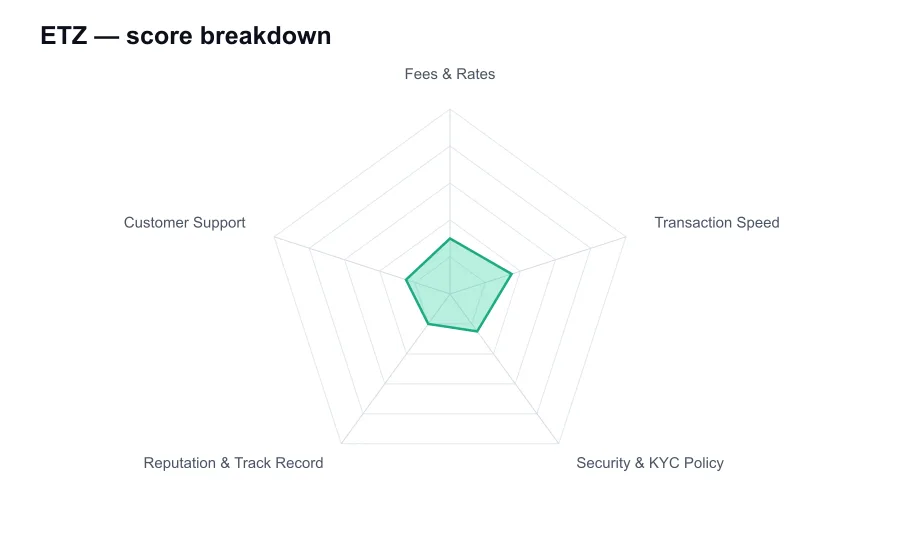
ETZ scores 2.7/10 overall in our independent review, measured against every other provider we've compared, strongest on Transaction Speed (3.5/10) and weakest on Reputation & Track Record (2.0/10).
2.7/10 ★★★★★ How we score → Status: active (checked 2026-10-13T19:29:14.292Z) Visit official siteEditorial independence: our scores and rankings are produced using the fixed criteria above and are not influenced by advertisers. This is an independent ranking site and is not operated by, or affiliated with, any provider we list.
Affiliate disclosure: some links on this page may earn us a commission at no extra cost to you. This does not affect our rankings.
| Best for | Not for |
|---|---|
| Potentially simple crypto conversion flow | Limited verifiable public company information |
| May suit a very small test transaction | No clearly documented fee methodology |
What is ETZ?
How ETZ Works
- Confirm the provider's current terms and supported network
- Choose the source and destination asset
- Review the exact payout quote and receiving address
- Send only a small test amount to the generated address
- Save all transaction and order details until delivery
Criteria & Scores
| Criterion | Score | Note |
|---|---|---|
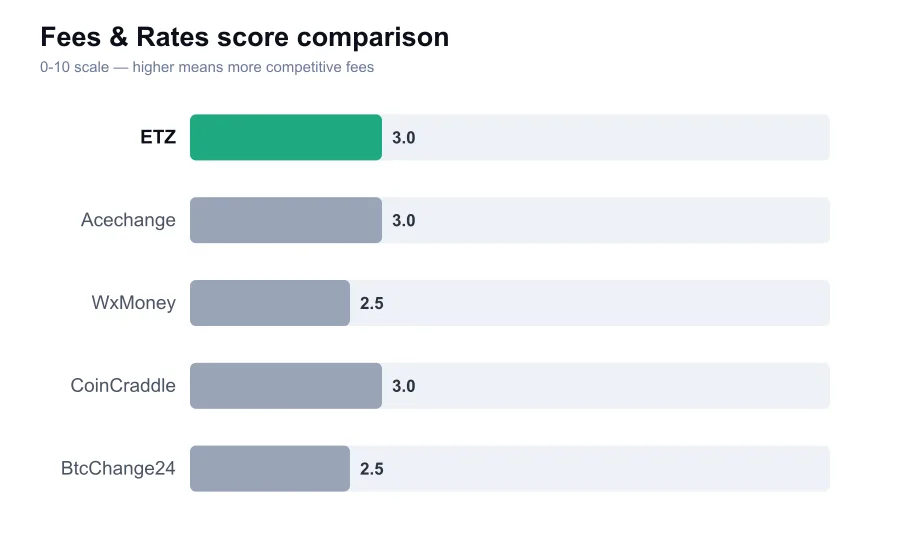
| Fees & Rates | 3.0 | No clearly verifiable public fee breakdown |
| Transaction Speed | 3.5 | Limited independent evidence of processing performance |
| Security & KYC Policy | 2.5 | Security and compliance documentation lack visibility |
| Reputation & Track Record | 2.0 | Very limited independently verifiable track record |
| Customer Support | 2.5 | Public support and recovery process are unclear |
| Fact | Value | Source |
|---|---|---|
| Service type | Crypto conversion service | - |
| Execution model | Quote-based rather than order-book trading | - |
| Fee disclosure | Detailed public schedule not verified | - |
| KYC policy | Public policy not clearly verified | - |
| Support visibility | Public recovery process not clearly verified | - |
KYC
| Requirement | optional |
|---|---|
| Notes | ETZ's current KYC policy is not sufficiently clear to treat it as a guaranteed no-KYC service. Assume a transaction can be reviewed or paused for compliance. |
How to Use ETZ Safely
- Do not send a large amount as your first ETZ transaction
- Compare the final payout with established alternatives
- Verify the official domain independently before using it
- Check the network, token contract, and any memo requirement
- Keep all order references and the blockchain transaction hash
- Avoid sending funds if the support route or terms are unclear
In-Depth Review
ETZ is one of those crypto exchange names that requires more caution than enthusiasm. It has a limited public identity compared with established instant exchangers and major centralised platforms, which makes it difficult for a reviewer to verify core details that should be easy to find. In crypto, obscurity is not automatically disqualifying. Plenty of legitimate niche services begin small. But a provider handling irreversible transfers needs to earn trust with facts, not just an exchange form and a few reassuring claims.
The basic proposition appears to be crypto conversion rather than a full trading environment. This places ETZ closer to an instant exchange service than to a conventional centralised exchange with visible liquidity, account balances, advanced orders, and audited reserves. Such a service can be useful for a quick wallet-to-wallet conversion. It also means the user is accepting a black-box execution model, where the provider determines the route, temporary custody process, and final payout mechanics.
My concern begins with verifiability. A prospective customer should be able to identify the legal operator, find clear terms, understand the fee model, locate compliance policy, and see a support route that is more substantial than a contact form. ETZ does not have the public documentation depth that I would expect before recommending it. If the company has improved its internal controls or liquidity arrangements, it has not made the case clearly enough to a cautious external user.
Fee transparency is particularly weak. The relevant number for any instant exchange is not a vague claim of low fees. It is the precise difference between what you send and what you receive, after the provider's margin, liquidity spread, and blockchain fees. ETZ does not appear to publish a detailed, readily auditable rate policy comparable to the clearer fee pages offered by stronger competitors. That makes it hard to know whether a quote is fair or merely convenient.
Users should therefore treat every ETZ quote as something to verify independently. Compare the output against at least two alternatives, using the same input amount and network. Do not compare only the displayed market rate. A provider may show a rate close to the market price while delivering less after hidden spread or network deductions. This is especially important with stablecoins, where users often expect one-for-one economics and can miss a costly conversion margin.
Transaction speed is also difficult to assess with confidence because there is little independently visible operational data. All instant exchange services depend on blockchain confirmations and liquidity availability, but a mature provider will normally make its processing stages, expected confirmation requirements, and delay procedures clear. Without that detail, a customer cannot easily tell whether a pending order is waiting for the blockchain, the provider's liquidity partner, a compliance review, or a manual support intervention.
There is no reason to expect ETZ to be faster than well-established competitors merely because it advertises a simple exchange flow. Bitcoin remains Bitcoin, Ethereum congestion remains Ethereum congestion, and cross-chain transfers can introduce additional moving parts. A small provider may be perfectly capable of completing normal orders, but it has less public evidence of resilience during unusual conditions such as market volatility, network outages, or heavy demand.
Security should be viewed through the counterparty lens. Once you send a deposit to an instant exchanger, you rely on that business to return the converted funds. The temporary custody period may be short, but it is still a real transfer of control. Strong providers offset this risk with transparent security practices, identifiable ownership, long-running operations, responsive support, and a trail of successful transactions. ETZ offers less independently checkable reassurance in each of those areas.
KYC policy is another unresolved point. It would be irresponsible to describe ETZ as definitively no-KYC without clear, current documentation. Many services that market a frictionless swap still reserve broad rights to freeze or review activity under anti-money-laundering rules. Users should expect that possibility. If you need to know whether documentation may be requested, contact the provider before sending funds and retain its written answer. Even then, do not treat informal support language as a legal guarantee.
Reputation is the weakest category. ETZ does not have the same recognisable operating history, broad review trail, or industry presence as ChangeHero or Nexchange. Reputation is imperfect evidence, and review sites can be manipulated, but a real service should leave traces over time. Public complaints, praise, support responses, product updates, and company activity help a user judge whether the business exists beyond its front-end. Sparse evidence leaves too much uncertainty.
Support becomes crucial when the provider's reputation is thin. A wrong token contract, missing destination tag, delayed deposit, or disputed payout cannot be fixed by a blockchain explorer alone. The customer needs a reachable human who can trace the order and explain the next step. ETZ does not have a support record that gives me confidence in complicated recovery cases. That is enough reason to avoid using it for an amount that would cause real financial stress.
The best argument for trying ETZ would be an unusually attractive quote on a small, ordinary pair. Even then, the sensible approach is a minimal test amount sent from a self-custody wallet. Do not use borrowed money, do not move your full portfolio, and do not send a token through a network that you have not used before. If the test completes properly, that proves only that one order completed. It does not transform the platform into a proven large-transfer venue.
Beginners should not start here. They need a provider with clear prompts, transaction tracking, established support, and accessible explanations of network differences. Experienced users may be able to manage the operational details, but expertise does not make an under-documented counterparty safer. It merely makes it easier to reduce avoidable user error. The trust question remains.
ETZ could become more credible by publishing clear ownership information, a detailed fee methodology, specific support commitments, transparent terms for compliance holds, and a visible record of operational updates. Those are not extravagant demands. They are basic signals that a crypto financial service takes customer funds seriously. Until that information is easy to verify, the service belongs in the high-caution category.
My final view is that ETZ has not earned a recommendation beyond a tiny experimental transaction. The potential convenience of a direct swap is not enough to overcome the lack of reliable public information about fees, security practices, reputation, and customer recourse. There are established alternatives that make the same basic promise with more documentation and more observable operating history. In a market full of exchange options, uncertainty is itself a cost, and ETZ asks users to pay too much of it.
Pros & Cons
| Pros | Cons |
|---|
Verdict
Frequently Asked Questions
Is ETZ a full centralised crypto exchange?
ETZ appears closer to a direct crypto conversion service than a traditional order-book exchange. Users should verify the exact product terms before depositing funds.
Should I use ETZ for a large transaction?
No. Its limited independently verifiable track record makes it unsuitable for a large or financially important transfer. If you use it at all, begin with a minimal test amount.
Can I verify ETZ's fees before sending crypto?
Check the exact quoted payout and compare it against other services. A clearly published public fee breakdown is not readily verifiable, so the final received amount is the practical comparison.
Will ETZ request KYC documents?
Do not assume it will not. Crypto exchange services can apply anti-money-laundering reviews and request identity or source-of-funds information after a transaction is submitted.
What should I do if an ETZ transaction is delayed?
Keep the deposit transaction hash, the quote or order reference, screenshots, and the destination address. Contact support with those details and do not send a second deposit unless instructed.
Can I recover funds sent through the wrong network?
Recovery is never guaranteed. Wrong-network or wrong-token deposits can require manual intervention and may be unrecoverable, especially with a provider whose recovery policy is unclear.