Mine
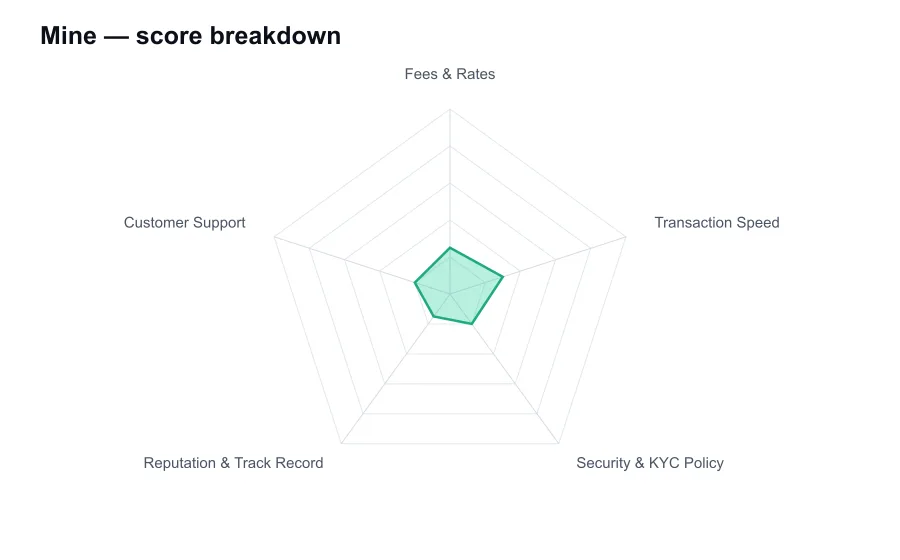
Mine scores 2.2/10 overall in our independent review, measured against every other provider we've compared, strongest on Transaction Speed (3.0/10) and weakest on Reputation & Track Record (1.5/10).
2.2/10 ★★★★★ How we score → Status: active (checked 2026-10-13T19:41:03.438Z) Visit official siteEditorial independence: our scores and rankings are produced using the fixed criteria above and are not influenced by advertisers. This is an independent ranking site and is not operated by, or affiliated with, any provider we list.
Affiliate disclosure: some links on this page may earn us a commission at no extra cost to you. This does not affect our rankings.
| Best for | Not for |
|---|---|
| Simple brand positioning | Operator identity is difficult to verify |
| May appeal to users seeking a basic interface | No dependable public fee documentation |
What is Mine?
How Mine Works
- Verify the exact domain and legal operator independently
- Create an account only after reviewing available terms
- Use a self-custody wallet for any test deposit
- Send the smallest practical amount
- Confirm receipt and attempt a withdrawal before using more funds
Criteria & Scores
| Criterion | Score | Note |
|---|---|---|
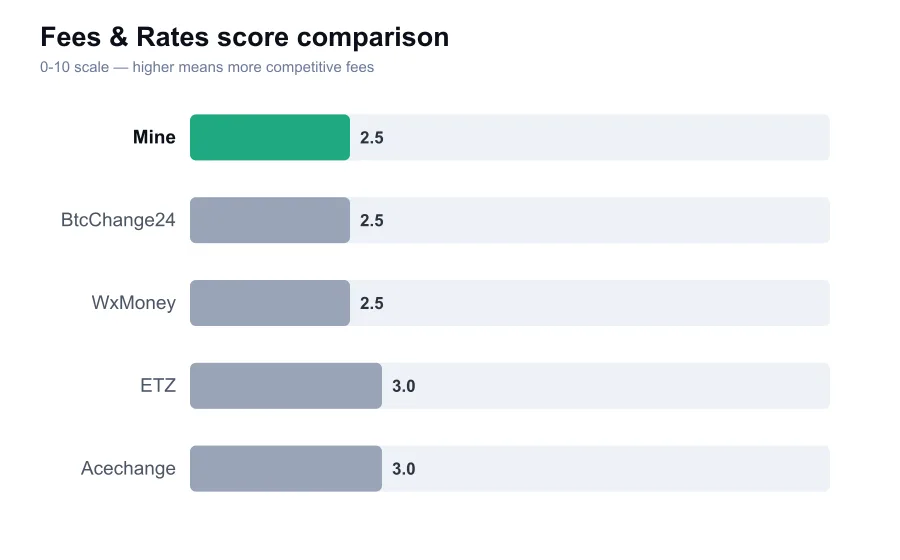
| Fees & Rates | 2.5 | No reliably published fee schedule to assess |
| Transaction Speed | 3.0 | Processing performance is not independently documented |
| Security & KYC Policy | 2.0 | Custody, KYC and security controls are unclear |
| Reputation & Track Record | 1.5 | Limited verifiable operating track record |
| Customer Support | 2.0 | No well evidenced escalation process |
| Fact | Value | Source |
|---|---|---|
| Brand name | Mine | - |
| Public fee schedule | Not reliably verified | - |
| Operator identity | Not clearly verified | - |
| Security disclosures | Limited public evidence | - |
| Support escalation | Not clearly documented | - |
KYC
| Requirement | optional |
|---|---|
| Notes | The public KYC policy is not clear enough to rely on. Users should assume identity verification or a review could be requested before a withdrawal. |
How to Use Mine Safely
- Verify the domain through independent sources
- Test deposits and withdrawals with a minimal amount
- Do not pay extra funds to release a withdrawal
- Keep keys in a wallet you control
- Save transaction hashes and support correspondence
In-Depth Review
Mine is one of those crypto trading names that is difficult to review in the conventional sense because the brand is far more visible in scattered listings and user references than in a well documented corporate record. That is a serious problem, not a minor administrative gap. An exchange asking customers to deposit assets needs to make its legal operator, custody model, product terms and support channels easy to verify. Mine does not inspire confidence on that front.
The name itself creates an immediate due diligence obstacle. "Mine" is generic enough to overlap with mining services, wallets, apps and unrelated businesses. A prospective customer can easily land on an unofficial social account, an imitation domain or a stale review page. Established exchanges spend years making their official identity unambiguous. Here, the burden falls too heavily on the customer to determine which service, if any, is the genuine operator.
I would not treat promotional claims around broad coin coverage, attractive conversion quotes or easy registration as proof of a capable exchange. Those are table stakes in this category. What matters is whether a user can independently confirm the company behind the service, the jurisdiction it operates from, its reserve arrangements and the conditions under which withdrawals can be paused. Publicly verifiable information in those areas is thin.
Fees are hard to assess for the same reason. Mine does not have the kind of clear, durable fee documentation expected from a serious centralized venue, such as a maker and taker schedule, spread explanation, network-fee policy and examples of conversion costs. A quoted rate can contain a spread even if the screen says there is no commission. Without a transparent benchmark, customers cannot tell whether they are paying a reasonable convenience premium or a steep hidden charge.
That makes small test transactions especially important. Compare the amount shown before confirmation with the amount actually received, then compare both with a liquid market price on Kraken, Coinbase or Binance. Do it at different times of day. A service can appear inexpensive in a single screenshot while consistently delivering a weak effective rate. Mine has not earned the benefit of the doubt that transparent, liquid exchanges receive.
Speed claims deserve the same skepticism. Crypto transfers depend partly on the underlying chain, but an exchange has control over its own crediting rules, risk checks, manual review queue and withdrawal processing. A fast blockchain does not help if a platform holds a transfer for hours while asking for documents after funds have arrived. Mine provides too little independently corroborated operating data to predict how it handles that moment.
The most worrying pattern with opaque trading brands is post-deposit friction. Users may be told that a transaction needs verification, that a wallet has triggered a compliance rule, or that an additional payment is required before a withdrawal can proceed. Legitimate firms can and do conduct compliance reviews. The distinction is whether the policy was disclosed in advance, whether the request is proportionate, and whether there is a named escalation route. Mine does not give customers enough public material to judge those safeguards.
Its KYC position is similarly unclear. That is worse than a straightforward mandatory verification policy. An exchange can require identity checks, explain accepted documents and state which actions trigger enhanced review. A customer can then make an informed choice before sending assets. A vague promise of easy access followed by an undisclosed verification demand is a poor customer experience and a material custody risk.
Security is not established by a lock icon, a polished dashboard or generic language about encryption. Good exchanges publish practical details: two-factor authentication options, withdrawal address controls, device management, cold-storage practices, incident notices and a coherent account-recovery policy. Mine does not offer a public security record that can be assessed alongside names such as Bitstamp or Coinbase. Silence is not evidence of a breach, but it is not evidence of resilience either.
The lack of a recognizable track record also affects reputation. I found no dependable body of long-running, attributable user feedback that would let a reviewer separate ordinary complaints from a pattern of operational trouble. Anonymous testimonials and affiliate-style ratings are not enough. A good reputation is built through years of handling outages, disputed deposits and difficult withdrawals in public, then leaving an evidence trail behind.
Customer support is another blind spot. A visible live-chat bubble means little if there is no published response standard, ticket number, business identity or escalation channel. If a deposit goes missing, the customer needs someone capable of tracing the transaction with a hash and explaining the result. If an account is frozen, they need a written reason and a route beyond the first-line agent. Mine's public support footprint does not demonstrate that level of accountability.
This does not mean every transaction connected with a service called Mine will fail. It means the available information does not justify trusting it with meaningful funds. The difference matters. Crypto users are used to accepting price volatility, but they should not also accept uncertainty over who controls their assets and whether they can recover them.
If you are determined to try it, use a wallet you control, send the minimum practical amount, record every quoted rate and keep transaction hashes, screenshots and correspondence. Never send a second transfer merely because somebody says it is needed to release a first one. No credible exchange should turn withdrawal access into an open-ended sequence of extra payments.
My view is blunt: Mine is not a provider I can recommend for serious trading, savings or large conversions. The apparent issue is not an uncompetitive feature set. It is the lack of verifiable information required to evaluate fees, execution, custody and support responsibly. Until the operator offers clear ownership, enforceable terms and a durable public record, established regulated exchanges and well documented self-custody routes are the safer choice.
Pros & Cons
| Pros | Cons |
|---|
Verdict
Frequently Asked Questions
Is Mine's official website easy to verify?
No. The generic Mine name overlaps with unrelated crypto and non-crypto services, so users should verify the exact operator and domain before sending funds.
Does Mine publish a maker and taker fee schedule?
I could not verify a durable public maker and taker schedule. Treat any quoted conversion price as potentially including a spread.
Should I send a second payment to release a Mine withdrawal?
No. Do not send extra crypto to unlock a withdrawal. Keep records, request a written explanation and seek help from the receiving wallet or relevant authorities if needed.
Can Mine's withdrawal speed be predicted from blockchain confirmation time?
No. Blockchain confirmation is only one part of the process. Internal compliance review and withdrawal approval can add delays.
What should I save before testing Mine?
Save the quoted rate, deposit address, transaction hash, timestamps, account messages and every support reply. These records are essential if a transfer is disputed.