Allswap
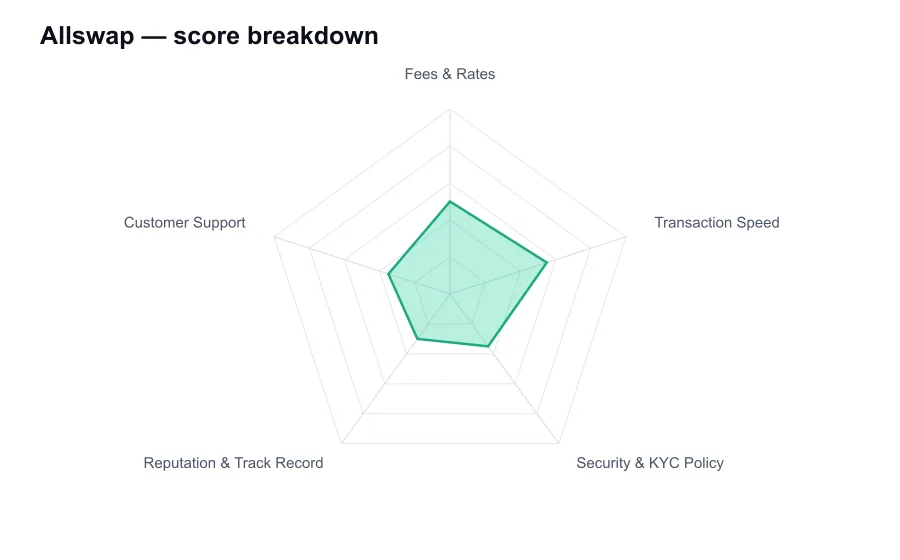
Allswap scores 4.2/10 overall in our independent review, measured against every other provider we've compared, strongest on Transaction Speed (5.5/10) and weakest on Reputation & Track Record (3.0/10).
4.2/10 ★★★★★ How we score → Status: active (checked 2026-10-13T19:35:26.849Z) Visit official siteEditorial independence: our scores and rankings are produced using the fixed criteria above and are not influenced by advertisers. This is an independent ranking site and is not operated by, or affiliated with, any provider we list.
Affiliate disclosure: some links on this page may earn us a commission at no extra cost to you. This does not affect our rankings.
| Best for | Not for |
|---|---|
| Simple quote-to-wallet swap model | Limited independently verifiable operating history |
| Avoids a full trading-terminal workflow | Fee structure is not clearly benchmarked publicly |
What is Allswap?
How Allswap Works
- Choose the asset you want to send and receive
- Enter the recipient wallet address
- Review whether the quote is fixed or floating
- Send the exact deposit amount to the generated address
- Track the order and confirm receipt in your wallet
Criteria & Scores
| Criterion | Score | Note |
|---|---|---|
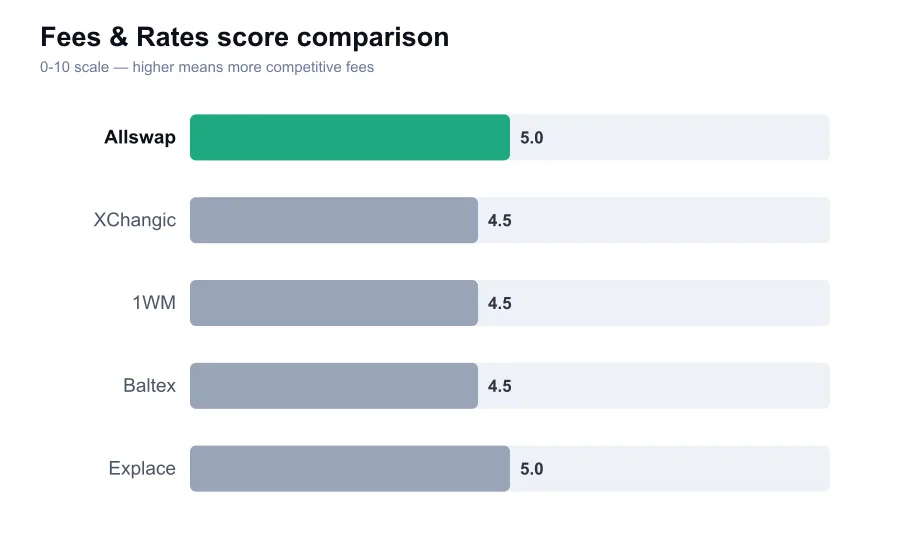
| Fees & Rates | 5.0 | Compare the final receive quote before depositing. |
| Transaction Speed | 5.5 | Settlement depends heavily on network confirmations. |
| Security & KYC Policy | 3.5 | Limited independently verifiable security information. |
| Reputation & Track Record | 3.0 | Thin public track record beside major rivals. |
| Customer Support | 3.5 | Test support before sending a meaningful amount. |
| Fact | Value | Source |
|---|---|---|
| Service model | Quote-and-send crypto swap service | - |
| Custody during swap | Temporary provider custody during execution | - |
| Rate check needed | Confirm fixed or floating rate per order | - |
| Public track record | Limited independent documentation found | - |
| Recommended first use | Small test transaction | - |
KYC
| Requirement | optional |
|---|---|
| Notes | Do not assume a no-account flow means identity checks can never occur. Instant exchangers commonly reserve compliance-review rights in their terms. |
How to Use Allswap Safely
- Run a small test swap before sending a large amount
- Compare the final receive amount with established competitors
- Verify the network, token contract, and wallet address
- Save the order ID and sending transaction hash
- Do not send funds until support answers a pre-sale question
In-Depth Review
Allswap presents itself as a quick crypto swap service, the kind of provider built for users who want to exchange one asset for another without opening a full trading account. That can be a useful niche. Plenty of people don't need charts, order books, margin products, or a custodial wallet. They need a clean route from one coin to another and a transaction that lands without drama.
The problem is that Allswap has very little independently verifiable public history compared with established instant exchangers such as ChangeNOW, SimpleSwap, Changelly, or StealthEX. A low-profile provider is not automatically unsafe, but it does demand more caution from the user. With an exchange handling an irreversible blockchain transfer, weak public documentation and a thin reputation record matter a great deal.
The service appears to follow the usual quote-and-send model. A customer selects a pair, enters a destination address, receives a deposit address, and sends funds. Allswap, or a liquidity partner behind it, then completes the conversion and sends the purchased asset to the chosen wallet. That is familiar territory for anyone who has used an instant exchange before.
Fees are the first area where I would want clearer disclosure. Many swap services do not show a simple flat platform fee because their final quote can include a provider spread, network fee, liquidity-provider cost, and, for floating-rate orders, price movement during confirmation. That model is legitimate if it is explained plainly. It becomes frustrating when the visible estimate looks attractive but the received amount is materially lower than a comparable quote elsewhere.
With Allswap, I would not treat a displayed rate as a promise until the order page explicitly states whether it is fixed or floating and what amount is guaranteed. Compare the final receive amount against at least two larger competitors before depositing. A difference of a few dollars may be normal. A noticeably worse quote is a reason to walk away, particularly on a larger conversion.
Speed is likely to depend more on the selected asset and network than on the web interface itself. Bitcoin deposits can take longer because the service may wait for confirmations. Ethereum and ERC-20 transfers can be delayed by congestion and gas settings. A swap involving a thinly traded token may also take longer while liquidity is sourced. No instant exchanger can make a slow blockchain instant.
The practical concern is whether Allswap gives an order ID, a transaction-status page, and meaningful status changes after the deposit arrives. Those features are basic but essential. A customer needs to know whether a deposit is awaiting confirmations, being exchanged, delayed for liquidity, or awaiting a compliance review. A vague message such as "processing" is not enough if funds have been held for hours.
Security is where Allswap's limited public footprint weighs hardest on the assessment. An instant exchange is temporarily entrusted with customer funds. That is different from a non-custodial wallet, where the user controls the keys throughout. The safer providers explain who operates the service, how risk controls work, how support can be reached, and what happens if an automated compliance system flags a transaction.
I could not independently establish a detailed public security architecture, audited reserve reporting, a long corporate track record, or a robust policy library for Allswap. That does not prove misconduct. It does mean users should avoid treating it like a proven venue for life-changing sums. For a small test transaction, the risk may be acceptable if the quote is competitive. For a five-figure conversion, the information gap is too large.
KYC is another point where customers should read the active order terms before paying. No-registration services often market simplicity, yet nearly all of them reserve the right to request identification if a transaction triggers compliance checks. That can lead to a hold after funds have already been sent. Users who need predictable identity requirements should choose a regulated exchange with published verification tiers instead of assuming an anonymous swap will remain anonymous.
Reputation is not simply about star ratings. It is about how long a brand has operated, whether complaints can be matched to real order IDs and responses, whether its terms identify a responsible entity, and whether the service has a record of resolving stuck transactions in public. Allswap does not have the volume of independently documented user experience that gives larger rivals a meaningful reputation advantage.
Support is likely to be the deciding factor if anything goes wrong. Before depositing, test the listed support channel with a specific question about the pair, rate type, or confirmation requirement. A fast and informed response is encouraging. Silence, copy-pasted answers, or an inability to explain an order hold should be treated as a stop sign, not a minor inconvenience.
There are sensible ways to use a small provider. Start with the minimum practical amount, use a self-custody wallet, save the quoted amount and order ID, and send only on the stated network. Never reuse an old deposit address. Never send an unsupported token to a compatible-looking address merely because the wallet format appears similar.
My view is blunt. Allswap may suit a cautious user making a small, straightforward swap after comparing its live quote, but it has not earned the confidence I would place in a mature and well-documented exchange. Its apparent convenience cannot make up for a modest public track record and limited independently verifiable detail. Test it, document everything, and keep the transaction size small.
Pros & Cons
| Pros | Cons |
|---|
Verdict
Frequently Asked Questions
Should I send a large amount to Allswap first?
No. Given the limited independently verifiable public track record, start with a small test transaction and confirm that the full deposit, conversion, and withdrawal flow works.
Why can the received amount differ from the first quote?
A floating-rate swap can change while the deposit confirms. Provider spreads, liquidity costs, and network fees can also affect the final amount, so check whether the order is fixed-rate or floating-rate.
What should I save before making an Allswap order?
Save the quoted receive amount, deposit address, destination address, order ID, timestamp, and your sending-wallet transaction hash. Those are the core records support will need.
Can a no-account swap still request identification?
Yes. Many instant exchangers reserve the right to request identity documents if automated compliance controls flag a transfer. Read the active order terms before depositing.
How can I reduce the chance of a network mistake?
Match the exact network on both sides of the transaction. Do not assume that an address format alone proves compatibility, especially for tokens that exist on several chains.