YaObmen
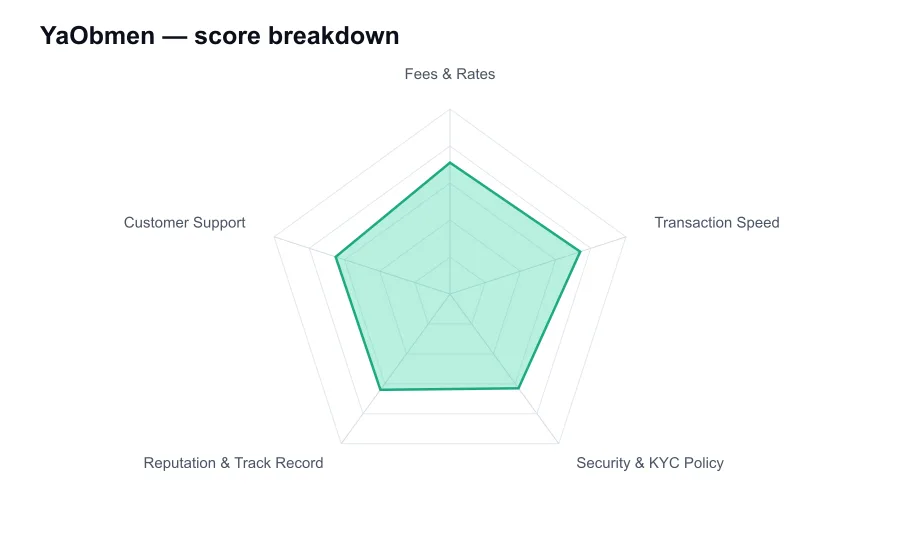
YaObmen scores 6.8/10 overall in our independent review, measured against every other provider we've compared, strongest on Transaction Speed (7.4/10) and weakest on Security & KYC Policy (6.3/10).
6.8/10 ★★★★★ How we score → Visit official siteEditorial independence: our scores and rankings are produced using the fixed criteria above and are not influenced by advertisers. This is an independent ranking site and is not operated by, or affiliated with, any provider we list.
Affiliate disclosure: some links on this page may earn us a commission at no extra cost to you. This does not affect our rankings.
| Best for | Not for |
|---|---|
| Simple quote-first exchange flow | Final rate can differ widely by route |
| Useful for smaller routine conversions | No major-exchange level of transparency |
Criteria & Scores
| Criterion | Score | Note |
|---|---|---|
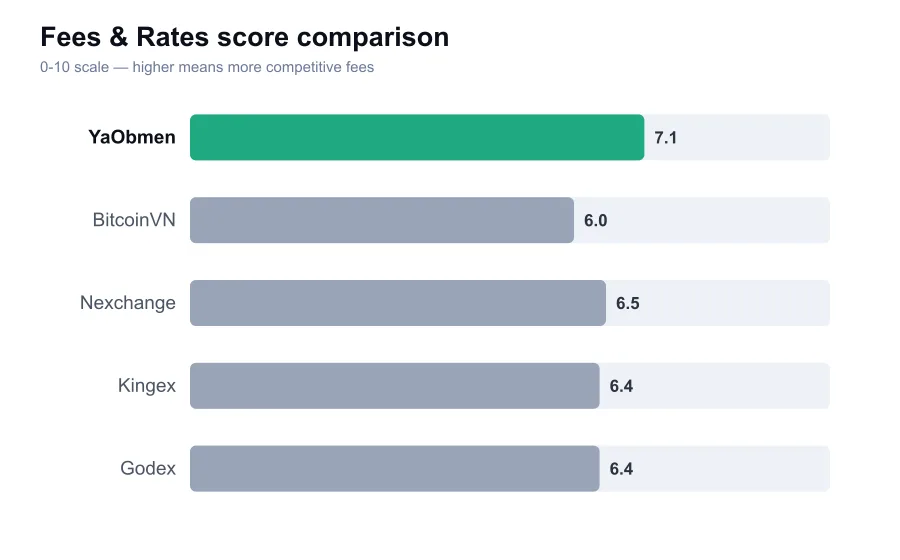
| Fees & Rates | 7.1 | Competitive quotes on common routes, but spreads vary sharply. |
| Transaction Speed | 7.4 | Crypto orders can move quickly after confirmation. |
| Security & KYC Policy | 6.3 | Conditional verification and standard exchanger safeguards. |
| Reputation & Track Record | 6.4 | Established monitor visibility, limited institutional track record. |
| Customer Support | 6.5 | Order-focused help, with variable response times. |
In-Depth Review
YaObmen sits in the familiar Eastern European online exchanger category: a service built for swapping crypto, electronic money and, depending on the route, fiat payment methods without the heavy interface of a full trading exchange. It is aimed at people who already know what they want to send and receive. That focus is useful, although it also means you should not expect advanced charts, order books, custody tools or the institutional safeguards associated with a major regulated exchange.
The site experience is usually straightforward. Pick a direction, enter an amount, provide payout details, and follow the payment instructions. For a small exchange, that simplicity matters. Many competitors bury key limits or force visitors through several account screens before displaying an executable quote. YaObmen tends to put the actual exchange direction front and center, which reduces avoidable errors for users converting stablecoins, Bitcoin, bank transfers or payment-system balances.
Its pricing is competitive only if you judge the final amount rather than an advertised fee. This is true of practically every instant exchanger, but it is especially important here. YaObmen's margin is generally embedded in the quoted rate, and the spread can change considerably by payment rail, liquidity conditions and the asset being sold. A popular USDT to bank or USDT to card route may look fair, while a low-liquidity direction can become expensive very quickly.
That does not automatically make the service poor value. For someone exchanging a modest amount and prioritizing convenience, a slightly weaker rate can be preferable to opening an account at Binance, completing verification, funding it, placing a trade and arranging a withdrawal. But rate-sensitive users should compare the final receive amount against at least two BestChange-listed alternatives before paying. The gap on a single transaction can be more meaningful than a nominal half-percent fee advertised elsewhere.
Fixed-rate language also deserves careful reading. A rate may be reserved for a limited payment window, but blockchain congestion, a delayed bank payment or a transfer sent below the requested amount can change the practical result. Do not assume a quote is an unconditional promise. Save the order page, send the exact amount requested, use the correct network, and do not split payments unless support explicitly instructs you to do so.
Speed is one of YaObmen's better arguments. Crypto-to-crypto exchanges can be processed soon after the incoming transaction receives the confirmations specified for that asset. On fast networks, a routine order can finish within minutes. Bitcoin, bank cards, manual checks and certain fiat routes are a different story. Those can take from tens of minutes to several hours, especially outside business hours or if the payment operator places a transaction under review.
The company should not be judged as if it controls every delay in the chain. A USDT transfer on TRC20 may arrive quickly, while an outgoing bank payment depends on the bank and local settlement schedules. Still, YaObmen could be more explicit about which directions are automated and which are handled manually. The distinction is crucial for a user who needs money immediately rather than merely wants a competitive quote.
On security, YaObmen follows the common exchanger model rather than the model of a licensed custodial platform. You generally provide only transaction details unless an order triggers a compliance check. That lower-friction approach is attractive, but it is not the same thing as being anonymous or exempt from screening. The service can request identification, source-of-funds information or a wallet explanation when anti-money-laundering rules or risk systems flag a transaction.
That conditional KYC policy is reasonable in principle, yet it creates a practical risk: a user who assumes every route is no-KYC may find an exchange paused after funds have already been sent. Do not use an exchanger of this type for a time-critical transaction if you cannot comply with possible verification. Privacy-minded users should also remember that payment details, IP logs and blockchain records can connect activity even without a formal account.
The absence of a long public corporate history is the main reason to be conservative. YaObmen has visibility in exchanger-monitoring circles, but it does not have the lengthy, independently audited record of a Kraken, Coinbase or Bitstamp. Monitoring-site reviews are useful signals, especially where complaints receive public replies, but they are not equivalent to financial regulation, proof of reserves or a customer compensation scheme.
I would treat YaObmen as a transaction service, not a wallet. Send in the amount needed for the order, confirm that the payout arrived, and move on. Leaving balances with a small exchanger is unnecessary risk. It is also wise to make a small test order before moving a large sum, particularly for a new bank destination, a first-time payment method or a token network you have not used before.
Support appears geared toward resolving individual order issues rather than providing a polished enterprise help desk. Chat and ticket-style contact can be effective when you provide an order number, payment proof and transaction hash. Vague messages such as "my money is missing" slow everything down. English-language depth and response time may be less consistent than with larger global brands, particularly during busy market periods.
There is a difference between a support team being available and a support team being empowered to override compliance or banking checks. YaObmen cannot simply release a flagged payment because a customer is impatient. That is frustrating, but it is also normal. The better test is whether support explains the problem, requests only necessary documents and gives a realistic next step. Public feedback suggests mixed experiences, which is typical for smaller exchangers but not an excuse to skip due diligence.
YaObmen is best approached as a practical, quote-driven converter for users who understand wallet addresses, network selection and payment timing. It can be quick and reasonably priced on common directions, but it does not offer the transparency or deep track record that would justify blind trust with large sums. Compare quotes, test with a small amount, and keep records. For routine exchanges, that discipline makes the service far more usable than the headline claims alone suggest.
Pros & Cons
| Pros | Cons |
|---|
Verdict
Frequently Asked Questions
Does YaObmen require KYC?
Not every order appears to require full verification, but compliance screening can trigger document requests. Do not assume a route is permanently no-KYC.
How fast are YaObmen exchanges?
Crypto-to-crypto orders may complete shortly after required confirmations. Bank, card and manually reviewed orders can take substantially longer.
How can I judge YaObmen's real fee?
Compare the final amount you will receive against other exchangers immediately before creating the order. The effective cost is usually built into the rate.