Nexchange
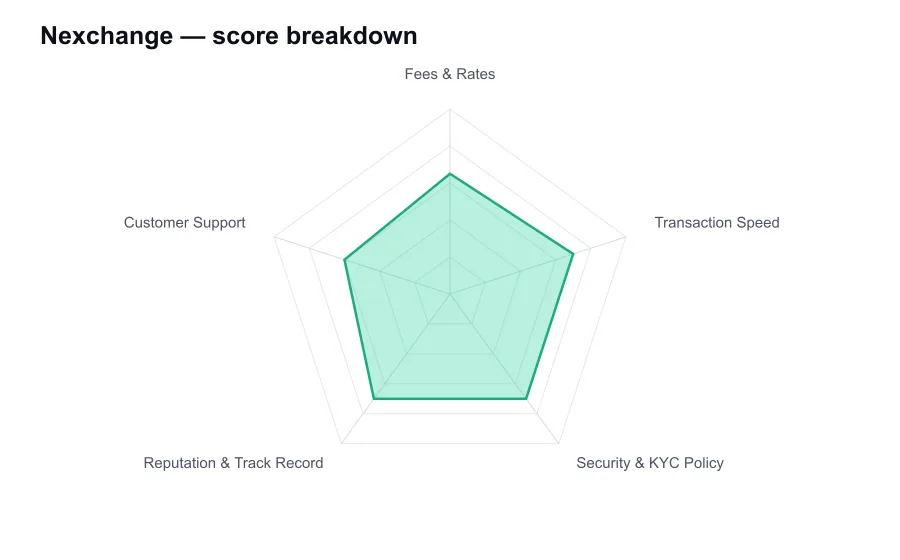
Nexchange scores 6.8/10 overall in our independent review, measured against every other provider we've compared, strongest on Transaction Speed (7.0/10) and weakest on Customer Support (6.0/10).
6.8/10 ★★★★★ How we score → Status: active (checked 2026-10-13T19:29:14.166Z) Visit official siteEditorial independence: our scores and rankings are produced using the fixed criteria above and are not influenced by advertisers. This is an independent ranking site and is not operated by, or affiliated with, any provider we list.
Affiliate disclosure: some links on this page may earn us a commission at no extra cost to you. This does not affect our rankings.
| Best for | Not for |
|---|---|
| Established API and white-label exchange infrastructure | Quote-based pricing is not always cheapest |
| Direct wallet-to-wallet conversion flow | Network confirmation time still affects completion |
What is Nexchange?
How Nexchange Works
- Select the source and destination crypto assets
- Enter the amount and your receiving wallet address
- Review the conversion quote and deposit instructions
- Send the required amount on the specified network
- Wait for blockchain confirmations and automated delivery
Criteria & Scores
| Criterion | Score | Note |
|---|---|---|
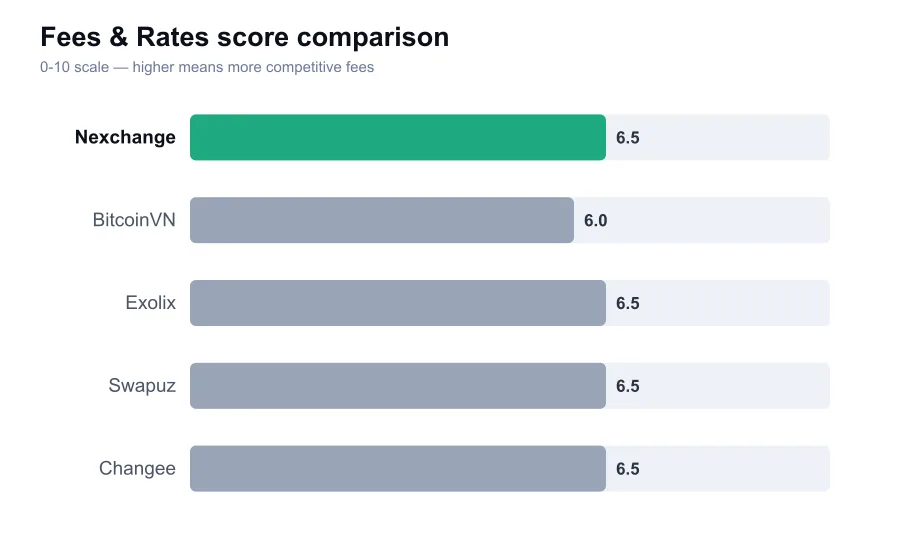
| Fees & Rates | 6.5 | Quote-based pricing can vary by pair and liquidity |
| Transaction Speed | 7.0 | Automated execution after required confirmations |
| Security & KYC Policy | 7.0 | Established infrastructure, with risk-based compliance |
| Reputation & Track Record | 7.0 | Recognised API and exchange-infrastructure provider |
| Customer Support | 6.0 | Documentation is stronger than consumer hand-holding |
KYC
| Requirement | optional |
|---|---|
| Notes | Nexchange may allow a normal transaction without full account onboarding, but it can apply risk-based anti-money-laundering checks and request documentation. |
How to Use Nexchange Safely
- Compare the final quoted output with at least one alternative
- Use the exact deposit network shown in the order
- Check whether a memo or destination tag is required
- Save the quote details and blockchain transaction hash
- Do not send additional funds to a completed order address unless instructed
In-Depth Review
Nexchange is a cryptocurrency exchange infrastructure provider and instant swap service with a more business-oriented character than many consumer-facing swap sites. Its public product is built around quoted conversions, while its API and white-label orientation have made it relevant to wallets, fintech products, and platforms that need exchange functionality without building liquidity connections from scratch. That is a legitimate niche, and it gives Nexchange a more concrete operational purpose than a generic swap widget.
The service is still an instant exchanger from the customer's point of view. You choose a pair, obtain a quote, send funds to a deposit address, and receive the output asset in another wallet. There is no traditional spot-market interface where you can place a limit order and wait for a price. That makes Nexchange useful for straightforward conversions, but it also means you are relying on its pricing, liquidity routing, and transaction handling at the moment you commit funds.
Nexchange's strongest feature is that it looks like a real infrastructure business rather than a short-lived retail brand. Its API documentation, partner focus, and long-running presence give it more credibility than many lightly documented instant exchanges. A technical product does not automatically make a provider safe, of course. It does, however, suggest that the company has incentives to maintain reliable transaction flows because business customers depend on them.
Fees need careful reading. Nexchange does not work like an exchange charging a simple maker and taker schedule. The rate you see for a retail conversion incorporates liquidity, market movement, service margin, and network costs. The effective cost can therefore vary materially by pair, order size, liquidity conditions, and whether you use a fixed or floating quote. This is normal for instant conversion services, but it makes a direct comparison with a spot exchange misleading.
For small, awkward, or cross-chain conversions, Nexchange can be competitive because the convenience is built into the quote. For a large conversion between liquid assets such as BTC, ETH, USDT, or USDC, I would still compare it with the cost of using a major centralised exchange and withdrawing. The latter takes more steps, but the pricing may be far sharper. Nexchange is paying for simplicity and integration, and users should decide if that convenience is worth the spread.
Speed is generally one of Nexchange's better attributes. Once the deposit has sufficient confirmations, the exchange process itself is designed to be automated. The limiting factor is usually the source network. A Bitcoin transaction may need confirmation time before processing begins, while Ethereum congestion can affect both the incoming deposit and the final delivery. Faster networks can complete more quickly, but users should not mistake a quoted swap for an instant blockchain settlement.
The company provides more transaction-oriented structure than a bare-bones swap page. That matters if a deposit is delayed or if a customer needs to identify the exact status of an order. A good instant exchanger should let a user distinguish between awaiting deposit, confirming, exchanging, and sending stages. Nexchange's infrastructure focus makes this part of the experience more credible than it is at obscure retail-only services.
Security has two layers here. At the user level, the service reduces some exposure because the customer can send output directly to a self-custody wallet rather than leaving assets on an exchange balance. At the provider level, Nexchange is still a counterparty during the swap and may use external liquidity sources. The right security mindset is not that the transaction is trustless, but that the custody period is short and purpose-specific.
KYC is not best understood as a simple yes or no. Instant exchange providers often allow users to initiate a normal transaction without creating a full account, yet reserve the right to conduct anti-money-laundering checks. Nexchange's compliance posture is more visible than that of anonymous-looking competitors, which is reassuring from a legitimacy perspective but less attractive to users expecting unconditional privacy. If you need certainty about verification, ask before depositing rather than after a transaction has been flagged.
Its reputation is solid in the infrastructure segment, though it is less familiar to casual retail traders than ChangeHero or ChangeNOW. That is not a flaw by itself. Nexchange has been around long enough to establish a recognisable business identity, and its API presence means it is evaluated by professional users who care about uptime and transaction completion. Still, retail reviewers should remember that B2B competence does not always translate into hand-holding for a confused first-time customer.
Support is adequate rather than exceptional. Technical platforms often provide useful documentation and transaction references, but a consumer in the middle of a delayed swap wants fast human confirmation, not just an API-oriented help page. Nexchange is likely to suit users who can read a transaction hash, distinguish network confirmations from exchange processing, and provide precise details in a support request. Beginners may find a more consumer-polished brand easier to deal with.
There are also practical network risks. Sending an asset over the wrong chain, omitting a tag for an asset that requires one, or depositing an unsupported token contract can create a recovery problem. Nexchange cannot make those blockchain mechanics disappear. Before sending, match the deposit network exactly, check whether the displayed address supports the intended asset, and make sure the receiving wallet can accept the output network.
I would use Nexchange for a routine swap when the quoted output is competitive and I understand the chain mechanics. I would be less enthusiastic for a large trade where execution price matters more than convenience, because a liquid order-book exchange will usually give more control. It is also not the place to learn basic crypto transfer skills through trial and error. The system expects customers to provide accurate wallet and network information.
Nexchange earns a respectable score because it has a clearer business identity and more credible infrastructure than many instant exchange brands. It is not the cheapest route for every trade, and its retail support experience is not its defining strength. But it is a serious option for users who value direct wallet delivery, API-backed execution, and a provider with a longer operational history. Compare quotes, understand the confirmation process, and it can do its job well.
Pros & Cons
| Pros | Cons |
|---|
Verdict
Frequently Asked Questions
Is Nexchange an order-book exchange?
No. Nexchange is primarily a quote-based exchange and infrastructure provider. A user requests a conversion quote rather than placing a limit order against a visible order book.
Why can an Nexchange swap take longer than expected?
The exchange generally needs to detect and confirm the incoming blockchain transaction before conversion. Bitcoin and congested Ethereum transactions can take longer than transfers on faster networks.
Does Nexchange offer an API?
Yes. Nexchange is known for exchange API and white-label infrastructure, which is one reason it is used by products that need embedded crypto conversion functionality.
Will Nexchange ask for KYC?
It can apply risk-based compliance checks. A user may be able to start a normal swap without a full account, but a flagged transaction can require identity or source-of-funds information.
Can I use Nexchange for a large BTC to USDT conversion?
You can request a quote, but compare the final received amount against major spot exchanges first. Large liquid trades often receive tighter pricing on an order-book platform.
What happens if I select the wrong blockchain network?
Recovery may be difficult or impossible. Send only on the network specified in the quote and verify whether the asset requires a memo, destination tag, or particular token standard.