Exolix
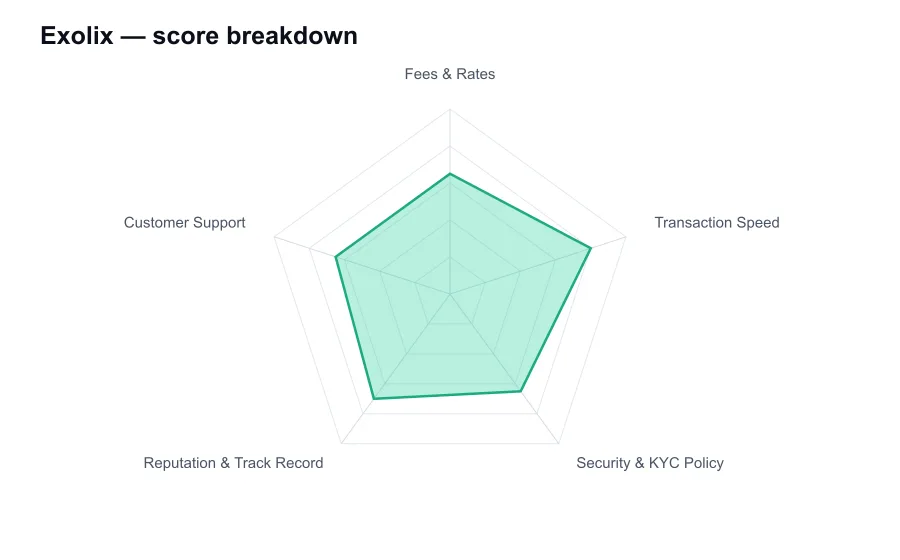
Exolix scores 6.9/10 overall in our independent review, measured against every other provider we've compared, strongest on Transaction Speed (8.0/10) and weakest on Customer Support (6.5/10).
6.9/10 ★★★★★ How we score → Status: active (checked 2026-10-13T19:31:16.224Z) Visit official siteEditorial independence: our scores and rankings are produced using the fixed criteria above and are not influenced by advertisers. This is an independent ranking site and is not operated by, or affiliated with, any provider we list.
Affiliate disclosure: some links on this page may earn us a commission at no extra cost to you. This does not affect our rankings.
| Best for | Not for |
|---|---|
| Straightforward wallet to wallet swaps | Rates include an embedded spread |
| Fixed and floating rate options | Compliance reviews can interrupt a swap |
What is Exolix?
How Exolix Works
- Choose the source and destination crypto assets
- Select fixed or floating rate and enter the amount
- Add a destination wallet address and create the order
- Send the source asset on the exact requested network
- Wait for confirmations and receive the converted asset
- Use the order ID and transaction hash if support is needed
Criteria & Scores
| Criterion | Score | Note |
|---|---|---|
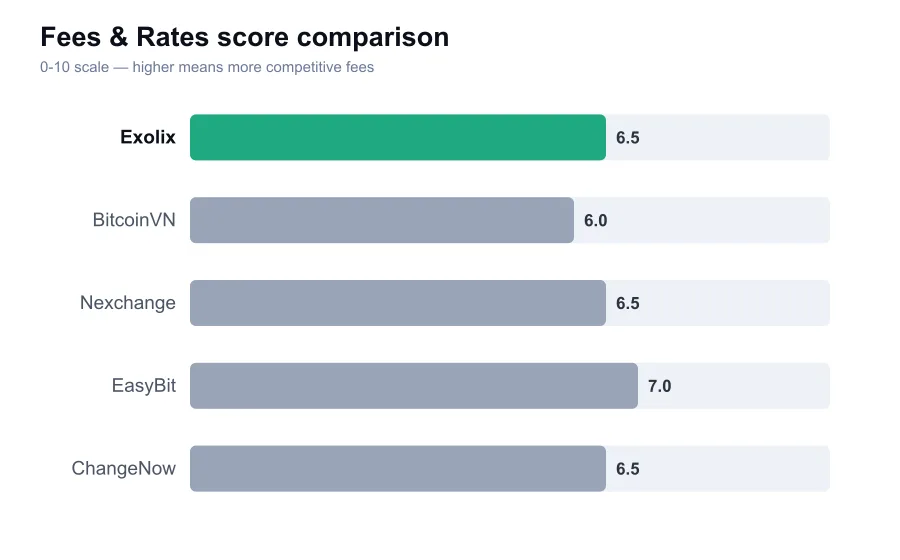
| Fees & Rates | 6.5 | Competitive for convenience, but costs are embedded in quotes |
| Transaction Speed | 8.0 | Automated swaps are quick once deposits confirm |
| Security & KYC Policy | 6.5 | No routine account custody, but swaps still require trust |
| Reputation & Track Record | 7.0 | Recognizable instant exchange brand with years of operation |
| Customer Support | 6.5 | Order tracking helps, though exceptions still need ticket support |
KYC
| Requirement | optional |
|---|---|
| Notes | Exolix does not require routine registration for standard swaps, but it may request information or pause a transaction where anti money laundering controls are triggered. |
Supported Assets
How to Use Exolix Safely
- Compare fixed and floating quotes before creating an order
- Match the selected network at the sender and recipient wallets
- Run a test transaction before a large swap
- Never send a token to a previous order address
- Save the order ID and source transaction hash
- Keep long term holdings in a wallet you control
In-Depth Review
Exolix is an instant crypto exchange built for users who want to swap assets directly from one wallet to another. You do not place bids on an order book or leave a balance in a conventional exchange account. Instead, you select a pair, enter a receiving address, send the source asset to a one time deposit address, and wait for the converted coins to arrive. It is a familiar model, but Exolix has stayed visible longer than many small swap brands.
The service positions itself around fast conversions, a wide asset selection, and a low friction flow. That makes it attractive to users moving between Bitcoin, Ether, stablecoins, and smaller assets without opening another exchange account. It is especially convenient for someone who already keeps funds in self custody and needs a swap rather than a trading relationship. That is a legitimate use case, though convenience should never be mistaken for zero risk.
Exolix's fee presentation needs a close reading. Like most instant exchangers, the platform's compensation is often reflected in the quoted exchange rate rather than as a clean separate trading commission. Network fees may also affect the final received amount. The number to compare is not a marketing claim about low fees. It is the exact amount of destination crypto shown before you send funds, compared with at least one alternative at the same moment.
For small, time sensitive swaps, Exolix can be competitively convenient. For bigger trades, its quote based format has a built in disadvantage against a deep exchange order book. A trader selling a large amount of Bitcoin for USDT can often achieve better pricing by using Kraken, Binance, Coinbase Advanced, or another liquid venue, assuming that account access and withdrawal costs are manageable. Exolix is paying for simplicity, not offering institutional execution.
The platform commonly offers both floating and fixed rate swap choices. Floating rate exchanges follow the market while the order is being processed. That may produce a better rate if the market moves in your favor, but the received amount can change. A fixed rate offers more certainty for a limited period, usually at a cost. I prefer fixed rate for a meaningful transfer where I need to know the output, and floating rate only for a smaller conversion where some movement is acceptable.
Speed is one of Exolix's credible strengths, but users need to define speed correctly. The order creation is immediate. The blockchain deposit is not. Bitcoin transactions need confirmations, Ethereum can become expensive or congested, and some assets require memo or tag handling. After the incoming funds are confirmed and liquidity is available, many common swaps complete quickly. A claim of instant service should be read as automated processing, not as a promise that every chain settles instantly.
Exolix has advertised a very broad selection of assets and networks over time. That breadth is useful, but it increases the chances of user error. USDT alone exists on several networks, and a token name can conceal materially different technical routes. Sending USDT on the wrong chain is one of the most common and expensive mistakes in crypto. Before confirming, match the network on the sending wallet, Exolix order, and receiving wallet exactly.
The service does not use a normal custody account for routine swaps, which is preferable to leaving an idle balance at a centralized exchange. Still, Exolix controls the funds during the conversion process. It is therefore a counterparty, not a magical decentralized protocol. If a transaction is delayed, requires compliance review, or encounters a liquidity problem, the customer must rely on Exolix support to resolve it. That temporary trust requirement is the central risk of this category.
Exolix describes its standard flow as no registration, and that is genuinely convenient. But users should not interpret it as a guarantee of no verification in every circumstance. Like comparable services, it can apply anti money laundering procedures to suspicious or high risk transactions. A swap may be paused while the provider requests information. Anyone who cannot tolerate that possibility should not send funds to a centralized instant exchanger in the first place.
Its reputation is better than a newly launched anonymous swap page, but it does not match the transparency or regulatory standing of the largest centralized exchanges. Exolix has operated publicly for years and has accumulated a recognizable presence among instant exchange users. That history counts. It does not eliminate the usual concerns about liquidity sourcing, transaction screening, and the difficulty of independently verifying a private company's financial resilience.
Customer support is important here because the failure modes are specific. A normal completed swap needs no conversation. A delayed deposit, destination tag error, or compliance hold can become stressful very quickly. Exolix provides order tracking and support channels, which is essential. In my view, users should judge support partly by preparation: if you cannot provide an order ID, transaction hash, asset, network, and exact amount, even a good agent will struggle to help.
I would not send an entire portfolio through Exolix in one transaction. Split a large conversion into deliberate pieces, starting with a small test. That limits the damage from an address error and gives you a real data point on processing time and final rate. It also helps you notice whether your receiving wallet has an asset or network compatibility issue before the stakes become serious.
Exolix is strongest as a utility service, not as a home for your crypto. It works best when the source wallet and destination wallet are both yours, the asset pair is liquid, and you have checked the quote against alternatives. It is less compelling for fiat purchases, complex tax reporting, large institutional conversions, or a customer who needs phone based reassurance before every transaction. Those jobs call for a different kind of provider.
My final view is that Exolix is a capable instant exchanger with a better established name than many rivals, but it remains an instant exchanger. The simple user flow, broad coverage, and fixed rate option can be very useful. Rate opacity, temporary counterparty exposure, and possible compliance holds keep it below a top exchange for serious volume. Use it for targeted wallet to wallet swaps, double check every network detail, and keep your long term holdings outside the service.
Pros & Cons
| Pros | Cons |
|---|
Verdict
Frequently Asked Questions
Does Exolix require an account?
The standard swap flow does not require a conventional exchange account or routine registration. Transactions can still be reviewed under anti money laundering procedures.
What is the difference between fixed and floating rates on Exolix?
A fixed rate aims to lock the quoted output for a limited period. A floating rate follows market movement while the deposit is confirmed and processed.
Why is my Exolix swap not instant?
Exolix must first receive blockchain confirmations. Bitcoin confirmation time, Ethereum congestion, liquidity availability, and network conditions can all delay completion.
Can I send USDT on any network to Exolix?
No. Use only the exact network selected in the order. USDT on Ethereum, Tron, BNB Smart Chain, and other networks are not interchangeable transfers.
What should I provide if an Exolix order is delayed?
Provide the order ID, source transaction hash, asset, network, sent amount, and destination address. Those details let support locate the transaction.
Is Exolix cheaper than trading on a large exchange?
Not necessarily. Exolix includes its cost in the conversion quote. For significant size, compare the final receive amount with a liquid exchange after all withdrawal costs.
Should I split a large Exolix swap?
Yes. A small test transaction verifies the address, network, and processing flow. Splitting a larger conversion reduces the impact of an avoidable mistake.