Symbiosis
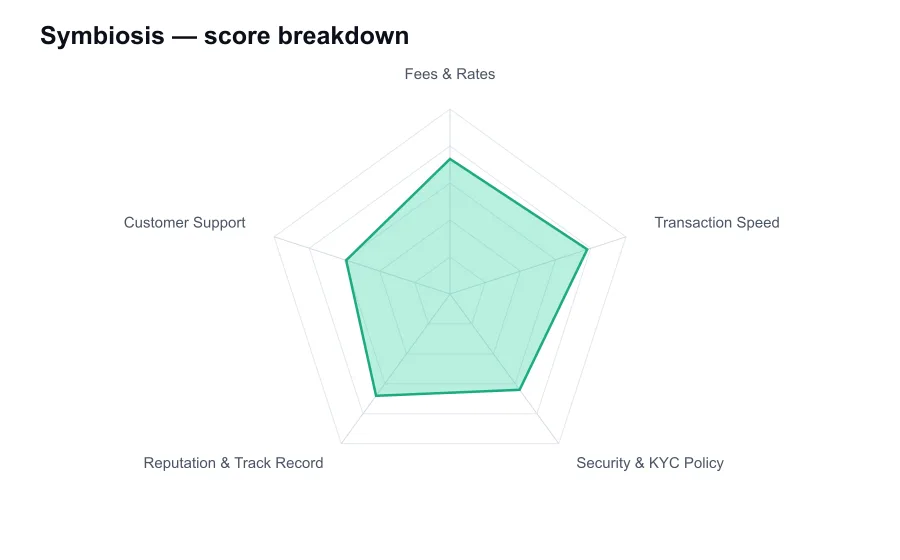
Symbiosis scores 6.9/10 overall in our independent review, measured against every other provider we've compared, strongest on Transaction Speed (7.8/10) and weakest on Customer Support (5.9/10).
6.9/10 ★★★★★ How we score → Visit official siteEditorial independence: our scores and rankings are produced using the fixed criteria above and are not influenced by advertisers. This is an independent ranking site and is not operated by, or affiliated with, any provider we list.
Affiliate disclosure: some links on this page may earn us a commission at no extra cost to you. This does not affect our rankings.
| Best for | Not for |
|---|---|
| Cross-chain swaps in one transaction flow | Cross-chain smart-contract and routing risks |
| Self-custody wallet connection | Costs vary with gas, liquidity, and route complexity |
Criteria & Scores
| Criterion | Score | Note |
|---|---|---|
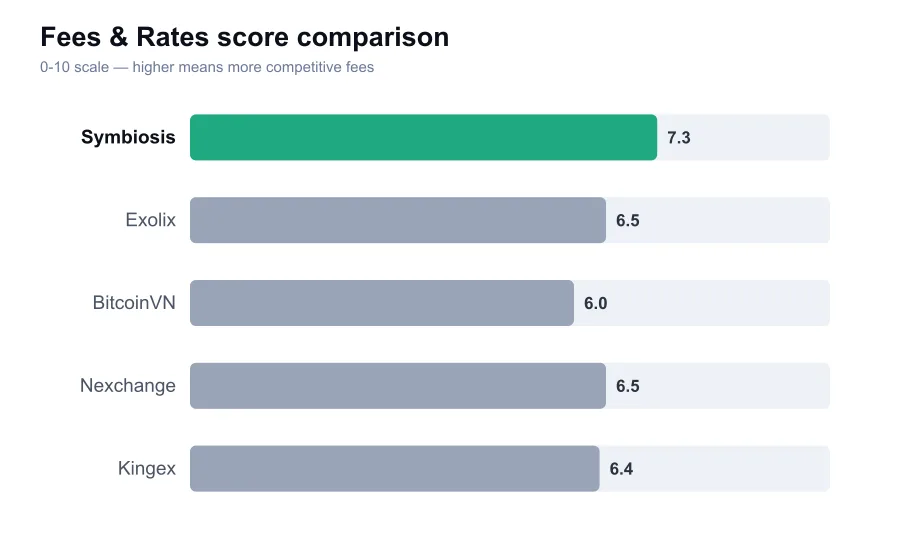
| Fees & Rates | 7.3 | Efficient on good routes, but gas and route costs can stack up |
| Transaction Speed | 7.8 | Convenient routing, with settlement tied to chain conditions |
| Security & KYC Policy | 6.4 | Self-custody and no KYC, but cross-chain contract risk is real |
| Reputation & Track Record | 6.8 | Established DeFi interoperability project, still a niche protocol |
| Customer Support | 5.9 | Community and documentation led support, not concierge service |
In-Depth Review
Symbiosis is not a centralized exchange and should not be judged as if it were one. It is a cross-chain liquidity protocol and swap interface designed to move assets between different blockchain ecosystems in a single transaction flow. Its pitch is simple: instead of manually bridging, changing networks, and swapping again, you can route the whole job through one interface. That puts it closer to LI.FI, Rango, Socket, Across, and multichain swap aggregators than to Coinbase or WhiteBIT.
The product addresses a real headache. A user holding USDC on one network may want an asset on another network without maintaining gas balances, learning several bridges, or dealing with wrapped-token confusion. Symbiosis can combine a source-chain swap, a cross-chain transfer, and a destination-chain swap. For ordinary DeFi users, that feels dramatically easier than stitching together three separate apps.
Its architecture is centered on cross-chain liquidity and relayer-style infrastructure rather than a traditional hosted account. You connect a self-custody wallet such as MetaMask, Rabby, or WalletConnect-compatible software, approve the transaction, and sign it yourself. Symbiosis does not ask you to create a conventional exchange account, and it does not require routine KYC for protocol use. That is a genuine advantage for users who want to retain wallet control.
Self-custody does not make a cross-chain protocol low risk by default. The risk simply changes shape. You face smart-contract risk, bridge and message-passing risk, wallet approval risk, liquidity-provider risk, front-end risk, and the possibility that a route fails midway through its intended path. Cross-chain infrastructure is among the most attacked areas in DeFi, and users should approach it with more care than a same-chain token swap.
Fees are not one tidy number. A Symbiosis route can include a protocol fee, liquidity-provider or relayer costs, source-chain gas, destination-chain gas, and the swap price impact or aggregator spread. Some routes also use stablecoin liquidity as a transit layer, which can make the mechanics less visible to the user. The interface should show estimated output and costs, but estimates are not a substitute for understanding what the transaction is doing.
For modest transfers between supported liquid networks, the effective cost can be quite reasonable compared with manually bridging and paying gas several times. The value proposition improves when it saves you from expensive Ethereum mainnet actions or from holding native gas tokens on multiple chains. The economics become worse with small transfers, congested chains, low-liquidity tokens, or exotic routes. A twenty-dollar cross-chain experiment can lose an embarrassing share of its value to gas and slippage.
Speed depends heavily on the origin and destination. Transactions involving quick finality networks can complete in a few minutes, while routes touching Ethereum mainnet or requiring more confirmation time can take longer. The phrase instant cross-chain swap should be treated as marketing shorthand, not a settlement guarantee. A transaction can look complete in the interface while one leg still depends on network finality and relayer processing.
This is where Symbiosis earns a better speed score than traditional manual bridging, but not a perfect one. Its routing can remove several clicks and wait periods. Yet the protocol cannot repeal blockchain congestion, RPC failures, wallet pop-up problems, or a paused route. If you need exact timing for a liquidation, mint, or exchange deposit deadline, do not build your plan around a cross-chain route behaving perfectly.
The supported-chain list and available assets evolve, which is good for growth but can confuse users. Do not assume that a token with the same ticker on two networks is interchangeable. Check the contract address, the destination token format, and whether the asset is native, canonical, or wrapped. This is especially important for USDT, USDC, ETH variants, and smaller assets with duplicated branding.
No-KYC access is appealing, but it comes with less conventional consumer protection. There is no call center that can reverse a signature, no account manager who can unwind a bad wallet approval, and no bank-style chargeback process. If you sign an incorrect transaction, send to the wrong address, or connect to a fake site, the protocol's non-custodial design gives you very little room to recover.
Symbiosis has been present through multiple DeFi market cycles and has maintained a visible position in the interoperability niche. That gives it more credibility than a fresh cross-chain app with no history. Still, its reputation is narrower than that of blue-chip DeFi venues such as Uniswap or Aave, and far narrower than a major regulated exchange. The cross-chain sector's history should make every user skeptical of grand security claims.
The protocol's documentation and community channels matter more than support tickets here. Help is typically found through docs, Discord, Telegram, social channels, and transaction explorers. That can be efficient for technically capable users, especially when a team member can identify a stuck route from a transaction hash. It is less reassuring for a newcomer who just sees an unfamiliar pending transaction and wants a guaranteed resolution time.
Before using Symbiosis, I would connect a fresh or low-balance wallet, test the exact route with a small amount, and revoke unnecessary approvals afterward. I would also independently verify the domain, use a reputable RPC connection, and keep enough native gas token on both ends if the route requires interaction after arrival. These are not paranoid rituals. They are normal operating habits for cross-chain DeFi.
Symbiosis is best viewed as a useful routing layer, not a vault and not a place to park money. It can save meaningful effort for users who already understand wallets and networks. It is a bad first crypto transaction, and it is a poor choice for anyone unable to diagnose a failed transaction from an explorer. The interface lowers friction, but the underlying complexity remains.
My opinion is that Symbiosis deserves credit for solving a difficult usability problem without forcing users into a custodial account. Its strongest appeal is the ability to package multiple blockchain actions into one route. The cost is a higher technical and smart-contract risk profile than a simple exchange trade. Use it for purposeful cross-chain moves, keep amounts sensible, and do not mistake a polished swap screen for guaranteed finality.
Pros & Cons
| Pros | Cons |
|---|
Verdict
Frequently Asked Questions
Does Symbiosis require KYC?
Routine protocol use is wallet-based and does not normally require creating a centralized account or completing KYC. Your wallet provider, token issuer, or local law may still impose separate restrictions.
How long does a Symbiosis cross-chain swap take?
Many routes complete in minutes, but timing depends on the source chain, destination chain, confirmations, liquidity, relayer activity, and congestion. It should not be treated as guaranteed instant settlement.
What fees does Symbiosis charge?
The displayed route can include protocol and liquidity costs, swap price impact, and gas on relevant networks. Check the final output rather than relying on one advertised fee figure.