Sanctum
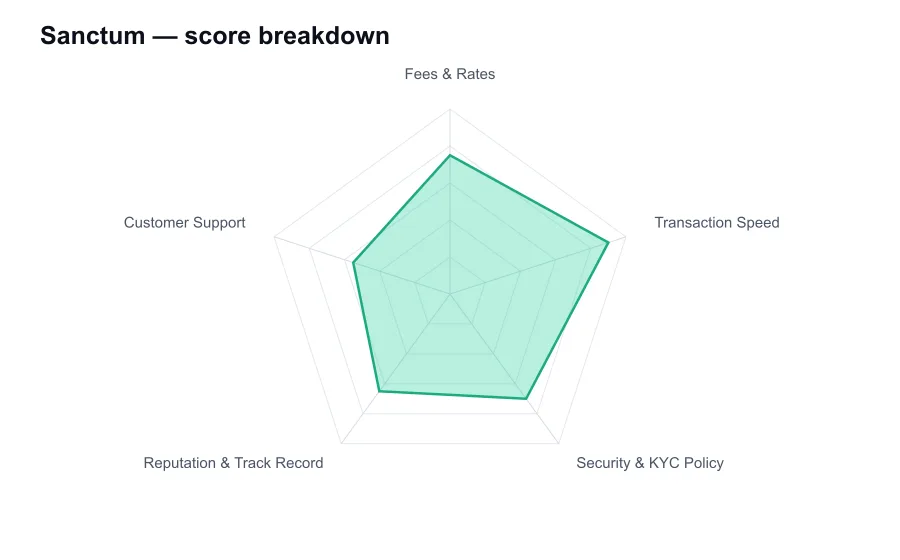
Sanctum scores 7.3/10 overall in our independent review, measured against every other provider we've compared, strongest on Transaction Speed (9.0/10) and weakest on Customer Support (5.5/10).
7.3/10 ★★★★★ How we score → Visit official siteEditorial independence: our scores and rankings are produced using the fixed criteria above and are not influenced by advertisers. This is an independent ranking site and is not operated by, or affiliated with, any provider we list.
Affiliate disclosure: some links on this page may earn us a commission at no extra cost to you. This does not affect our rankings.
| Best for | Not for |
|---|---|
| Instant liquidity can avoid the normal unstaking delay | LST-specific fees and liquidity conditions can be confusing |
| Shared liquidity design supports many Solana LSTs | Shorter operating history than major staking incumbents |
Criteria & Scores
| Criterion | Score | Note |
|---|---|---|
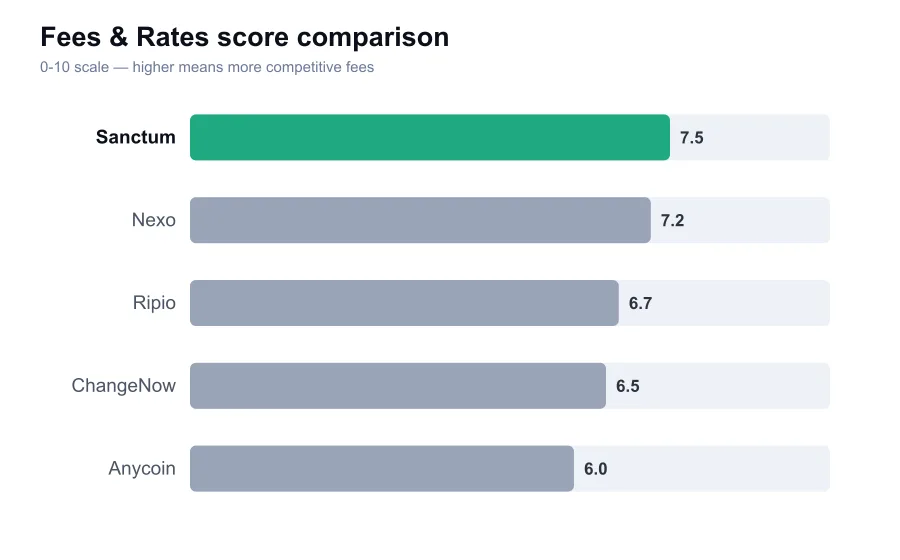
| Fees & Rates | 7.5 | Low-friction swaps, but LST spreads and issuer fees vary |
| Transaction Speed | 9.0 | Solana settlement and instant liquidity are major advantages |
| Security & KYC Policy | 7.0 | Non-custodial and audited, but liquid staking adds layers of risk |
| Reputation & Track Record | 6.5 | Well known on Solana, but still a relatively young protocol |
| Customer Support | 5.5 | Discord and documentation, not a full-service support desk |
In-Depth Review
Sanctum is a Solana liquid staking platform built around a useful idea: liquid staking tokens should be easier to use, exchange, and diversify than the old one-token-per-provider model allowed. It offers infrastructure for liquid staking tokens, an Infinity liquidity system, instant unstaking routes, and products tied to Solana validator staking. In a market dominated by JitoSOL, mSOL, and a handful of larger assets, Sanctum has tried to make the long tail of LSTs practical.
The product is not a conventional exchange, even though swapping is part of the experience. Its real focus is Solana staking liquidity. A user can stake SOL into supported liquid staking tokens, trade between LSTs, or exit to SOL without necessarily waiting through the normal validator deactivation period. That matters because native Solana unstaking can take roughly one epoch, often around two to three days depending on timing.
Sanctum's Infinity pool is the centerpiece. Instead of requiring every LST to build a separate deep liquidity pool against SOL, Infinity aims to provide shared liquidity for supported assets. This is a clever piece of market design. It helps smaller validator-linked LSTs become usable collateral or trading assets without forcing each project to bootstrap a large and expensive pool from scratch.
Fees require more attention than a simple exchange fee table suggests. Sanctum itself has promoted efficient swaps and low-friction liquidity, but users may still face spreads, underlying validator commissions, LST-specific economics, and network fees. Some LST issuers set their own staking or management fees. A swap that looks inexpensive on the surface can still be affected by the liquidity depth and redemption demand for that specific token.
For ordinary SOL holders, that complexity is manageable if they stick to major LSTs and inspect the final quote. It gets harder when moving through niche validator tokens or chasing points campaigns. The platform has attracted users partly because liquid staking can stack rewards, governance incentives, and DeFi utility. That can be valuable, but it can also tempt people into treating a staking position as if it were a risk-free savings account.
Speed is a genuine strength. Solana transactions usually settle in seconds, and Sanctum's instant liquidity tools can spare users the normal stake withdrawal wait. That is a major practical benefit during a volatile market, when a two-day wait to access SOL can feel like an eternity. Instant exits depend on available liquidity, though. If liquidity is constrained, the economic cost of leaving quickly may rise.
The distinction between instant unstaking and native unstaking is important. Native staking remains the cleaner path for users who can wait, because it does not rely on somebody providing immediate liquidity at an acceptable rate. Sanctum's convenience layer is useful precisely because it changes that trade-off. Users are paying, directly or indirectly, for speed and flexibility. That is reasonable, just not free.
Sanctum is non-custodial in the usual DeFi sense. Users interact through Solana wallets and do not complete standard identity verification to stake or swap. There is no account recovery desk if a wallet seed is lost. This will appeal to privacy-minded users, but the lack of KYC should never be confused with the absence of risk. A bad signing request on Solana can drain far more than a single intended transaction.
The protocol has published security materials and engaged external auditors for components of its stack, but it remains a younger platform than Solana's oldest staking names. Smart contract and program risk, oracle or pricing risk, liquidity risk, and validator performance risk all remain relevant. A liquid staking token also introduces a layer between the user and native stake. That layer can improve utility while increasing complexity.
Reputation is promising rather than settled. Sanctum gained serious visibility during the 2024 Solana resurgence, its Wonderland points campaign, and the launch of CLOUD. It has strong recognition within the Solana ecosystem and meaningful support from builders who want validator-specific liquid staking. Yet it does not have the multi-cycle operational history of older DeFi protocols. That should affect position sizing.
I like Sanctum most as infrastructure, not as a speculative dashboard. The ability to support many LSTs and make them more interchangeable can strengthen validator decentralization. Without systems like this, users tend to pile into one or two dominant liquid staking providers because those are the only assets with reliable liquidity. Sanctum gives smaller communities a better shot at competing.
Customer support is serviceable but familiar to anyone who has used DeFi. Documentation, Discord, social channels, and community guidance do much of the work. There is no round-the-clock account manager, no phone line, and no realistic way for staff to reverse an incorrect wallet action. Response quality can also vary with market activity, especially around campaigns and token events.
The platform deserves extra caution during incentive periods. Points, airdrop expectations, and high advertised yields can attract mercenary capital that leaves as soon as the reward changes. That can affect liquidity and token demand. A user who simply wants SOL staking yield should judge the LST by its validator exposure, fee structure, liquidity, and redemption mechanics, not by a temporary leaderboard.
Sanctum is a good fit for Solana-native users who understand liquid staking and want more flexibility than native delegation offers. It is fast, innovative, and materially useful for LST liquidity. The main weakness is not poor engineering, it is youth and complexity. I would use it for a measured staking allocation, especially with established LSTs, but I would not put my entire SOL position into a newer liquid staking structure merely because instant exits and rewards look attractive.
Pros & Cons
| Pros | Cons |
|---|
Verdict
Frequently Asked Questions
Can Sanctum unstake SOL instantly?
Sanctum can offer immediate liquidity through its supported routes and pools. The rate depends on available liquidity. Native unstaking may still take an epoch, often roughly two to three days.
Does Sanctum require KYC?
No routine KYC is required for normal wallet-based use. Users interact through a Solana wallet and remain responsible for transaction approvals and key security.
Are all Sanctum liquid staking tokens equally safe?
No. Each LST can have different validator exposure, fees, liquidity, issuer controls, and market depth. Check the specific token rather than treating every LST as interchangeable.