Ripio
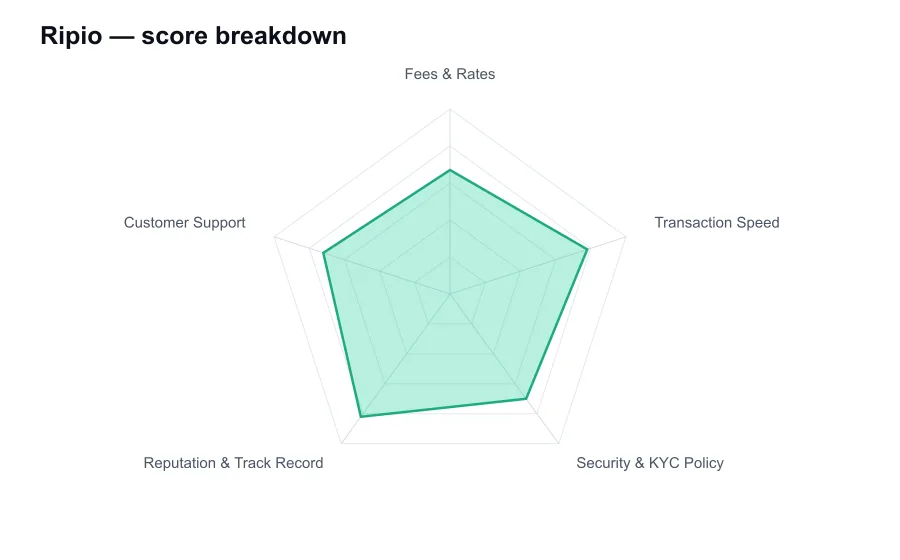
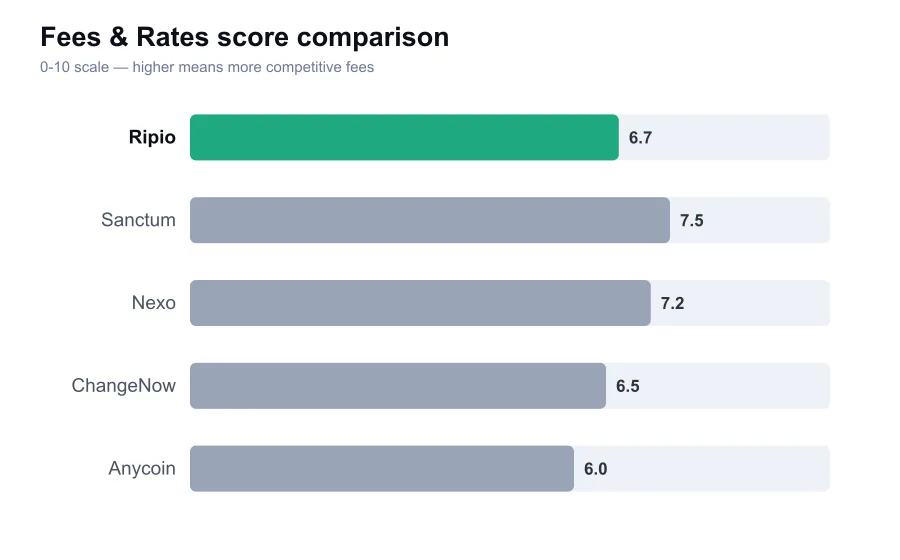
Ripio scores 7.3/10 overall in our independent review, measured against every other provider we've compared, strongest on Reputation & Track Record (8.2/10) and weakest on Fees & Rates (6.7/10).
7.3/10 ★★★★★ How we score → Visit official siteEditorial independence: our scores and rankings are produced using the fixed criteria above and are not influenced by advertisers. This is an independent ranking site and is not operated by, or affiliated with, any provider we list.
Affiliate disclosure: some links on this page may earn us a commission at no extra cost to you. This does not affect our rankings.
| Best for | Not for |
|---|---|
| Established Latin American brand | App spreads can exceed exchange pricing |
| Useful local fiat on-ramp | Less liquidity than top global exchanges |
Criteria & Scores
| Criterion | Score | Note |
|---|---|---|
| Fees & Rates | 6.7 | Ripio Trade is clearer and cheaper than the app's convenience quote. |
| Transaction Speed | 7.8 | Fast local funding and immediate in-app conversions. |
| Security & KYC Policy | 7.0 | Established compliance operation, but limited public reserve transparency. |
| Reputation & Track Record | 8.2 | Major Latin American brand operating since 2013. |
| Customer Support | 7.2 | Relevant regional support, with delays possible during busy periods. |
In-Depth Review
Ripio is one of Latin America's most recognizable crypto brands, and for good reason. Founded in Argentina in 2013, originally under the BitPagos name, it has lived through more crypto booms, crashes and regional currency crises than most competitors. Its core proposition is not exotic. Ripio gives users in markets such as Argentina, Brazil, Uruguay and Colombia a local route to buy, sell, hold and transfer digital assets, especially stablecoins.
That regional grounding is Ripio's real advantage. A global exchange may offer lower headline trading fees, but it can feel disconnected from local bank rails, tax realities and the practical need to convert volatile local currency into dollar-linked assets. Ripio understands that use case. Its app is designed for people who may care less about candlestick charts and more about turning pesos or reais into USDC, USDT, Bitcoin or ETH without navigating international transfers.
The company has expanded beyond a basic wallet over time, adding a trading platform, payment products, business services and, in some markets, its own stablecoin initiatives such as UXD. It has also raised substantial venture funding and reported millions of users across Latin America. Those facts give Ripio more institutional weight than a small local broker. They do not mean every product it offers is equally mature or equally well priced.
Fees need careful interpretation because Ripio has more than one interface. The simple app purchase flow is convenient but commonly works through a quoted price and spread. The advanced Ripio Trade experience is more relevant for users who want clearer market pricing and an order book. A buyer who uses the one-tap screen and assumes it has the same economics as an exchange trade is likely paying more for simplicity.
Ripio Trade has used maker-taker pricing that can be competitive for regional users, with fees commonly quoted from around 0.25 percent depending on the market and volume conditions. Exact schedules and promotions change, so customers should verify current rates in the relevant country. What matters is that an order book gives users a better chance to see the market, place a limit order and avoid blindly accepting a retail conversion quote.
Even then, Ripio is not usually the cheapest venue for a high-volume trader. Global exchanges can offer lower spot fees, much deeper liquidity and a wider selection of pairs. Ripio's value lies in the bridge between local money and crypto, not in winning a pure trading-fee war. For many users, paying a modest premium for a reliable local deposit and withdrawal route is rational. It is not rational to ignore the premium.
Transaction speed is generally strong for the jobs Ripio is designed to do. Local fiat deposits can often appear quickly once a bank transfer clears, and buying or selling inside the app is immediate. Transfers between Ripio users may be fast because they can be handled internally. External withdrawals depend on the blockchain, selected network and security review, so they should not be confused with an instant app balance update.
Stablecoin transfers deserve particular care. Ripio may support multiple networks for a given asset, and fees and settlement times vary sharply between them. A low-fee network can be attractive, but only if the receiving wallet supports the exact same chain. The platform can make crypto access easier, but it cannot reverse a transfer sent to an incompatible address. This is a user responsibility that remains unforgiving even in a consumer-friendly app.
Ripio requires account verification for full use. Users should expect identity documents, personal data and, in higher-risk or higher-value situations, further compliance questions. That is standard for a regulated, bank-connected Latin American provider. People searching for anonymous crypto access will find Ripio unsuitable. People who want a company that can connect to domestic payment rails should see KYC as the price of that convenience.
The company's security posture is more credible than that of an obscure local storefront, partly because Ripio has operated at scale and has had to build compliance and custody processes across several jurisdictions. It provides account-level security features and has an incentive to protect a recognized regional brand. Yet customers should not overread this. Public proof-of-reserves information and detailed custody disclosures are not as robust or easily independently verifiable as the gold standard users increasingly expect from major exchanges.
That makes self-custody a sensible complement, not an indictment. Ripio is very useful for entering and exiting the market, paying or converting local funds, and keeping an amount needed for near-term activity. It is less compelling as the permanent home for a substantial long-term portfolio. A hardware wallet or properly secured self-custody setup adds responsibility, but it removes reliance on a single corporate custodian.
Ripio's reputation is among its strongest assets. Remaining active since 2013 in Latin American crypto is an achievement, particularly given the number of exchanges that have vanished after market stress. The brand is familiar in Argentina and has expanded regionally rather than merely advertising there. Its long record does not make it immune to operational issues, product changes or regulatory pressure, but it offers a degree of continuity that newer platforms cannot claim.
Support is reasonably positioned for a regional consumer provider. Spanish and Portuguese localization matters, and help for payment methods and identity checks is more likely to be relevant than support from a distant global exchange. Still, users should temper expectations. During volatile periods, support queues can grow, and account reviews are rarely resolved as quickly as customers want. The more urgent the money is, the less appropriate it is to leave it in any centralized app.
Ripio's app is well suited to its audience because it reduces technical clutter. That is good for a person buying their first stablecoin, but it can be limiting for someone who wants advanced charting, broad altcoin access, derivatives or sophisticated tax reporting. The company offers more than a basic wallet, yet it remains fundamentally a regional access platform rather than a full substitute for the world's deepest crypto markets.
I particularly like Ripio for the user who has local income and needs an orderly way to gain stablecoin exposure, make a small Bitcoin allocation or send crypto to a self-custody wallet. I like it less for someone trying to trade several times a day. The latter user will likely notice thinner markets and less favorable execution. The former may find that Ripio's local rails and familiar support outweigh a modest cost difference.
My verdict is that Ripio deserves to be taken seriously as one of Latin America's more established crypto gateways. It is not the lowest-cost exchange and it does not offer the public custody transparency I would want before parking a major balance there. But it has a stronger regional track record, better local relevance and broader product maturity than many smaller alternatives. Use Ripio for access and conversion, use Ripio Trade where available for price-sensitive orders, and keep long-term holdings under your own control.
Pros & Cons
| Pros | Cons |
|---|
Verdict
Frequently Asked Questions
Is Ripio safe to use?
Ripio is an established regional provider with KYC and account security controls, but it is still a custodial crypto platform. Avoid treating an exchange balance as equivalent to self-custody or an insured bank deposit.
Are Ripio's fees high?
The simple app flow can include a spread for convenience. Ripio Trade is generally the better choice for users who want visible order-book pricing and lower trading costs.
How fast are Ripio withdrawals?
Fiat and internal processing can be quick, while external crypto withdrawals depend on security checks and blockchain conditions. The chosen network has a major effect on cost and timing.
Does Ripio require KYC?
Yes. Full functionality requires identity verification, and additional compliance checks may apply based on location, transaction size and account activity.