Magnatus
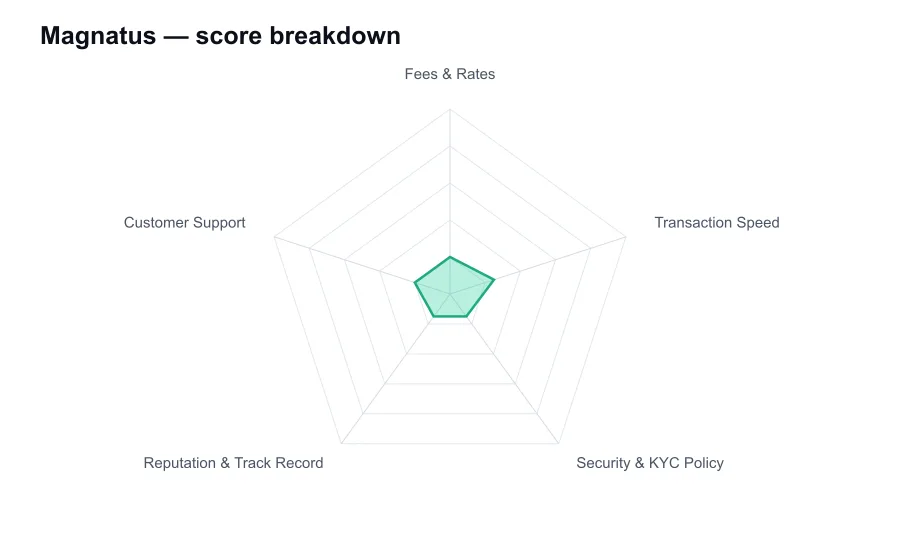
Magnatus scores 1.9/10 overall in our independent review, measured against every other provider we've compared, strongest on Transaction Speed (2.5/10) and weakest on Reputation & Track Record (1.5/10).
1.9/10 ★★★★★ How we score → Visit official siteEditorial independence: our scores and rankings are produced using the fixed criteria above and are not influenced by advertisers. This is an independent ranking site and is not operated by, or affiliated with, any provider we list.
Affiliate disclosure: some links on this page may earn us a commission at no extra cost to you. This does not affect our rankings.
| Best for | Not for |
|---|---|
| May appeal to users seeking a simple swap flow | No clearly verified official operating profile |
| No verified evidence of mandatory account custody | Fees and spreads are not independently documented |
Criteria & Scores
| Criterion | Score | Note |
|---|---|---|
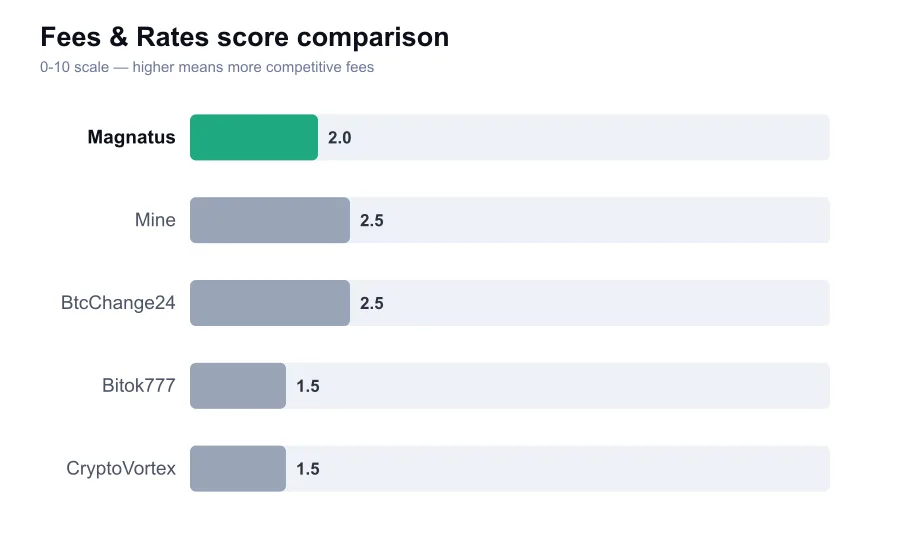
| Fees & Rates | 2.0 | No independently verified public fee schedule |
| Transaction Speed | 2.5 | Completion performance cannot be independently confirmed |
| Security & KYC Policy | 1.5 | Security controls and KYC terms are unclear |
| Reputation & Track Record | 1.5 | Very limited verifiable operating history |
| Customer Support | 2.0 | Support quality is not independently established |
In-Depth Review
Magnatus presents a difficult case for any reviewer trying to separate a genuine exchange service from a lightly documented brand. It does not occupy the same visible market space as established platforms such as Kraken, Coinbase, Bitstamp, or even larger instant-swap services such as ChangeNOW. I could not independently verify a clearly authoritative public company profile, regulated operating entity, or long-running official exchange presence tied unambiguously to this name. That matters before fees, speed, or coin selection even enter the discussion.
The first practical problem is discoverability. A serious exchange should make its legal entity, terms, privacy policy, customer contact routes, supported jurisdictions, and pricing model easy to locate. With Magnatus, the public footprint appears too thin to inspire confidence. A name alone is not proof of a scam, and small businesses can be legitimate, but anonymity and sparse documentation create a risk that users should not casually accept with irreversible crypto transfers.
I would be particularly cautious about any Magnatus page that arrives through a social-media promotion, unsolicited message, affiliate landing page, or a promise of unusually favorable exchange rates. That pattern is common across the crypto fraud ecosystem. A legitimate provider can advertise, of course, but the test is whether the promotion leads to verifiable company information and independently corroborated service history. If the trail ends at a generic chat account or a recently created site, walk away.
There is no reliable, independently confirmed public fee schedule I can use to credit Magnatus with competitive pricing. That means a reviewer cannot honestly state that it charges 0.25%, 0.5%, or any other fixed rate. Hidden cost is not limited to a displayed service fee anyway. The exchange rate, network fee, spread, minimum amount, and any final adjustment after a transaction begins all affect what a customer receives.
For a small or obscure swap provider, the quote screen is the only number that really counts. Before sending funds, compare the exact destination amount against at least two known alternatives, preferably an established instant exchanger and a liquid spot exchange. If Magnatus offers a fixed-rate quote, confirm how long that quote remains valid and what happens if the incoming transaction arrives late. If it offers floating rates, assume market movement can materially change the payout.
Speed is another area where claims should be treated carefully. Blockchain settlement depends on the source asset, network congestion, confirmation requirements, liquidity, and the provider's own review process. Nobody can credibly promise an exact completion time for every BTC, ETH, USDT, or cross-chain transaction. A provider with no well-documented operating record has not earned the benefit of the doubt when it advertises instant or near-instant service.
A normal low-friction swap might complete in minutes for common assets, while Bitcoin transfers often take longer because confirmation time is outside the provider's direct control. The danger is not a routine delay. The danger is a transfer that becomes stuck in manual review with no usable support channel, no transaction status detail, and no clear escalation route. That is precisely the point where a little extra convenience can turn into an expensive mistake.
Magnatus also gives prospective users little basis for evaluating custody and security controls. I could not verify a named security team, published audit, proof-of-reserves program, bug bounty, insurance arrangement, or technical explanation of how customer funds are handled. Those features do not guarantee safety, but their absence from public materials makes risk assessment much harder. A service asking users to trust it with crypto should be able to explain what it does to protect that trust.
KYC policy deserves equally close scrutiny. Some instant exchangers advertise no-KYC transactions while reserving the right to request identity documents under compliance or risk rules. That arrangement is common, but it needs clear disclosure before funds are sent. If Magnatus is promoting privacy, users should still assume a transaction can be paused for verification. Never send money you cannot afford to have locked while a provider asks for documents.
The reputational picture is the weakest part of the case. I could not find the depth of long-running, attributable coverage, regulator records, executive history, or broad independent review activity that would justify confidence in a financial service. A handful of testimonials on a provider's own site would not solve that problem. Reviews can be real, bought, copied, or selectively displayed. What matters is a durable body of evidence across independent sources.
That lack of history changes how a sensible user should behave. Do not test Magnatus with a life-changing amount because a quote looks attractive. Do not use it as a wallet, do not leave balances on a site, and do not provide more identity data than a documented compliance process requires. If someone insists on trying it, a very small transaction from a fresh wallet is the maximum reasonable exposure, followed by confirmation that funds reach a wallet they control.
Customer support is impossible to rate highly without published channels and observable response quality. An email address, Telegram handle, or website chat widget can be useful, but neither proves there is a trained team behind it. Good exchange support provides a ticket reference, explains delays without requesting seed phrases, and can identify the exact transaction hash under discussion. Anyone claiming support who asks for a recovery phrase is attempting theft.
The distinction between a delayed swap and a compromised account is important. Legitimate support may need a transaction ID, order ID, receiving address, and limited verification documents. It never needs a private key, seed phrase, remote access to a device, or a payment to release funds. Magnatus users should regard any request of that kind as a full stop, not a negotiable inconvenience.
Compared with transparent competitors, Magnatus has not supplied enough public evidence to compensate users for the extra counterparty risk. A known platform may charge a slightly wider spread, request KYC, or feel less exciting, but it also gives customers legal terms, established support processes, and a visible record to inspect. In crypto, boring is often a feature. Price is not the only cost of a transaction.
My view is blunt. Magnatus is not a provider I would recommend for ordinary buyers, first-time crypto users, or anyone moving meaningful value. Its weak public footprint leaves too many unanswered questions about ownership, fees, security practices, and dispute handling. Until the operator offers verifiable company information and develops a substantial independent track record, the rational choice is to use a better documented exchange or noncustodial service.
Pros & Cons
| Pros | Cons |
|---|
Verdict
Frequently Asked Questions
Is Magnatus safe to use?
Its public security and company information are too limited to support a confident safety assessment. Do not send meaningful funds without independently verifying the exact website, legal terms, and support channels.
What fees does Magnatus charge?
I could not verify a reliable public fee schedule. Compare the final amount shown in a quote against established exchanges, including network fees and the exchange-rate spread.
Does Magnatus require KYC?
A dependable public KYC policy could not be verified. Even services marketed as no-KYC may pause transactions for compliance checks.