CoinDrop
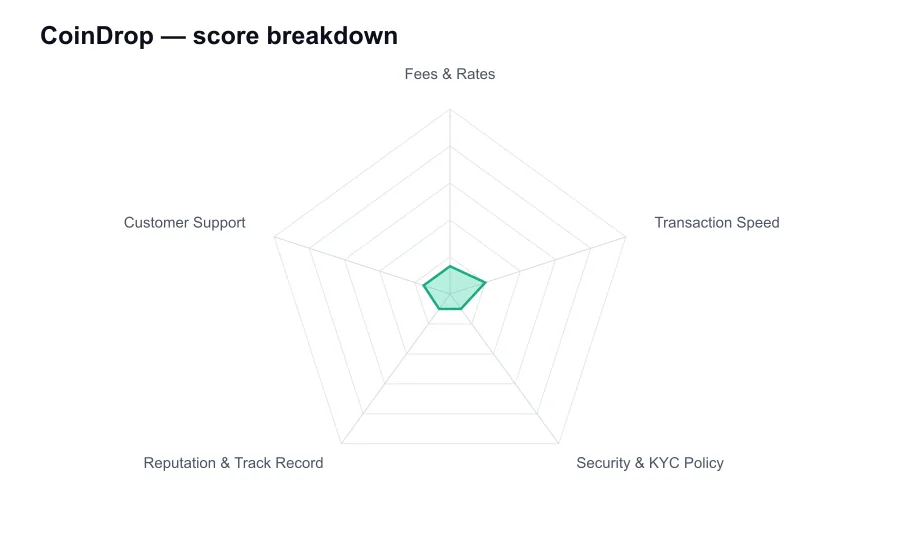
CoinDrop scores 1.4/10 overall in our independent review, measured against every other provider we've compared, strongest on Transaction Speed (2.0/10) and weakest on Reputation & Track Record (1.0/10).
1.4/10 ★★★★★ How we score → Status: active (checked 2026-10-13T19:45:44.632Z) Visit official siteEditorial independence: our scores and rankings are produced using the fixed criteria above and are not influenced by advertisers. This is an independent ranking site and is not operated by, or affiliated with, any provider we list.
Affiliate disclosure: some links on this page may earn us a commission at no extra cost to you. This does not affect our rankings.
| Best for | Not for |
|---|---|
| No verified strengths sufficient for a recommendation | Brand identity is ambiguous |
| Name may be easy to search | No attributable fee or withdrawal policy verified |
What is CoinDrop?
Criteria & Scores
| Criterion | Score | Note |
|---|---|---|
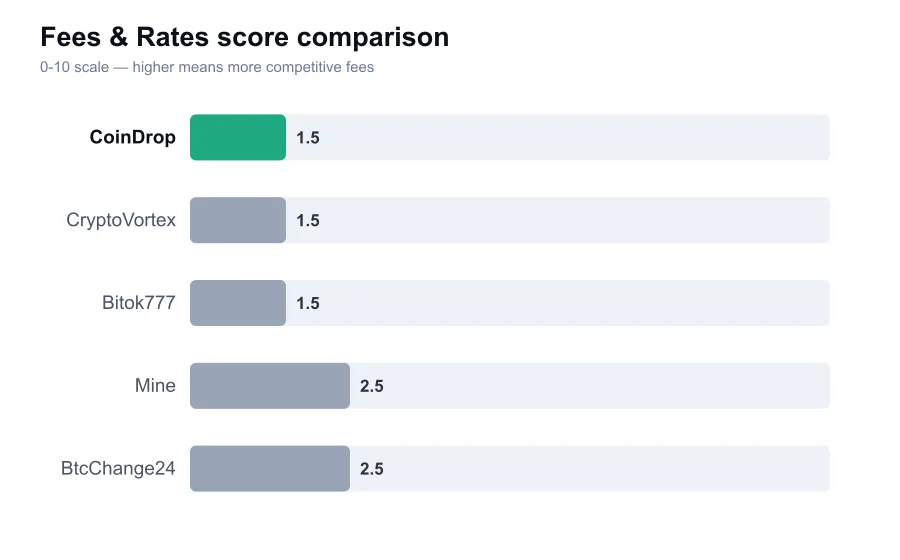
| Fees & Rates | 1.5 | No reliably attributable fee documentation found |
| Transaction Speed | 2.0 | No verified withdrawal or settlement record |
| Security & KYC Policy | 1.0 | No reliably attributable security disclosures |
| Reputation & Track Record | 1.0 | Brand identity is too ambiguous to verify |
| Customer Support | 1.5 | No established complaint route verified |
| Fact | Value | Source |
|---|---|---|
| Official operator | Could not be reliably identified | - |
| Fee schedule | Could not be reliably attributed | - |
| Withdrawal policy | Could not be reliably attributed | - |
| KYC policy | Could not be reliably attributed | - |
| Complaint process | No verified public route found | - |
KYC
| Requirement | tiered |
|---|---|
| Notes | A definitive policy could not be tied to one verified CoinDrop operator. Never assume a crypto service will not request identity documents or source-of-funds information. |
How to Use CoinDrop Safely
- Verify the exact website and legal entity first
- Check every claimed withdrawal on a block explorer
- Never pay to unlock or release an existing balance
- Never share seed phrases, private keys, or 2FA codes
- Keep records of all payments and support messages
In-Depth Review
CoinDrop is a difficult name to review responsibly because it is used by more than one crypto-related project and does not point cleanly to one established exchange operator. That ambiguity is a serious practical issue. Before discussing fees or transaction speed, a customer needs to know which legal entity, website, wallet addresses, and terms belong to the service they are considering.
A generic name can create a false sense of familiarity. Search results may mix airdrop promotions, payment tools, trading pages, token projects, and unrelated apps. A prospective customer should not rely on a logo, a social-media profile, or a sponsored search result as proof that they have found the authentic provider.
I could not verify a single clearly authoritative CoinDrop exchange operation with enough public documentation to support a conventional full review. There is no confidently identifiable public fee schedule, verified company history, broad record of customer dispute handling, or unambiguous product documentation tied to one operator. That sharply limits what can be said about the service without making claims up.
Fees are therefore impossible to score generously. An exchange should show its trading or conversion charge, spread treatment, withdrawal fee, minimum amount, and network fee policy before it receives a deposit. If a CoinDrop-branded page offers an unusually favorable rate but does not explain those terms, assume the quote is incomplete until proven otherwise.
The same applies to promotions. Crypto fraud often uses names that sound plausible and offers a deposit bonus, an airdrop claim, a recovery service, or a profitable automated-trading account. The common pattern is a customer seeing an apparent balance and then being asked for a tax, activation fee, verification deposit, or liquidity charge before withdrawing. Those payments should be treated as a major warning sign.
Speed claims are especially easy to manipulate on an unverified platform. A dashboard can show a trade as completed without proving that a blockchain withdrawal has been broadcast. The meaningful proof is a transaction ID that appears on the correct public block explorer and sends the stated amount to the customer's independently controlled address.
Do not confuse a transaction hash with a screenshot of a transaction hash. Copy the ID into a reputable explorer for the relevant network. Confirm that the sending address, receiving address, asset, amount, and confirmation status match what was promised. A genuine completed withdrawal can be checked outside the provider's own interface.
Security disclosure is inadequate if it amounts to generic claims about encryption or secure wallets. A credible exchange gives customers usable controls such as two-factor authentication, withdrawal protections, device history, password controls, and clear information about custody. It also states what happens when a deposit is flagged or a customer account is locked.
CoinDrop's KYC position cannot be reliably established from the name alone. That means users should not assume it is private, regulated, anonymous, or exempt from compliance checks. A service that waits until after receiving funds to explain its verification demands is behaving badly, even if it later calls the process AML compliance.
Reputation is the weakest category. A provider can be small and still earn trust through transparent ownership, durable terms, a real support record, and consistent references from independent sources. I could not identify sufficient evidence of that for a distinct CoinDrop exchange operation. The absence of a solid public record should lead to caution, not curiosity.
Support is also impossible to assess without a reliably identified service endpoint. A Telegram account, a direct message, or a web chat controlled by an unknown operator does not provide meaningful recourse. A customer needs a documented contact method, a case reference, terms that identify the contracting entity, and a way to escalate a complaint.
If you already have a CoinDrop-branded account balance, attempt a small withdrawal to a wallet you control before depositing more. Do not allow a support agent to remote into your device. Do not install screen-sharing software, and never disclose a seed phrase, private key, SMS code, or two-factor authentication code.
For anyone who has already been told that a withdrawal requires another payment, stop sending funds. Preserve screenshots, wallet addresses, transaction IDs, and every message. If you paid from a centralized exchange, contact that exchange promptly with the destination address and transaction record. Recovery is difficult in crypto, but fast documentation is better than repeated deposits.
My assessment is that CoinDrop cannot be recommended as an exchange provider because its identity is too ambiguous and its verifiable public record is too thin. This is not a close call on product features. A financial service has to be identifiable before it can be trusted. Pick an exchange with a clear operator, published policies, and a withdrawal history you can independently verify.
Pros & Cons
| Pros | Cons |
|---|
Verdict
Frequently Asked Questions
Is CoinDrop a clearly identifiable crypto exchange?
I could not verify one authoritative CoinDrop exchange operator with a clear public company profile, consistent terms, and independently documented operating history.
How can I verify a CoinDrop withdrawal?
Ask for the transaction ID, then check it on the public explorer for the correct blockchain. Confirm the amount, asset, sender, recipient, and confirmation status.
Should I pay a release fee to withdraw from CoinDrop?
No. Do not send an extra deposit, tax payment, activation fee, or liquidity charge to release an existing crypto balance. Preserve evidence and stop funding the account.
Can CoinDrop support ask for my seed phrase?
No legitimate support team needs a wallet recovery phrase or private key. Anyone requesting either can take control of your wallet.
What evidence should I keep if CoinDrop blocks a withdrawal?
Save the website address, account screenshots, wallet addresses, transaction IDs, payment records, emails, chats, and the date and time of every interaction.